From Childhood Mock Trading to $185B Revenue: Inside Jamie Dimon’s Wall Street Playbook
How early lessons in stock picking and financial discipline built the chief executive of America's largest bank.
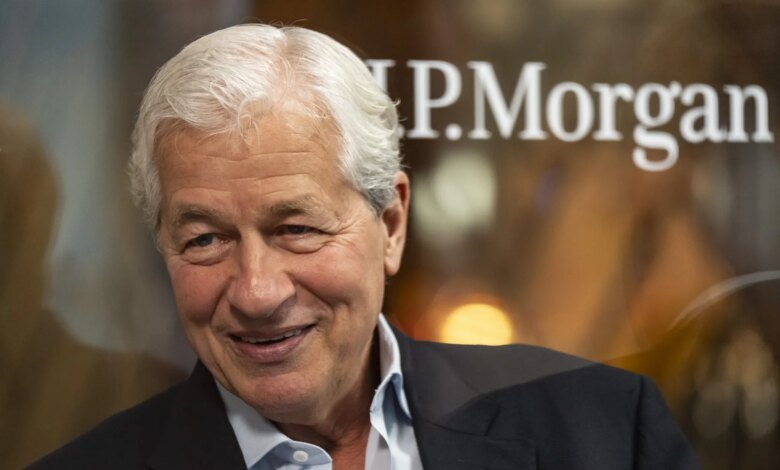
JPMorgan Chase posted $185.6 billion in revenue for 2025, marking a $5 billion increase from the previous year and solidifying its standing as the largest financial institution in the United States. At the helm for nearly two decades is chief executive Jamie Dimon, whose $3.2 billion net worth according to the Bloomberg Billionaire’s Index reflects a career built on fundamental analysis and disciplined risk management.
Dimon, 70, remains one of the few Wall Street leaders still in charge who piloted a major bank through the 2008 global financial crisis. According to corporate governance data from Esgauge, executive tenures across major financial institutions typically average under a decade. Under Dimon’s leadership, JPMorgan Chase has climbed to No. 12 on the Fortune 500 and No. 19 on the Global 500 list while navigating post-crisis regulatory developments such as Dodd-Frank capital reserves and Federal Reserve stress testing.
The roots of Dimon’s analytical approach trace back to childhood investment simulation games designed by his father, Theodore Dimon, a Wall Street stockbroker. While his brothers pursued other interests, Dimon spent hours analyzing balance sheets, evaluating industry metrics, and determining business valuations.
“He would give me an industry you might know something about, like a restaurant,” Dimon shared on The Master Investor Podcast with Wilfred Frost. “And say, ‘Okay, look at this. Look at the history. Read the annual report. Study the industry if you want. What would you pay for the stock?'”
By high school, Dimon was reading Graham and Dodd—the foundational 1934 text Security Analysis by Benjamin Graham and David Dodd that established modern value investing—alongside works on accounting, economics, and psychology. In 1970, at age 14, he bought his first stock under his father’s guidance before earning an undergraduate degree at Tufts University and an MBA from Harvard Business School.
In 1982, Dimon began his Wall Street career as an assistant to Sanford “Sandy” Weill, who was then president of American Express. “My first goal was to learn something and not say anything until I could add some value,” a 28-year-old Dimon noted in a 1984 Fortune profile. When Weill left to acquire consumer lender Commercial Credit in 1986, Dimon became Chief Financial Officer at age 30.
That mentorship laid the foundation for senior roles across major institutions, including Citigroup and Bank One. After Bank One merged with JPMorgan Chase in 2004, Dimon stepped into the role of chief executive in 2006. Dimon has credited his long-term approach to principles of daily execution rather than pursuing scale for its own sake, contrasting aggressive expansion with sustained preparation.
Speaking at the Fortune Most Powerful Women Summit in 2025, Dimon compared his operating mindset to NFL quarterbacks Tom Brady and Peyton Manning, emphasizing that continuous effort and humility drive top performance even when raw talent or circumstances vary.