Decentralized Exchange Protocol 1inch Debuts Non-Custodial Liquidity Registry Aqua Across 13 Blockchains
The protocol shifts decentralized trading away from traditional pooled smart contracts across 13 EVM chains.
Decentralized finance aggregator 1inch has officially opened its shared liquidity framework, Aqua, to all public market participants following an eight-month developer testing period. Deployed across 13 distinct Ethereum Virtual Machine (EVM) networks—including mainnet Ethereum, Arbitrum, Base, BNB Chain, and Robinhood Chain—the protocol introduces an architectural departure from conventional automated market maker structures.
Rather than requiring yield-seeking users to lock assets into pooled smart contracts, Aqua functions as an on-chain registry. Liquidity providers grant allowance approvals directly from their self-custodial wallets and establish order positions referencing those funds. Capital remains entirely within user custody until a transaction matches the exact parameters of a quote, at which point tokens are transferred and settled atomically alongside fee payouts.
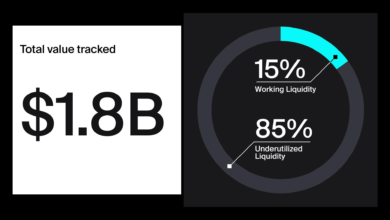
This non-custodial registry design fundamentally alters capital efficiency ratios in decentralized trading. Under standard liquidity pool designs, capital must be fully funded and segregated inside specific pool contracts. In contrast, Aqua allows a single collateral balance—such as $100,000 in underlying tokens—to back multiple distinct position quotes totaling $300,000 across various strategies. Maximum downside and asset exposure remain strictly bounded by actual wallet balances, removing the need for leverage or borrowed capital while multiplying effective market depth.
Beyond capital routing, Aqua introduces a novel execution layer designed to combat harmful Maximal Extractable Value tactics. Every transaction on the venue must be filled by an on-chain verified counterparty, typically institutional market makers or automated arbitrage algorithms validated prior to transaction execution. This restrictive execution pipeline addresses long-standing vulnerabilities like Just-In-Time liquidity attacks, where predatory traders front-run order flow to capture transaction fees away from passive liquidity providers—a phenomenon 1inch estimates can drain up to 44 percent of fee income.
The rollout reflects a broader institutional evolution within decentralized protocols, bridging permissionless asset custody with guarded, risk-managed trade settlement environments. To bootstrap liquidity across all 13 supported chains following the public release, the 1inch Foundation and the 1inch DAO have allocated an incentive program comprising 10 million 1INCH tokens and 500,000 USDC, routed through the Merkl rewards platform.
Prior to its general availability, the Aqua codebase underwent eight separate security evaluations by blockchain auditing firms including OpenZeppelin, Nethermind, Hexens, and Bailsec. Despite these security checks, 1inch emphasized that the venue remains tailored for experienced users, as positions carry persistent market risks, price volatility, and smart contract exposure.