Global Markets Shake as Fed Holds Rates Amid Escalating Middle East Conflict and Apple’s $5 Trillion Valuation
Surging oil prices, rising Treasury yields, and central bank credibility concerns hit Wall Street while tech valuations reach extreme territory.
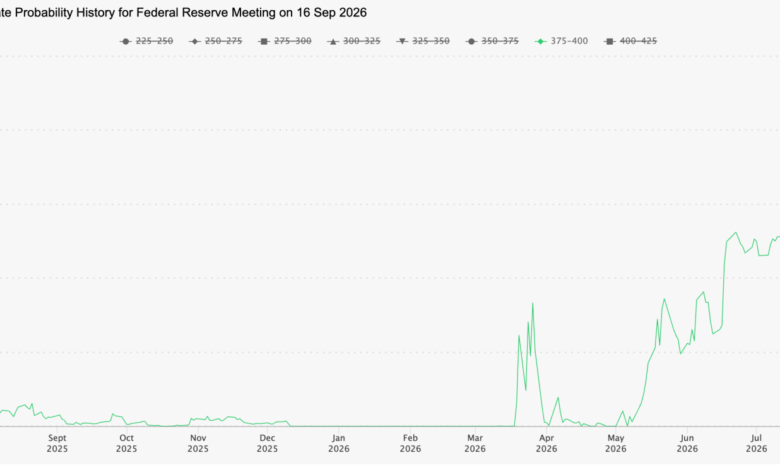
Wall Street faced sharp headwinds after the Federal Reserve opted to hold its benchmark interest rate at 3.5 percent, despite Personal Consumption Expenditures (PCE) inflation holding at 4.1 percent—well above the central bank’s 2 percent target for five consecutive years. The decision triggered a 1.52 percent decline in the S&P 500, while the tech-heavy Nasdaq 100 slid into official correction territory, down more than 10 percent over the past month. According to market data from the CME FedWatch Tool, 65 percent of interest rate futures traders now anticipate that Fed Chairman Kevin Warsh will enact a rate increase at the upcoming September meeting.
The central bank policy stance triggered a swift reaction in fixed-income markets, pushing the yield on the 30-year U.S. Treasury bond to 5.23 percent—its highest level in 19 years. Bond investors demanded higher risk premiums, reflecting concerns that monetary policy remains too loose relative to prevailing price pressures. The current benchmark rate sits approximately 100 basis points below standard Taylor Rule projections, which evaluate appropriate policy rates relative to prevailing inflation and labor market capacity.
Geopolitical instability further complicated economic expectations after U.S. Central Command launched a major series of military strikes against Iranian targets following recent regional bombings. The escalation pushed Brent crude prices above $90 per barrel, up from a previous low of $87. Analysts at Pimco warned that conflict across key transit points, including the Strait of Hormuz and the Bab al-Mandeb, presents a stagflationary supply risk to the global economy. The supply pressures arrive as the U.S. Strategic Petroleum Reserve has fallen to levels not recorded since 1983, while Ukrainian strikes against Russian processing facilities have brought Moscow’s oil refining output to a 20-year low.
Amid broader market turbulence, Apple shares rose approximately 3 percent in midday trading on July 28, bringing the company’s market capitalization to $5 trillion. Apple joins Nvidia as the only public entity to achieve that market value. The price advance pushed Apple’s price-to-earnings (P/E) ratio to 41.2, placing its valuation significantly above major technology peers such as Nvidia at 30.2, Amazon at 27.7, Meta at 21.6, and Alphabet at 16.8.
To support its valuation and elevate earnings per share, Apple has relied heavily on capital return programs. During fiscal years 2024 and 2025, the company deployed $185 billion toward share repurchases, amounting to 92 percent of its GAAP net earnings over that period.
Market volatility extended into smaller technology equities, particularly those tied to artificial intelligence and hardware manufacturing. The top 25 performers within the Russell 1000 small-cap segment retain an average year-to-date gain of 238 percent, despite suffering a 36 percent drop during the broader technology retrenchment in July.
Underlying economic indicators also point to a growing disconnect between labor statistics and consumer perception. Bank of America analysis notes that while the U.S. unemployment rate stands at 4.2 percent, worker sentiment captured by the Conference Board reflects anxiety levels typically aligned with an unemployment rate above 5 percent.
In corporate fiscal developments, U.S. businesses are expected to receive roughly $140 billion in International Emergency Economic Powers Act (IEEPA) tariff refunds by the end of October, according to estimates from Piper Sandler. However, net economic stimulus will remain limited, as updated trade measures preserve an effective average import tariff rate of 7 percent, directing those funds back to the U.S. Treasury.
Separately, a White House official confirmed that Gabriel Perez, a former federal teleprompter operator, is no longer employed by the government. Perez was previously placed on unpaid leave after reports disclosed he used advance knowledge of executive speeches, including the State of the Union address, to place wagers on the prediction market Kalshi, accumulating over $100,000 in gains.