US Restructures Import Tariffs with 60 Country Directives, Giving Europe Relief while Hitting Asia and Brazil
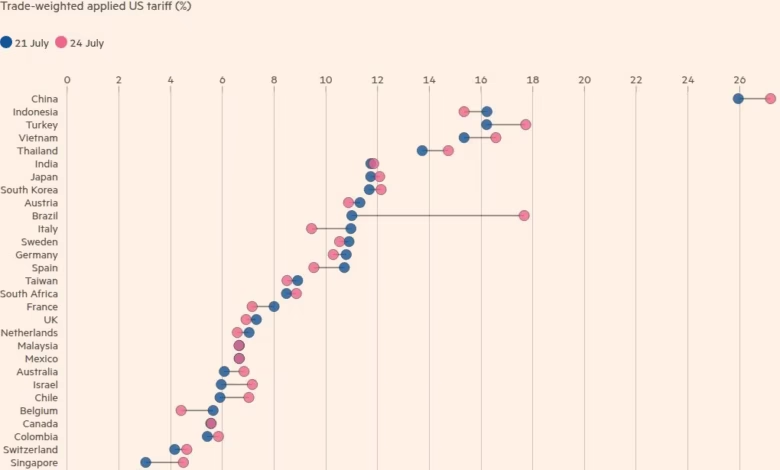
Washington has fundamentally altered its import tariff structure by issuing 60 individual country directives under Section 301 of the Trade Act of 1974, establishing a legal framework that lowers import barriers for European exporters while raising costs across key Asian and Latin American economies.
The measure replaces a temporary 10 percent universal tariff that expired Friday. The interim duty had been implemented as an emergency stopgap after the US Supreme Court struck down a previous attempt at across-the-board global levies introduced during the administration’s April 2025 trade rollouts.
By shifting to 60 distinct executive actions linked to an investigation into foreign forced labor practices, trade policy architects aim to insulate the tariff wall against legal challenges. Legal experts note that this structure prevents a single judicial ruling from striking down the entire national trade policy, as a court victory by one nation would leave the regulations on the remaining 59 trading partners intact.
Data from independent trade monitoring organization Global Trade Alert indicates that the overall effective US tariff rate now stands at 10.8 percent—holding steady relative to recent months, but well below the 15.8 percent effective rate in place prior to the Supreme Court ruling.
European economies have emerged as notable beneficiaries under the newly calibrated system. Effective duties decreased for major European trade partners, including France, Germany, the UK, Spain, Italy, and Belgium. The largest drops occurred in Belgium, Spain, and Italy, where effective rates decreased between 1 and 1.5 percentage points. These reductions were driven by reduced duties on traditional exports such as footwear, apparel, and handbags, alongside broad product exemptions covering pig iron, cork, and unworked diamonds.
Additionally, European goods benefit from the removal of tariff stacking, a practice under the previous temporary system where universal tariffs were added on top of existing trade duties.

In contrast, levies increased across major manufacturing hubs in Asia and South America. Import duties for China, Vietnam, Indonesia, Chile, and Colombia rose between 0.5 and 1 percentage point.
Brazil experienced the sharpest surge, with its effective tariff rate climbing from 11 percent to 17.7 percent following separate trade penalties enacted earlier this month.

While European Union officials acknowledged that current rates remain beneath the 15 percent ceiling established during the bilateral Turnberry summit in Scotland last summer, transatlantic trade tensions remain unresolved. Washington is conducting a parallel investigation into manufacturing overcapacity and structural industrial surpluses, which could trigger additional trade duties.
Should cumulative tariffs exceed the 15 percent threshold, the European Commission has prepared a retaliatory package targeting €93 billion in American goods, including motor vehicles, agricultural soybeans, and bourbon whiskey.