AMD Targets Nvidia’s AI Dominance with Full-Rack Hardware and AI-Assisted Software Stack
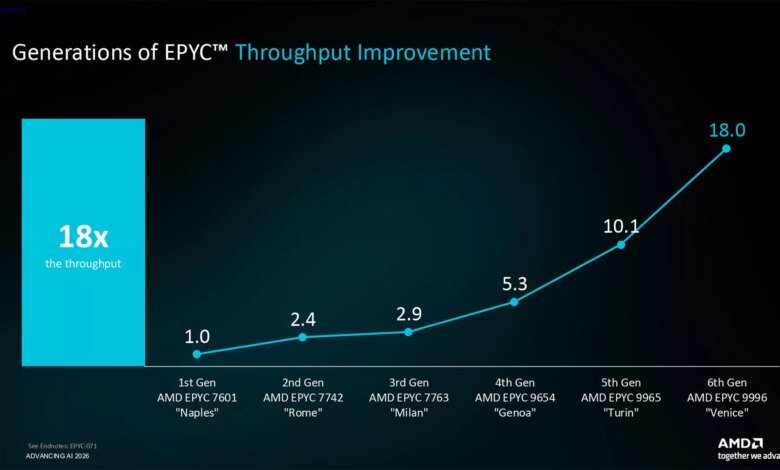
Advanced Micro Devices has officially entered the full-scale AI data center rack market, announcing that shipments of its integrated Helios rack system will begin later this quarter as part of a sweeping strategy to challenge Nvidia’s market dominance.
Unveiled at the company’s Advancing AI conference in San Francisco, the Helios platform marks AMD’s transition from selling individual computing components to delivering fully assembled, rack-scale infrastructure. The turnkey system integrates sixth-generation Epyc central processing units, Instinct MI455X data center graphics processors, and Pensando high-performance networking controllers. Early design partners and prospective enterprise users include Meta, OpenAI, Anthropic, and AT&T.
Modern artificial intelligence workloads—particularly the training and inference of frontier large language models—increasingly demand whole-rack architectures to bypass communication bottlenecks between processor nodes. By offering a pre-configured rack, Advanced Micro Devices is addressing the operational deployment model pioneered by Nvidia’s integrated server systems. AMD claims its latest Epyc processors deliver a 20 percent per-core performance advantage over Nvidia’s competing Vera CPUs, alongside higher HBM4 high-bandwidth memory capacity and throughput. To address extreme low-latency inference demands, AMD also structured a deployment partnership enabling Cerebras wafer-scale racks to operate alongside Helios units.
To rival Nvidia’s proprietary CUDA platform, which has anchored developer loyalty since its launch in 2006, AMD introduced ROCm.ai. The updated software suite uses artificial intelligence to streamline code optimization and port legacy CUDA code to AMD’s native architecture. Among its key tools is Hyperloom, an automated optimization engine. During the event, Anthropic demonstrated how an engineer used its Claude AI model to autonomously refine application performance on an AMD Instinct MI355X chip over a weekend, yielding measurable speed improvements without manual code intervention.
Expanding its presence beyond central data centers, the chipmaker detailed “Gorgon Halo,” a specialized deskside AI computing platform targeted at developers. Powered by an enhanced Ryzen AI Max Accelerated Processing Unit combining Zen 5 CPU cores with RDNA 3.5 graphics architecture, the unit supports up to 192 gigabytes of unified memory—a crucial feature for running large neural networks locally. AMD has partnered with Cisco Systems to equip these developer systems with enterprise-grade monitoring, security, and token management tools leveraging Cisco Cloud Control, AI Defense, and Splunk platforms.
For physical AI and industrial automation, AMD introduced the Kria AI system-on-module (SOM) and an accompanying developer platform built on Ryzen AI Embedded X100 series chips. The initiative draws heavily on adaptive computing technology inherited from AMD’s $49 billion acquisition of Xilinx in 2022. Field-programmable gate arrays (FPGAs) acquired through that deal remain critical for low-latency sensor fusion and real-time algorithmic adjustments in robotic hardware, supported by a new open-source Kria AI software framework.