Cardano Enters Era of Decentralized Development as Input Output Hands Over Core Infrastructure Control
Founding developer IOG relinquishes control of Haskell node, Plutus, and Hydra to independent specialist firms ahead of the Van Rossem upgrade.
In a defining moment for the decentralization of the Cardano blockchain, its founding development firm, Input Output, has announced a sweeping plan to hand over control of the network’s core technical infrastructure to a decentralized consortium of external specialist firms.
Starting in August, the transition will see key architectural pillars—including the Haskell node, the Plutus smart-contract platform, the Daedalus wallet, and the Hydra scaling technology—transferred to independent development entities. This multi-year handover is scheduled to run through 2027, marking the end of centralized stewardship and the beginning of a truly community-led ecosystem.
Among the specialized firms stepping up to assume these responsibilities are Se7en Labs, a development agency with a strong background in Solana infrastructure, and Teragone, a cryptographic research team that already spearheads the development of Mithril, Cardano’s stake-based signature protocol. To ensure resilience and avoid single points of failure, the network will run at least three independent node implementations in parallel across Haskell, Rust, and Go. This multi-client ecosystem will be overseen by community-led governance bodies, namely Intersect and Pragma.
This strategic pivot aligns with Cardano’s new operational motto: “Built by many, owned by all.” For years, Cardano’s development roadmap has been divided into distinct developmental epochs: Byron (foundation), Shelley (decentralization), Goguen (smart contracts), Basho (scaling), and finally, Voltaire (governance).
According to Cardano founder Charles Hoskinson, this handover represents the final push of the Voltaire era, the governance and decentralization phase Cardano has been building toward since 2024. “Our partners are ready, and the ecosystem now has many diverse options,” Hoskinson stated in the official announcement from IOGroup.
The announcement of this structural shift comes at a critical technical juncture. On July 18 at 21:44 UTC, the Van Rossem hard fork is scheduled to go live on the Cardano mainnet. Ratified on July 13 with an overwhelming 77.63% approval from delegated community representatives, this upgrade transitions the network to Protocol Version 11. The hard fork introduces new Plutus built-in functions designed to cut smart contract execution costs, significantly optimizing the network’s decentralized application (dApp) ecosystem.
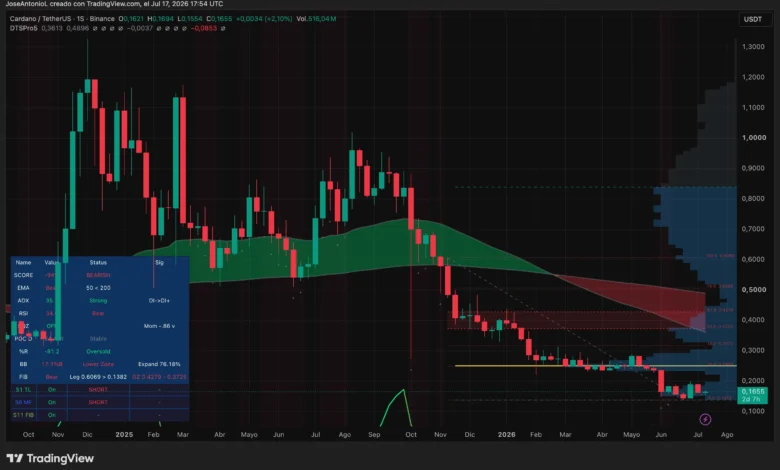
In the wake of these announcements, Cardano’s native token, ADA, experienced a modest uptick. ADA ticked up about 2% on the day, trading near $0.165, which brings its total market capitalization to approximately $6 billion. Derivative markets show sustained interest, with open interest in ADA futures sitting around $193 million. The long-to-short ratio stands at 2.84, indicating that a significant majority of leveraged traders are still betting on an upward price spike.
However, looking at the broader technical landscape, the token has faced a prolonged period of downward pressure. ADA remains nearly 95% below its 2021 all-time high and has struggled to recapture its 2024 highs near $1.20.
Should you buy the dip?
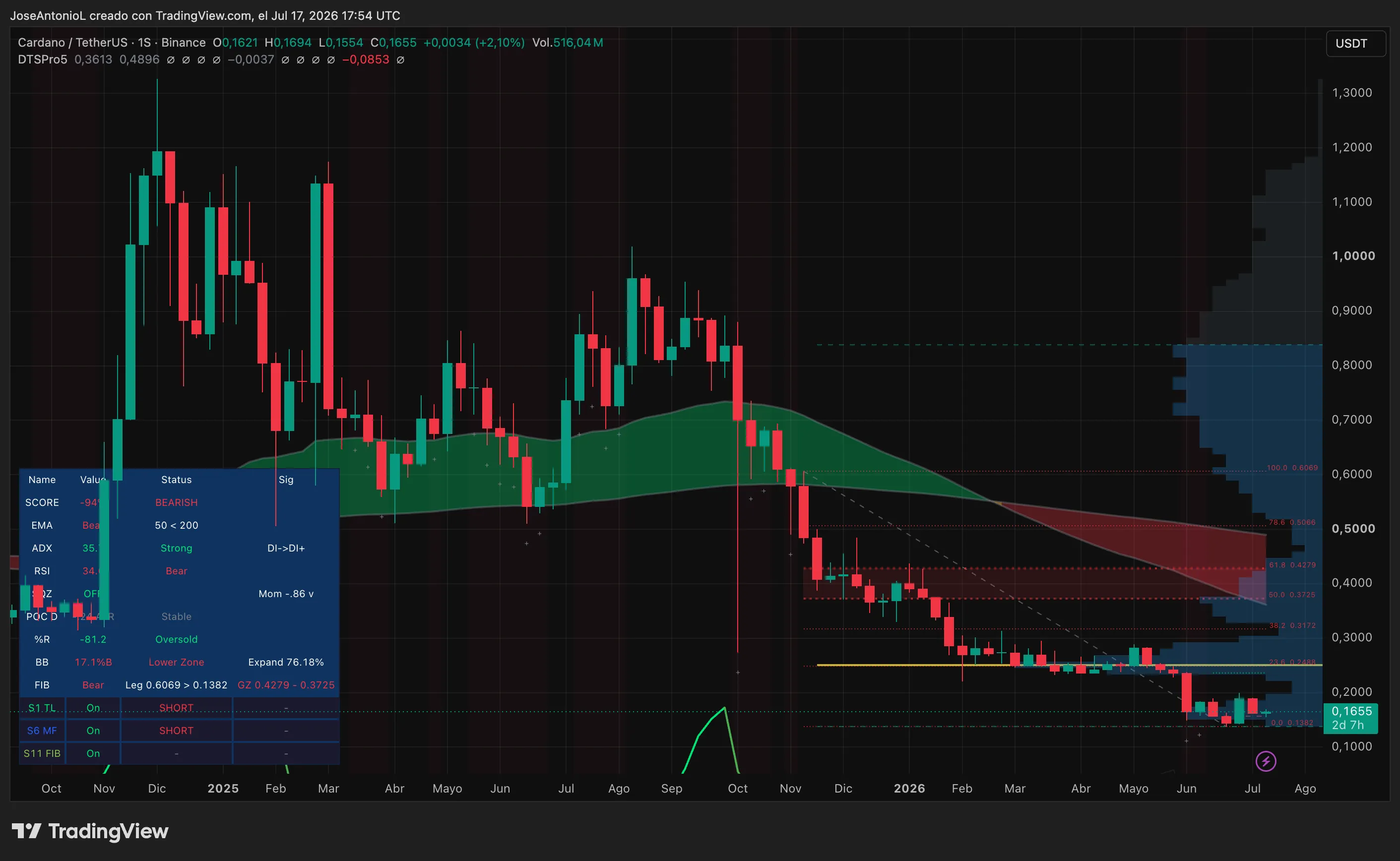
Based purely on the charts, probably not on impulse. The technical indicators present a challenging picture for immediate recovery. The coin has been grinding lower since August 2025, with the 50-week exponential moving average trending below the 200-week exponential moving average, a classic bearish signal.
Furthermore, the Relative Strength Index, or RSI, is currently sitting at 34. The RSI measures price momentum on a scale from 0 to 100, where readings above 70 indicate overbought conditions and those below 30 point to oversold territory. Meanwhile, the Average Directional Index, or ADX, which measures trend strength and direction, is pointing at a strong bearish long-term trend. Under these conditions, buying at current levels represents a leap of faith rather than a high-conviction trade.
That said, ADA has surprised traders before. If the Van Rossem hard fork successfully delivers on its cost-reduction promise, the highly anticipated Leios upgrade arrives on schedule, and the newly decentralized engineering model proves more productive than the status quo, those holding the token at 16 cents could be looking at serious upside.
For Input Output, this handover closes a major chapter in its corporate history. The development firm will now shift its focus toward cutting-edge research and pioneering new ventures through its specialized arms, IO Labs and IO Ventures. This leaves the broader Cardano community with the responsibility to prove whether a decentralized engineering model can move faster and more efficiently than the centralized structure it is replacing.
Disclaimer
The views and opinions expressed by the author are for informational purposes only and do not constitute financial, investment, or other advice.