Michael Saylor Publishes 110-Point Manifesto Opposing Controversial Bitcoin BIP-110 Soft Fork
The Strategy chairman warns that restricting Ordinals and inscriptions sets a dangerous precedent for the network's neutrality.


The debate over the technical soul of the world’s largest cryptocurrency has reached a boiling point. Michael Saylor, the executive chairman of Strategy, has launched a comprehensive defense of network neutrality, publishing a 110-point essay opposing the controversial BIP-110 soft fork proposal.
The proposed upgrade, championed by developer Luke Dashjr and the Bitcoin Knots camp, seeks to temporarily restrict non-financial data—such as Ordinals and inscriptions—from being embedded on the blockchain. Proponents argue these elements act as digital spam, clogging the network and driving up transaction fees. Saylor, however, warns that the cure is far more dangerous than the disease.
In his essay, titled “110 Reasons BIP 110 Is a Bad Idea,” Saylor characterized BIP-110 as a “Bitcoin Iatrogenic Proposal”—a medical term for a treatment that causes more harm than the illness itself. He argued that using consensus rules to filter out specific types of data sets a perilous precedent. Because the network cannot programmatically determine the intent behind data bytes, attempting to block inscriptions could inadvertently restrict legitimate use cases, including privacy tools, novel custody setups, stablecoin settlements, or token systems.
“Disapproval of a use is not invalidity,” Saylor wrote, asserting that “spam” is not a valid consensus primitive. He emphasized that while the proposed restrictions are designed to expire after roughly one year, the regulatory and governance precedent they establish would remain permanently.
This philosophical divide echoes the historic “Blocksize War” of 2015–2017, which pitted developers wanting to keep node validation cheap against those advocating for larger blocks to accommodate more transactions. The current dispute stems from the 2017 Segregated Witness (SegWit) and 2021 Taproot upgrades, which accidentally lowered the cost of storing arbitrary data on-chain, enabling the rise of Ordinals in early 2023.
Saylor also raised alarms over the activation mechanics of the proposed soft fork. Traditionally, Bitcoin upgrades require a near-unanimous 95% miner-signaling threshold to ensure network cohesion. BIP-110 lowers this requirement to just 55% and eliminates the standard option for the proposal to quietly expire if it fails to gain traction. With current miner signaling languishing below 1%, Saylor cautioned that forcing the upgrade through could split the network.
The Strategy chairman’s stance places him alongside other prominent industry figures who have voiced opposition to the measure, including Blockstream CEO Adam Back, Jameson Lopp of Casa, and Bitcoin advocate Samson Mow. The mandatory signaling window for the upgrade is set to open in August, with activation targeted for September 1. Saylor concluded his manifesto by stating that Bitcoin does not need “guardians of purity” but rather “guardians of neutrality.”
This high-profile intervention comes as Saylor’s firm undergoes a notable shift in its corporate treasury strategy. Long famous for its aggressive “never sell” approach to digital asset accumulation, Strategy is pivoting toward “active capital management.” The company has paused its Bitcoin acquisitions to build a $3 billion cash reserve, aimed at meeting stock dividend payments and debt interest obligations.
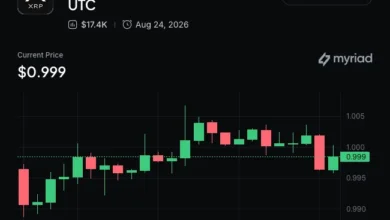
Despite the pause, Strategy CEO Phong Le recently stated that the firm’s debt obligations would not pose a risk unless the price of Bitcoin plummeted to the $8,000–$10,000 range. Meanwhile, on the prediction market Myriad—owned by Dastan—traders have grown increasingly skeptical of the firm’s immediate growth trajectory, placing just an 8% chance on Strategy holding over 1 million BTC by the end of the year, down from 17% a week ago.