Copper Prices Turn California Memorials Into Scrap-Metal Targets
Rising metal prices drive thefts from churches, memorials, and public infrastructure
SANTA ANA, Calif. — The 6th Street Viaduct in Los Angeles has been dark for more than a year after thieves stripped more than seven miles of copper wire from its internal electrical systems. The bridge, a $588 million arch designed by architect Michael Maltzan, opened in July 2022 as the “Ribbon of Light,” replacing a historic 1932 crossing. The stolen wire brought an estimated $11,000 on the scrap market, while repairs are expected to cost taxpayers millions. The Los Angeles City Council responded by establishing a specialized task force to combat copper wire theft.
Copper prices have hovered near historic highs, trading between $3 and $4.50 per pound at domestic recycling centers and exceeding $6 per pound on global commodity exchanges. Global demand for electrical grid upgrades, electric vehicle manufacturing, and green energy technology has helped drive the increase. Copper is also the primary component of bronze, an alloy typically consisting of about 88% copper, making outdoor installations lucrative targets for thieves using portable power tools.
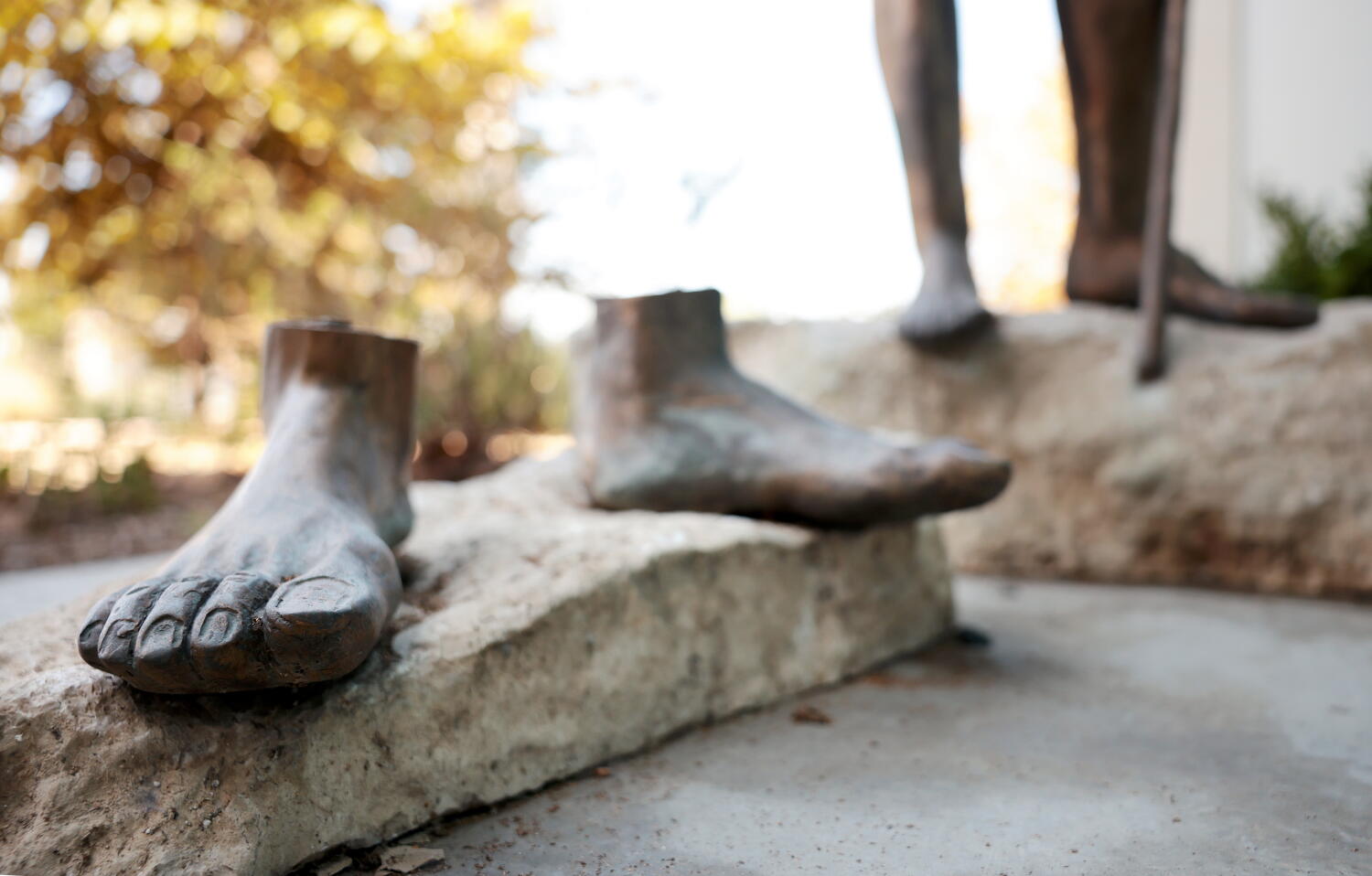
At Christ Our Savior Catholic Parish in Santa Ana, police are searching for suspects who struck around 2:00 a.m. on August 30. Two men cut through a chain-link fence and used an electric saw to sever a $50,000 bronze statue of Jesus at the ankles. They carried away the sculpture, leaving only the feet attached to its stone base. The statue formed part of a larger depiction of Saint John the Baptist baptizing Jesus, while the figure of Saint John was left intact.


The parish had already been targeted once this year. In April, thieves damaged the church’s wooden fencing while stealing sections of another bronze statue. In Paramount, a similar attack began in May, when thieves sawed off the bronze rifle and helmet from the “Battlefield Cross and Soldier” monument outside the city’s civic center. The military tribute is known as a Soldier’s Cross. In August, thieves returned and dismantled and stole the remaining portion of the bronze soldier statue from its base.
The thefts have also reached the historic district of Old Towne Orange. On the same night as an attack in Tustin, several bronze plaques were removed from a brick welcoming wall roughly seven miles away.
Tustin’s Veterans Sports Park was targeted overnight on January 20. The 47-acre facility occupies the historic grounds of the former Marine Corps Air Station Tustin, which served as a major military base from World War II through the Cold War. Thieves stripped bronze plaques honoring the Army, Navy, and Coast Guard from a central monument, along with a park dedication marker and a historical time capsule.
Tustin Mayor Austin Lumbard said the stolen bronze was likely sold for only a few thousand dollars as scrap, but replacing the markers cost the city $40,000. The city increased police patrols, installed surveillance cameras, and added security lighting around the park.
Surveillance footage eventually helped investigators identify Sean Paul Green. Prosecutors linked him to the Tustin and Orange thefts, as well as separate incidents in Long Beach and Huntington Beach. The Huntington Beach thefts included a beachside memorial to Vincent G. Moorhouse, the legendary local lifeguard chief who modernized ocean rescue services in the mid-20th century by introducing rescue boats and helicopter support. Four bronze placards were also taken from nearby Patriot Point.
Green pleaded guilty in April in Orange County Superior Court to 10 felony counts of grand theft and 10 felony counts of vandalism. He was sentenced to one year in jail. Officials said the stolen plaques had already been melted down by the time of his arrest.
California’s Business and Professions Code requires scrap metal dealers and recyclers to obtain government-issued photo identification, take thumbprints, photograph the seller and the material, and enforce a three-day waiting period before issuing payment for non-ferrous metals such as copper and bronze. Law enforcement officials report that thieves still frequently bypass those safeguards by using unlicensed scrap yards, moving stolen materials across state lines, or melting the materials down privately to obscure their origins.
Ben Stickle, a professor of criminal justice at Middle Tennessee State University and an expert on metal theft, said the geographic and institutional variety of the targets is a direct function of market forces. “I call this an emergent crime,” Stickle said. “It doesn’t mean it’s never happened before. It just means it’s suddenly popular.”
Stickle said rising global commodity prices make the financial reward increasingly outweigh the perceived risks or moral hesitations associated with targeting churches, cemeteries, and veterans’ memorials. “Some just flat out don’t care,” Stickle said of the thieves. “The value of copper has just gone up and up and up, and it’s probably at the highest it’s ever been. So that makes it more attractive for thieves to steal, and they do it more often.”