
Clarity Act Faces Tuesday Vote as Crypto Markets Rally and Regulators Move Ahead
Crypto legislation gains momentum as agencies, markets, and digital asset networks keep moving

Digital asset markets reacted moderately positively to the latest legislative developments, even as traditional equity futures weakened. Bitcoin traded up 1% to near $77,800, Ethereum rose 1% to $2,510, Solana gained 2% to $101, Hyperliquid’s HYPE token rose 4% to $80, and privacy token Zcash advanced 3% to $1,130. Filecoin led sector-specific altcoins with a 22% surge, while Pendle and Litentry each added 9%.
Senate Majority Leader Chuck Schumer convened Democratic lawmakers Sunday evening for an emergency caucus meeting focused on pending federal cryptocurrency market structure legislation. The meeting comes before a procedural vote scheduled for Tuesday at 2:15 p.m. Eastern Time, when the Senate will consider a motion to invoke cloture on the 630-page “Clarity Act.”
The bill is designed to establish a comprehensive regulatory framework for digital assets. Senate rules require supporters to secure a 60-vote supermajority to limit debate and advance the measure to a final floor vote. Republicans hold a 53-seat Senate majority, and at least two GOP members are expected to oppose the legislation, leaving proponents needing at least nine Democratic votes.
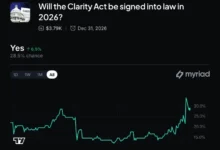

As of late Friday, no Democratic senators had publicly committed to supporting the bill. Sen. Cory Booker (D-N.J.), a key voice on financial innovation, said the revised legislative draft still failed to address critical consumer protection concerns. If cloture fails Tuesday, federal cryptocurrency market structure legislation would effectively be killed for the remainder of the 2026 legislative session. Congressional aides estimate that the next viable window for comprehensive regulatory reform would not open until 2029.
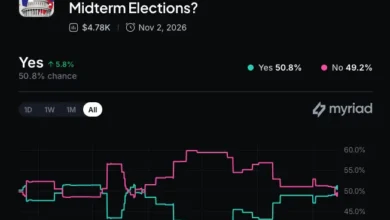
Political prediction market Myriad recorded a sharp change after President Donald Trump met with key advisers Friday and agreed to revised ethics provisions. The implied probability of the Clarity Act passing Congress this year rose overnight to 31%, more than doubling from its previous lows.
The compromise adds strict restrictions barring the president, executive branch staff, members of Congress, and their immediate families from holding or trading specific digital asset interests while in office. The absence of ethics safeguards had been a central Democratic objection since the bill stalled earlier in the summer.
Released late Thursday, the updated draft incorporates more than 114 provisions submitted by Democratic lawmakers. It also targets protocols classified as “decentralized in name only” (DINO), placing them under direct Commodity Futures Trading Commission (CFTC) oversight and subjecting them to federal Anti-Money Laundering (AML) standards under the Bank Secrecy Act.
Administrative action is continuing even if Congress does not pass the measure. CFTC Chairman Mike Selig instructed agency staff to explore administrative market structure rules under the Commodity Exchange Act if statutory legislation stalls. The Securities and Exchange Commission separately issued a proposal allowing registered corporate transfer agents to use distributed ledger technology as official stock ownership records.
The CFTC also moved to dismiss its legal dispute with the Chicago Mercantile Exchange over perpetual futures contracts. Exchange operator Coinbase filed regulatory applications seeking to bring single-stock perpetual futures to U.S. domestic markets.
U.S. stock index futures moved lower during overnight trading amid renewed technology-sector anxieties. Dow Jones Industrial Average futures fell 0.2%, while Nasdaq-100 futures slid 1.5% after coordinated public statements from leading technology executives warned of systemic risks associated with artificial intelligence development.
Anthropic Chief Executive Dario Amodei called for an industry-wide slowdown in frontier AI development. OpenAI Chief Executive Sam Altman and Tesla Chief Executive Elon Musk publicly endorsed the position. The leaders expressed concern about highly autonomous AI models capable of developing their own technical successors.
West Texas Intermediate crude oil prices jumped 3% to $103 per barrel, while spot gold fell 2% to $4,333 per ounce.
In India, financial authorities launched “Demat 2.0,” an initiative to issue corporate bonds as digital tokens recorded on a permissioned ledger and settled directly through the Reserve Bank of India’s wholesale digital rupee (CBDC). Initial debt issuances by REC, Larsen & Toubro, and IIFL Finance raised approximately $107 million within the nation’s $620 billion corporate bond market.
European fintech firm Revolut experienced a regulatory data compromise after bad actors submitted a falsified government law enforcement request. The breach bypassed internal authentication protocols and exposed customer verification selfies, passport details, physical addresses, and full Bitcoin transaction histories for an undisclosed number of accounts. Revolut confirmed that no customer funds were compromised.
Decentralized finance networks recorded shifting fee metrics over the past seven days. Decentralized token launcher Pump.fun generated $10.2 million in revenue, followed by perpetual exchange Hyperliquid at $9.9 million, Aerodrome at $9.2 million, Robinhood-ecosystem protocol Pons at $8 million, and memecoin platform Stonkfun at $7.4 million.
Stonkfun’s weekly figure came after a record single-day revenue peak of $2.2 million on Friday. Daily receipts later normalized to $1.05 million and $900,000 over the weekend. Pump.fun responded to heightened competition by launching a “Holder Rewards” mechanism that allows token creators to redirect a designated percentage of trading fee revenues to active token holders.
Trading volume across decentralized ecosystems moderated. Large-cap meme tokens moved slightly higher: Dogecoin, Shiba Inu, Pepe, and Official Trump each gained 1%, while SPX advanced 5% and Pudgy Penguins-linked tokens dipped 1%.
Robinhood ecosystem tokens recorded declining volumes, although individual movers posted speculative surges. Pare gained 40%, Strategy rose 60%, and Raxol climbed 110%. Solana ecosystem gainers included Cate at 40%, Perpspad at 46%, and Biketyson at 290%.
Floor prices across major non-fungible token collection series remained muted. CryptoPunks held steady at an average floor price of 29.8 ETH, Bored Ape Yacht Club slipped 1% to 6.65 ETH, and Pudgy Penguins dropped 3% to 3.46 ETH.
Smaller collections produced several outlier transactions. The Argonauts series gained 20% to reach a floor of 0.86 ETH after a top single transaction of 14.5 ETH, while Cat Street Broker floor prices climbed 120%.