

Chinese Coast Guard Vessel Rams Philippine Government Ship Off Palawan in Fresh South China Sea Clash
Competing versions of the collision emerge as Washington weighs in on the latest escalation in the South China Sea
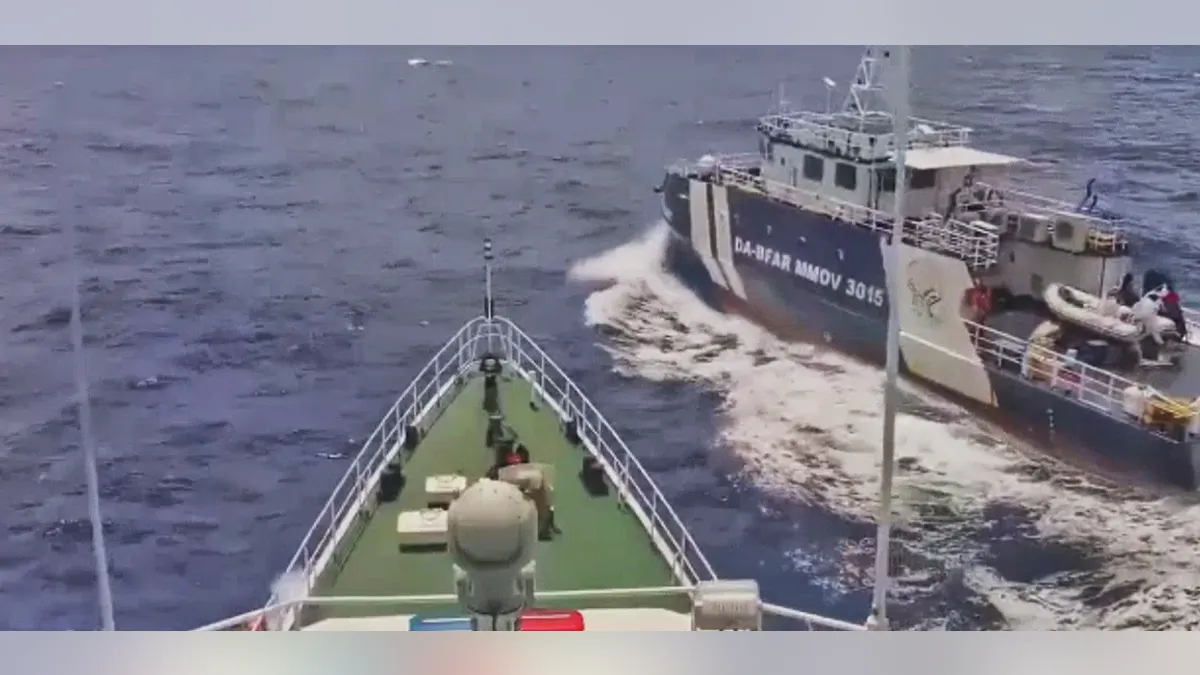
The South China Sea has become one of the most volatile flashpoints in the Indo-Pacific, with competing territorial claims involving six nations and a legal framework that has failed to restrain Beijing’s maritime assertiveness. On Friday, that simmering tension erupted into a physical confrontation when a Chinese Coast Guard craft struck a Philippine government vessel in waters Manila considers its sovereign economic territory.
The BRP Datu Magat Salamat, a Bureau of Fisheries and Aquatic Resources ship designated DA-BFAR MMOV 3015, was engaged in a mission to deliver fuel to Filipino fishermen operating near the waters off Palawan province when the collision took place at approximately 11:13 a.m. local time. The incident occurred roughly 54 nautical miles from the Philippine coast, a distance Manila maintains falls well within the country’s exclusive economic zone under the United Nations Convention on the Law of the Sea.
Video footage released by the Philippine Coast Guard captured crew members shouting “Brace for impact!” seconds before the vessel was struck. Post-collision photographs documented bent and detached railings, mangled metal supports, and debris scattered across the ship’s deck. Crew members escaped without injury.


Philippine Coast Guard spokesperson Jay Tarriela offered a detailed account of the encounter, saying the Chinese vessel first maneuvered across the stern of the Philippine ship at a distance of approximately 33 feet. Minutes later, the Chinese craft repeated the action and this time struck the vessel directly. Manila’s officials characterized the maneuver as a deliberate ramming of a civilian ship carrying out a humanitarian and livelihood mission.
Beijing issued a sharply different version of events. Chinese Coast Guard spokesperson Jiang Lue stated that the Philippine vessel “intentionally adjusted its course and suddenly accelerated to cut across the bow” of the Chinese ship after disregarding repeated warnings. China asserted its vessel was conducting lawful operations near Sabina Shoal and placed responsibility for the collision on the Philippine side.
The competing narratives reflect a pattern that has defined the South China Sea disputes for years: each side frames the same encounter in terms that justify its own position while assigning blame to the other. Sabina Shoal, the location China cites for its operations, sits within the broader Second Thomas Shoal area that has been the site of repeated confrontations between Beijing and Manila.
The United States moved quickly to weigh in on the latest incident. U.S. Ambassador to the Philippines Lee Lipton issued a statement strongly condemning what he described as the China Coast Guard’s deliberate ramming of the Philippine vessel. Washington has growing strategic interests in the South China Sea, where over $3 trillion in global trade passes annually through contested waterways.
The Chinese Embassy in Manila responded by accusing the United States of backing Philippine “infringement and provocations” in disputed waters — a recurring line of attack that underscores how the South China Sea dispute has become entangled with broader U.S.-China strategic competition.
Friday’s collision is the latest episode in an escalating series of maritime confrontations. In July, Manila accused Chinese forces of deploying water cannons against government vessels near Scarborough Shoal and of striking a Philippine Navy staff member on the head with a wooden baton during an encounter at Second Thomas Shoal. An earlier incident in March 2024 saw the Philippine resupply vessel Unaizah May 4 struck by water cannons from Chinese Coast Guard ships attempting to enter Second Thomas Shoal. A March 2025 standoff involved two Philippine Coast Guard ships surrounded by Chinese vessels in the same contested waters.
These recurring clashes occur against a backdrop in which the Permanent Court of Arbitration ruled in 2016 that China’s historic claims to much of the South China Sea have no legal basis — a decision Beijing has refused to recognize. The Philippines has consistently invoked that ruling to challenge Chinese actions, while China continues to assert its claims through coast guard and maritime militia activity rather than direct military force.
The collision near Palawan comes at a time of heightened U.S.-China rivalry in the region, with Washington reinforcing security commitments to its Asian allies and Beijing expanding its coast guard fleet — now the world’s largest — as an instrument of maritime enforcement.
The latest confrontation leaves little prospect of near-term de-escalation. Both Manila and Beijing have invested political capital in their respective versions of the incident, and each side’s domestic audiences demand a firm stance. The disputed waters between Palawan and Sabina Shoal remain among the most contested stretches of ocean in the world.
Bradford Betz is a Fox News Digital breaking reporter covering crime, political issues, and much more.









One Comment