Buying Losing Lottery Tickets on eBay Is Tax Fraud
Auction data shows bulk ticket sales spike every April as gamblers attempt to illegally erase taxable winnings under IRS Topic 419.
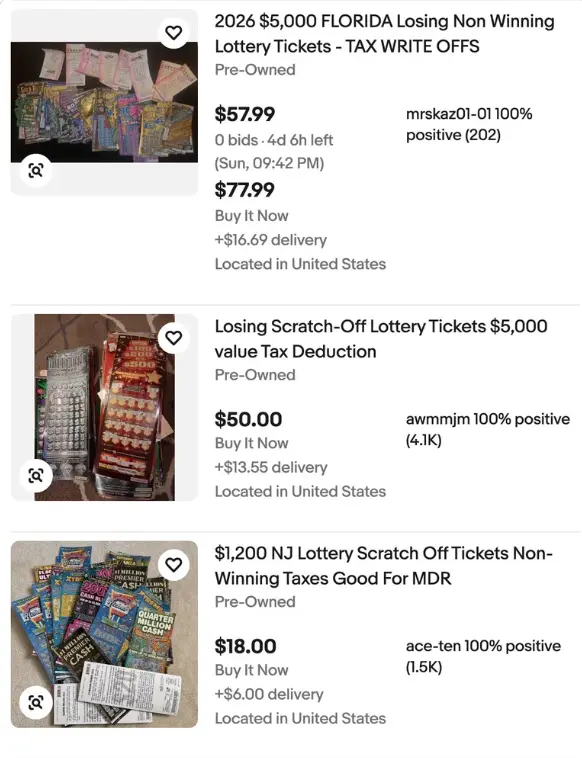
A three-inch stack of losing scratch-off tickets sits in a glass case at the University of North Carolina’s tax museum. Jeffrey Hoopes, an accounting professor and research director at the UNC Tax Center, bought the worthless paper on eBay to study a specific type of financial crime: taxpayers purchasing other people’s gambling losses to illegally erase their own tax bills.
The marketplace for discarded lottery tickets operates openly. Sellers list bulk quantities by weight or face value, marketing them as craft supplies or vintage collectibles. A pound of losing Pennsylvania scratch-offs sells for roughly $10. Bundles carrying thousands of dollars in face value from states like Ohio trade for under $30. One recent listing offered $90,000 worth of losing Florida tickets for $575.
While some buyers are genuine hobbyists, auction data reveals a different primary motivation. Hoopes tracked historical eBay listings tagged “losing lottery tickets” between 2014 and 2017 using data from ListingsHistory.com. Monthly sales volume climbed steadily from January, peaked at 66 listings in March, and held steady through April. By June, volume collapsed by more than half, bottoming out near 27 to 33 listings monthly for the remainder of the year, with only a minor bump in September. The spike aligns precisely with the weeks leading up to the April 15 federal filing deadline.


Under IRS Topic 419, gambling winnings from lotteries, casinos, sportsbooks, raffles, and horse races are fully taxable. Filers who itemize deductions can offset those winnings against documented gambling losses, but the deduction cannot exceed the reported winnings. The IRS requires contemporaneous records—a diary of wins and losses backed by receipts, tickets, or wagering statements—to substantiate the claim. Purchasing someone else’s discarded tickets to manufacture that paper trail constitutes tax fraud, functionally identical to forging expense receipts for a business.
Hoopes identifies three distinct profiles among fraudulent buyers based on purchase timing. The largest group stocks up in March and April while preparing returns. A second cohort buys in December to close out the year’s paperwork before filing. A third, smaller group purchases sporadically throughout the year, suggesting they are fabricating evidence only after receiving an audit notice.
The incentive to cheat is expanding alongside the U.S. gambling industry. Americans wagered approximately $166 billion on legal sports betting last year, a figure exceeding the combined revenues of the domestic film, music, publishing, and museum sectors. That total excludes state lotteries, commercial casinos, and untracked tribal gaming.
prediction markets have introduced a massive new layer of taxable events. Combined monthly trading volume on platforms like Kalshi and Polymarket surged from under $5 billion in September 2025 to roughly $24 billion by April 2026, according to Pew Research Center analysis. During the summer World Cup, prediction-market activity accounted for 27% of all legal U.S. sports-betting volume, up from 9% earlier in the year. Every settled contract produces a winner who owes federal income tax on the proceeds, multiplying the pool of filers who might seek artificial offsets.
Noncompliance is already systemic. A 2024 audit by the Treasury Inspector General for Tax Administration found nearly 149,000 individuals who won more than $15,000 gambling between 2018 and 2020 never filed a return reflecting the income. Those omissions represented $13.2 billion in unreported winnings. TIGTA estimated the IRS could recover roughly $1.4 billion annually by aggressively pursuing those specific cases, long before investigating fabricated loss deductions.
eBay’s terms of service permit the sale of expired lottery tickets if marketed strictly as collectibles and allowed under local law. Listings explicitly advertising tax write-offs violate platform rules and are subject to removal. However, because the platform merely connects buyers and sellers without taking physical possession of inventory, enforcement relies heavily on automated filters that sellers routinely bypass using coded language.
Even filers attempting to use legitimately acquired losing tickets face a shrinking tax advantage starting this year. The One Big Beautiful Bill Act, passed by Congress in 2025, altered the treatment of gambling losses for the first time in decades. Beginning with the 2026 tax year, taxpayers can deduct only 90% of their gambling losses against winnings, down from the previous 100% allowance.
The legislative change creates what accountants call phantom income. A taxpayer who wins $100,000 and loses $100,000 in the same calendar year previously owed no federal tax on the activity. Under the new 90% cap, that same break-even scenario leaves $10,000 exposed to ordinary income tax rates. The Joint Committee on Taxation projects the tighter deduction rule will generate approximately $1.1 billion in additional federal revenue over the next decade.