ASML Q3 Profit Beats on AI Chip Demand as France Debt Risk Rises
Monopoly EUV supplier raises Q4 guidance as shared fiscal strains push French and U.S. bond yields onto parallel tracks
ASML Holding NV signaled Wednesday that global demand for artificial intelligence infrastructure will outstrip its manufacturing capacity through the end of the decade, a forecast that lifted European and U.S. equity futures even as geopolitical shocks battered Asian markets and sovereign debt pressures mounted across Western capitals.
The Veldhoven, Netherlands-based company, which holds a global monopoly on extreme ultraviolet lithography systems required to manufacture semiconductors at nodes below 7 nanometers, reported third-quarter profit that exceeded analyst estimates. While total sales slightly missed consensus expectations, investors focused on management’s disclosure that customers are actively seeking to place equipment orders extending into 2030. ASML simultaneously raised its fourth-quarter revenue guidance and warned it lacks the production bandwidth to fulfill incoming requests.
EUV machines, which cost upward of $150 million each and use lasers to vaporize tin droplets into plasma for generating 13.5-nanometer wavelength light, are currently produced only by ASML. The technology is essential for fabricating the advanced processors used by Nvidia, AMD, and custom silicon designers building data center accelerators. No alternative supplier exists, meaning any bottleneck at ASML directly constrains the entire global supply chain for high-performance computing.


U.S. equity markets responded to the capacity warning as confirmation of sustained capital expenditure in the AI sector. S&P 500 futures climbed 0.21% in morning trading following a flat close Tuesday. European indexes tracked higher, with the Stoxx 600 advancing 0.48% and the FTSE 100 gaining 0.22% before midday.
Asian exchanges moved in the opposite direction. Escalating military engagements between Saudi Arabian forces and Houthi fighters pushed Brent crude oil to $106 per barrel, triggering risk-off selling across the region. China’s CSI 300 index fell 1.36%, India’s Nifty 50 dropped 0.46%, South Korea’s KOSPI slid 0.44%, and Japan’s Nikkei 225 edged down 0.05%. Elevated energy costs disproportionately pressure Asian economies heavily reliant on imported hydrocarbons, widening the performance gap with Western markets buoyed by domestic technology sectors.
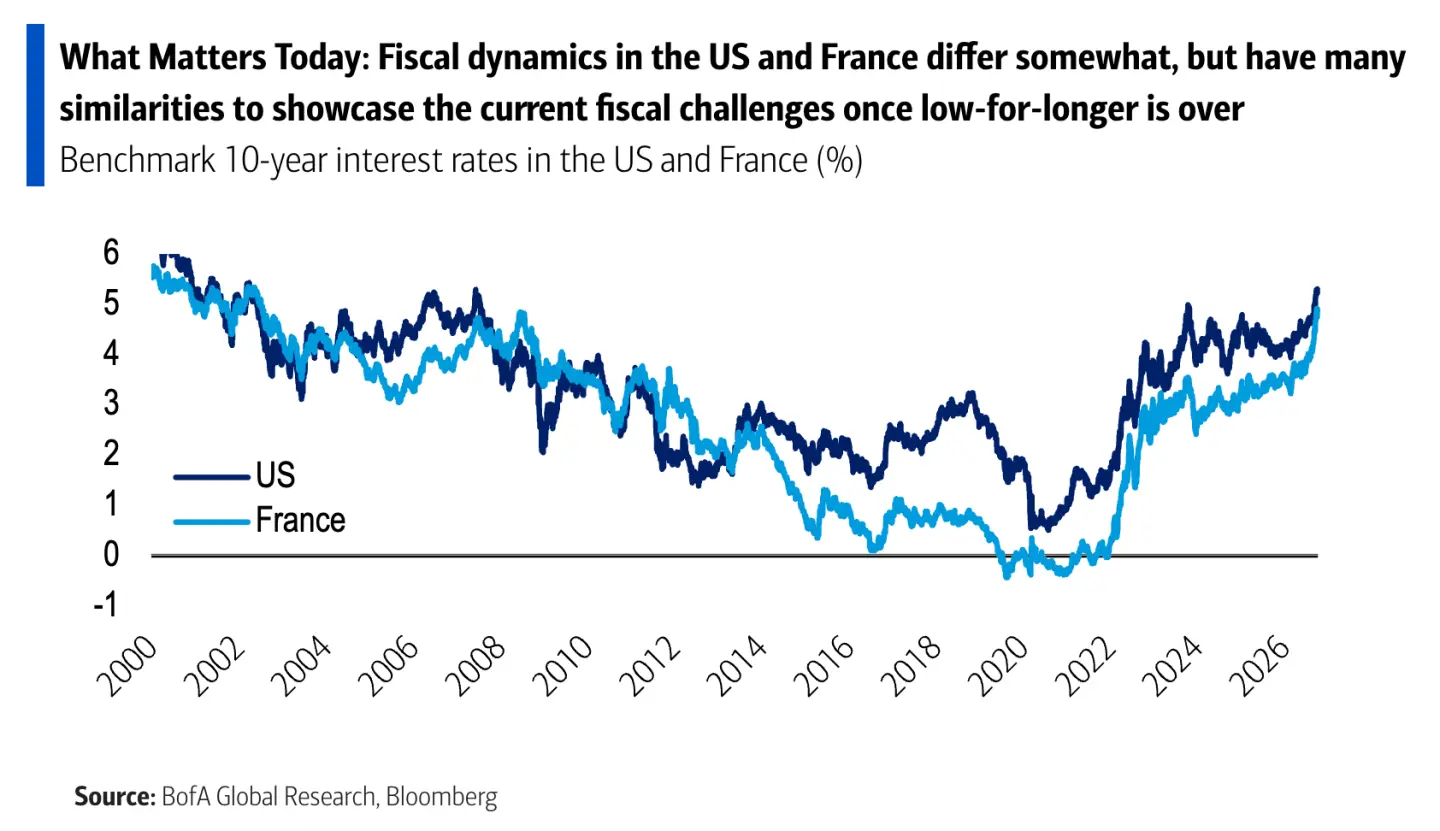
Beyond equities and commodities, structural vulnerabilities in sovereign credit markets are drawing scrutiny from institutional investors. Bank of America strategists Claudio Irigoyen and Antonio Gabriel published analysis demonstrating that French and U.S. 10-year government bond yields are moving in near-identical trajectories, driven by shared fiscal mechanics rather than synchronized monetary policy alone.
Both nations expanded deficits aggressively during the era of ultra-low interest rates, locking in cheap debt to fund structural spending increases. As borrowing costs normalized, the political feasibility of fiscal consolidation deteriorated. Paris is currently facing intense market pressure over its national debt trajectory. Macquarie Group analysts have begun modeling scenarios that include potential liquidity stress within the French banking sector if the Élysée Palace fails to stabilize public finances. ING scheduled a dedicated seminar to examine whether French fiscal deterioration could trigger a broader eurozone sovereign debt crisis, echoing the contagion fears last seen during the 2010–2012 peripheral bond sell-offs.
Unlike the 2012 crisis, which centered on smaller economies like Greece and Portugal, current anxieties involve the eurozone’s second-largest economy. French OAT bonds serve as core collateral throughout European financial plumbing, meaning sustained yield spikes carry systemic implications that cross the Atlantic through interconnected bank balance sheets and currency hedging markets.
Bitcoin traded at $83,330 amid the divergent macroeconomic signals.