Apple Developing Screenless Fitness Band to Challenge Whoop’s Subscription Model
The display-free wearable targets Whoop's subscription revenue model and could arrive by 2028 as Apple pauses its AI pendant project.
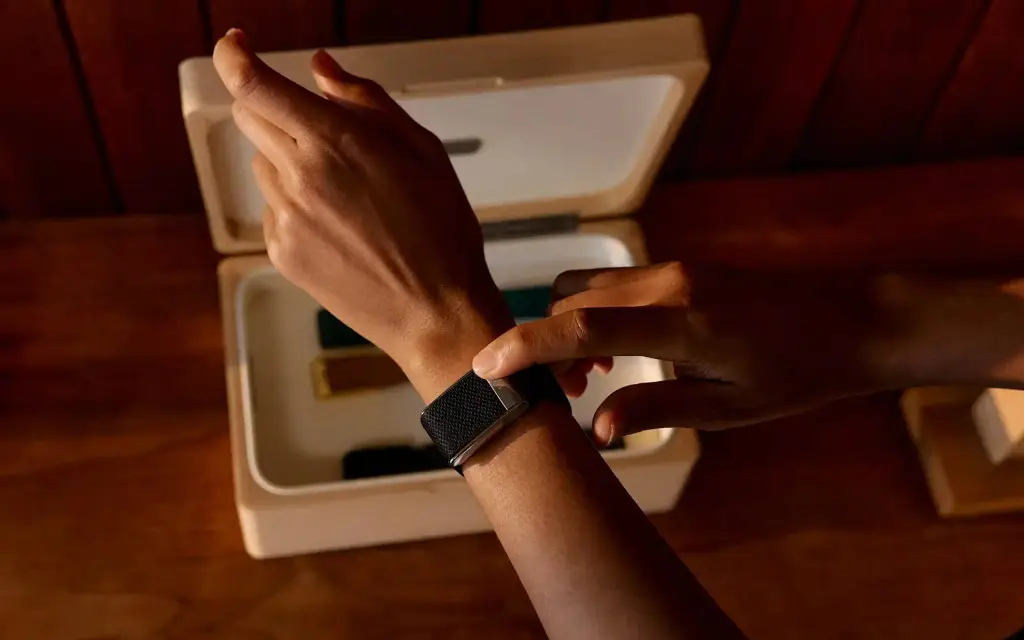
Apple has advanced a screenless fitness wristband into functional prototyping, signaling the company’s most direct attempt to capture the subscription-driven wearable market dominated by Whoop. The project, internally tracked under Apple’s technology research phase, involves a thin fabric band housing a dedicated sensor module without any display.
Engineers have moved beyond conceptual designs and are now testing hardware iterations to determine whether the device can meet performance thresholds required for mass production. If approved for commercial release, the earliest possible launch window is 2028. The extended timeline reflects both the rigorous validation process Apple applies to new health hardware and broader supply chain constraints currently strained by surging global demand for artificial intelligence infrastructure components.
The strategic rationale centers on recurring revenue rather than one-time hardware sales. Unlike the Apple Watch, which generates income primarily at the point of purchase, a screenless tracker aligns with the membership model popularized by Whoop and the Oura smart ring. Whoop charges users a monthly or annual fee that covers both the device and full access to its analytics platform, effectively locking customers into an ongoing financial relationship. Oura employs a similar structure, requiring a subscription to unlock detailed sleep, heart rate, and recovery insights from its $349 titanium ring.


For Apple, entering this space offers a pathway to steady cash flow that complements its existing services division, which generated over $85 billion in fiscal 2024. A lower-cost, distraction-free wearable would also target demographics alienated by the Apple Watch’s notifications, apps, and higher price points, particularly elite athletes and users who prefer continuous wear during sleep without the bulk of a traditional smartwatch.

Software groundwork for such a device is already visible within iOS. Recent updates to the Apple Health app introduced granular cardiovascular tracking metrics and a daily readiness score—features that closely mirror Whoop’s core strain and recovery algorithms. The interface overhaul prioritized cleaner data visualization, departing from Apple’s historically dense health dashboards to resemble the streamlined layouts favored by dedicated fitness platforms.
John Ternus, who assumed the chief executive role from Tim Cook, oversees the hardware engineering teams evaluating these prototypes. Cook and senior vice president Eddy Cue championed the initiative during its earlier stages, though internal backing does not guarantee the product will survive Apple’s notoriously strict development funnel. Many projects stall or are canceled during the technology research phase if sensor accuracy, battery life, or integration hurdles prove insurmountable.
Prioritizing the fitness band has directly impacted other experimental form factors. Development of an AI-powered smart pendant equipped with a camera and tied to Apple’s overhauled Siri architecture has been paused. That device was designed to analyze a user’s visual surroundings and deliver contextual voice responses, functioning similarly to ambient computing concepts explored by startups. However, the high-profile commercial failure of Humane’s AI Pin—a $699 lapel device plagued by slow response times and overheating—has made the industry deeply cautious about screenless, AI-reliant wearables.

Whoop, founded in 2012 by Will Ahmed, secured a $200 million funding round in 2023 that valued the Boston-based company at approximately $3.6 billion. Its dominance in professional sports, including partnerships across the NFL, PGA Tour, and Premier League, presents a formidable barrier to entry. Apple’s advantage lies in its seamless ecosystem integration; a proprietary band could sync natively with iPhone, iPad, and Apple Fitness+ without requiring third-party applications.
The hardware division continues to test various sensor configurations within the fabric band prototype to finalize biometric accuracy standards ahead of any potential 2028 production decision.