

America’s Consumer Economy Is Splitting in Two
Rising prices, grocery debt and uneven tax relief are reshaping corporate and fiscal strategy
WASHINGTON — The top 20% of U.S. households now account for approximately 60% of all domestic consumer spending, masking a severe contraction in the financial health of average families. Affluent households continue to push economic indicators higher through the wealth effect of rising asset portfolios and high-profile market milestones, including massive valuation surges in the aerospace and technology sectors.
The American middle and working classes face a structural margin collapse. A growing portion of the population can no longer cover basic daily living costs out of current earnings, while global corporations are being forced to fundamentally rethink their business models around two distinct consumer classes.
According to the latest federal economic data, annual wage growth has cooled to 3.2% as the Consumer Price Index (CPI) has climbed by 3.4%. The result is a negative 0.20 percentage point wage-price spread, compared with a pre-conflict baseline of 1.34 percentage points.


U.S. Household Wage-Price Spread
──────────────────────────────────────────────────────────
Pre-War Baseline: +1.34 percentage points
Current Level: -0.20 percentage points
Net Decline: -1.54 points (115% margin collapse)
──────────────────────────────────────────────────────────
The 115% collapse in the household margin means average consumers are no longer simply absorbing higher prices by thinning their savings; they are actively operating in the red. Millions of Americans are using short-term leverage for everyday survival, including at grocery checkout counters.
Buy Now, Pay Later (BNPL) services, once reserved for discretionary purchases such as electronics and apparel, have doubled in grocery use over the past two years. Financial analysts warn that multi-part installment plans for perishable consumer goods are a clear sign of systemic financial distress and reflect a consumer base that has exhausted traditional credit buffers.
Many U.S. corporations have responded to the bifurcated market with a “barbell” strategy. Rather than designing products for a broad middle class, a growing list of companies is shifting upmarket toward high-income earners who can tolerate persistent inflation. At the same time, businesses are aggressively deploying artificial intelligence and automation to protect corporate profit margins.
Hiring freezes and job cuts have been concentrated primarily in entry-level and middle-management roles. Wage growth for the demographic struggling with elevated energy, housing, and food costs has consequently faced further suppression.
The distribution of federal relief has also drawn scrutiny. The “One Big Beautiful Bill Act” (OBBBA), marketed to the public as a sweeping tax relief package for middle-income families, has produced highly unequal benefits. Public finance analyses indicate that households in the 95th to 99th income percentiles will receive roughly 1.9 times the tax relief allocated to middle-income households, reinforcing the upward concentration of disposable capital.
Economists caution that dependence on high-end consumption and skewed tax relief carries systemic risks. If a stock market correction or real estate downturn causes the top 20% of households to reduce discretionary spending, the hollowed-out middle class will lack the purchasing power to sustain the broader economy, leaving the U.S. without a reliable economic floor.
Some multinational retailers are pursuing a different operational playbook from domestic companies retreating to high-margin affluent sectors. They are betting that long-term resilience lies in high-volume, lower-margin accessibility.
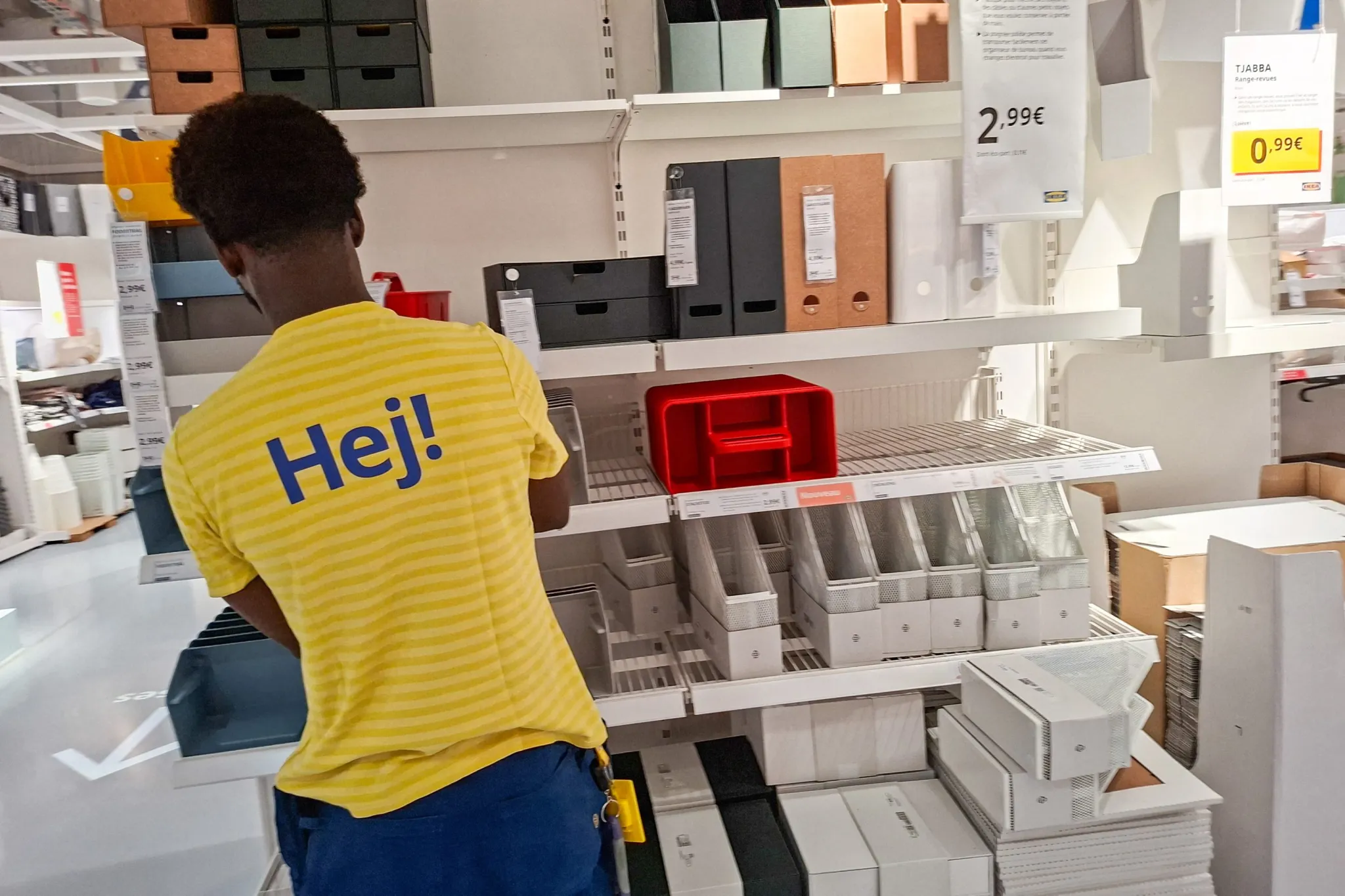
Ingka Group, the largest franchisee of Swedish furniture giant IKEA, has resisted the industry-wide trend of raising prices to match inflation. In fiscal year 2025, global revenue declined 0.9% to €41.5 billion, but the company pursued aggressive price reductions to capture market share from cash-strapped shoppers. Store visits rose to 736 million globally, while operating income jumped 16.8% to €1.46 billion.
“I like to say that for us, the big KPI is not top line in revenue,” Juvencio Maeztu, CEO of Ingka Group, said of the strategy. “The big KPI is in how many homes we are present. We have a saying normally that we sell umbrellas in IKEA, and we normally reduce the price of the umbrella when it’s actually raining.”
The retailer is also changing how it manages exposure to global trade. Geopolitical conflicts that paralyzed shipping routes through the Strait of Hormuz in early 2026 sent global shipping rates and transit times soaring. In response, IKEA accelerated a “Re-Americanization” strategy.
IKEA supplier SBA Home invested $70 million to establish a highly automated manufacturing plant in Mocksville, North Carolina. Supported by Inter IKEA, the localized facility produces high-volume items directly within the North American market and reduces reliance on vulnerable maritime chokepoints.
Ingka Investments has committed €7.5 billion by 2030 to construct and acquire utility-scale renewable energy assets. The group already owns and operates 49 wind farms and 26 solar parks globally, turning energy from a volatile operational cost into a stable, fixed asset.
The company has paired automation with worker retraining rather than using technology to reduce headcount. Its AI-driven customer service bot, “Billie,” now handles 74% of routine customer queries, while 8,500 customer service employees were retrained and shifted into higher-value remote sales and interior-design consulting roles.
Remote sales centers generated €1.25 billion ($1.37 billion) in revenue last fiscal year, and overall customer satisfaction scores improved from 60% to 89%.
The negative wage-price spread has not affected all groups equally. An analysis of Bureau of Labor Statistics (BLS) data finds that women and people of color are bearing a disproportionate share of the strain within the secondary economy.
Native American women currently earn 53 cents for every dollar paid to white, non-Hispanic men. Labor participation data also shows that 510,000 Black women left the U.S. labor force over a recent five-month period.
Macroeconomists say these demographic disparities are more than social concerns and represent a major drag on the country’s fiscal health. Closing racial and gender wage and employment gaps would inject an estimated $3.1 trillion into the U.S. Gross Domestic Product (GDP).
The federal government faces a $2.1 trillion annual deficit, while long-term liabilities such as the Social Security Trust Fund are projected to face shortfalls within the decade. Broadening the payroll tax base is increasingly viewed as a fiscal necessity.
According to economic models, closing the gender and racial pay gap alone would generate enough new payroll tax revenue to cover roughly one-third of the projected Social Security funding shortfall. Expanding those equity gains across the broader labor market would generate sufficient economic growth to offset the rising interest payments on the U.S. national debt.
As policymakers and executives navigate a volatile economic landscape, the divergence between upscale corporate strategies and the realities of the average consumer continues to grow. The coming years will test whether a consumption-driven economy can remain stable while its primary driver—the American middle class—increasingly relies on short-term debt to meet its most basic needs.