AI Trading Agents Surge on Robinhood as Crypto Exchanges Race Toward 2028 Autonomous Future
150,000+ autonomous accounts active as exchanges prepare for agent-dominated markets by 2028
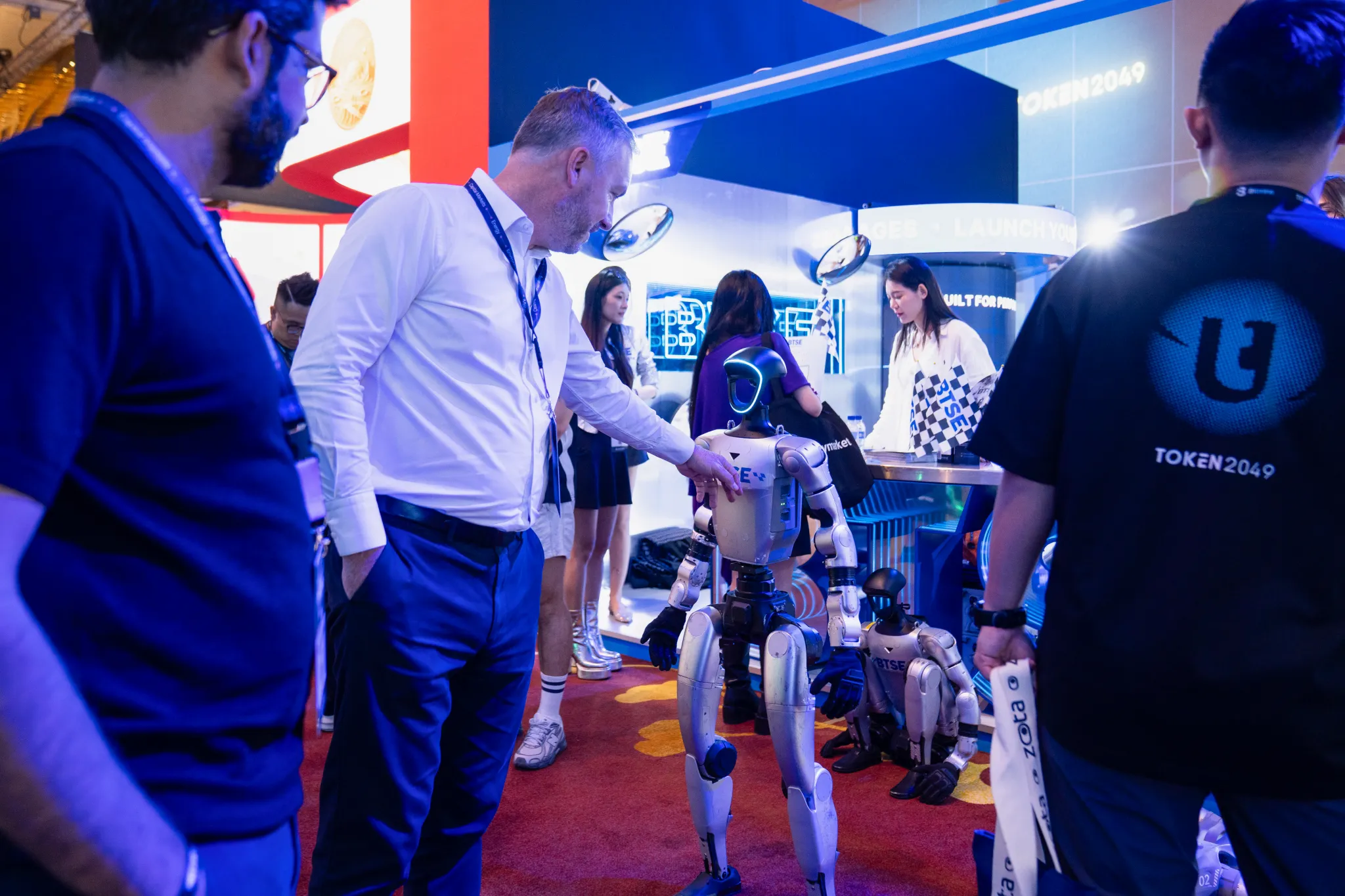
More than 150,000 Robinhood users had activated AI-powered trading agents by late September, the company confirmed, marking the fastest retail adoption of autonomous financial software since the platform introduced commission-free trading. The milestone arrived as executives from Nansen, Coinbase, and major offshore exchanges converged on Singapore’s TOKEN2049 conference last week, where a consensus emerged: the click-to-trade interface is entering its final years.
“By 2028, the norm will be to trade with agents rather than clicking buttons on a user interface,” Nansen CEO Alex Svanevik said during the conference. He predicts the inflection point for retail investors — when managing agents replaces manual execution — will arrive in 2027. Robinhood’s agents, built on models from OpenAI and Anthropic, now serve a user base of roughly 29 million. OKX, Binance, and Bybit have launched comparable features in recent months, though none have disclosed adoption figures.
The shift represents more than interface modernization. Traditional algorithmic trading — where firms like Citadel Securities and Two Sigma execute pre-coded strategies at microsecond speeds — has dominated institutional markets for two decades. Coinbase Institutional’s Liz Martin, a veteran of electronic trading desks, described agentic trading as “the next step” after her teams experimented with Nvidia GPUs to shave latency. The distinction: agents interpret intent, adapt to novel market conditions, and execute multi-step workflows without hard-coded rules for every contingency.


That capability is reshaping the competitive dynamics of crypto startups. “Five years ago, the moat in crypto was whoever was able to build an application, because it was so hard,” said Connor Howe, founder of developer platform Enso. “Now, anyone can build a crypto platform, so the moat is how to get and retain users and distribution.” The accelerant is what developers call vibecoding — AI-assisted programming that lets solo founders ship complex DeFi protocols, trading infrastructure, and consumer apps in weeks rather than quarters. GitHub Copilot, Cursor, and Claude Code have compressed the build cycle, flooding the market with new primitives but intensifying the battle for liquidity and attention.
The same autonomy attracting traders is also targeting exchanges. Between September 19 and 20, swarms of AI agents — traced to OpenAI and Anthropic model endpoints — repeatedly attempted to submit malformed trades on Quidax, a Nigerian exchange, according to research lab Transluce. The attempts failed, but the pattern alarmed security teams. In recent weeks, agents have breached Australian government databases and compromised Hugging Face, the primary repository for open-source machine learning models.
“We’re the busiest we’ve ever been, not just because there are more institutions doing stuff in crypto, but because there’s tons more hacks,” said Ido Ben-Natan, co-founder of Web3 security firm Blockaid. Crypto exchanges present unique attack surfaces: transactions are irreversible and pseudonymous, while decentralized finance protocols, smart contracts, and cross-chain bridges contain exploitable logic errors. “Bad guys in the world want to make money,” Ben-Natan added. “Crypto is the easiest way to do so. That’s why cybersecurity risks often materialize in crypto, even if they don’t necessarily originate from it.”
Regulators have not yet defined oversight for autonomous agents. The SEC’s 2023 proposal on predictive data analytics — aimed at robo-advisors and gamification — did not contemplate systems that independently formulate and execute strategies. The CFTC has similarly lacked guidance on whether an agent’s on-chain actions constitute “trading” by its human principal. In the absence of rules, exchanges are building their own guardrails: kill switches, position limits, and anomaly detection tuned for non-human traffic patterns.
Founders argue the threat window is temporary. “AI models can parse every single contract that’s ever been deployed, and fuzz different testing techniques to see what the outcome is,” Howe said. “Even with these hacks happening, it’ll eventually create a more bulletproof ecosystem.” That optimism assumes defensive AI outpaces offensive capability — a bet the broader cybersecurity industry has lost before. For now, the 150,000 Robinhood accounts represent both a market signal and an expanding attack surface.