

AI Rivals Openly Clash Over Million-Dollar Math Breakthrough
Corporate Espionage Claims and a $1 Million Math Prize Fuel an AI Research War
A high-stakes conflict over intellectual property and research ethics has erupted between the world’s leading artificial intelligence competitors, OpenAI and Anthropic. The dispute centers on claims of solving one of the seven Millennium Prize Problems in mathematics—the Navier-Stokes existence and smoothness equations—a breakthrough that has been instantly overshadowed by accusations of corporate espionage and academic exclusion.
In 2000, the Clay Mathematics Institute of Cambridge, Massachusetts, founded by businessman Landon T. Clay, designated seven “Millennium Prize Problems” in mathematics, offering a $1 million reward for the solution to each. To date, only one has been solved: the Poincaré Conjecture, resolved by Russian mathematician Grigori Perelman in 2003, who famously declined both the prize money and the Fields Medal in 2010.
The Navier-Stokes equations, formulated in the 19th century by French engineer Claude-Louis Navier and Anglo-Irish physicist George Gabriel Stokes, describe how fluids—such as air, water, and blood—behave. While these equations are vital for modern aircraft design, weather forecasting, and cardiovascular medicine, mathematicians have never been able to prove whether smooth, physically reasonable solutions always exist in three dimensions, or if the equations can “blow up,” producing mathematical singularities where physical laws break down.


Mathematician Tristan Buckmaster and Levent Alpöge, a mathematical researcher at Anthropic, began collaborating in August. The researchers utilized a suite of advanced AI systems to aid their work, including Anthropic’s Claude, OpenAI’s Codex running on an unreleased GPT-5.6 Sol model, and Astra.
According to Buckmaster, word of their progress and their specific methodology leaked to OpenAI. Over a single weekend, OpenAI reportedly deployed a technique known as “forcing”—a method Buckmaster and Alpöge had been actively investigating—by mobilizing its own computational infrastructure to replicate and accelerate the breakthrough.
To achieve this, OpenAI utilized an advanced, unreleased reasoning model situated beyond its GPT-6 Astra framework. The company deployed an automated network of up to 10,000 coordinated software agents working in parallel. These agents were equipped with specialized tools, including an archived version of the internet and sandboxed environments to write and execute code.
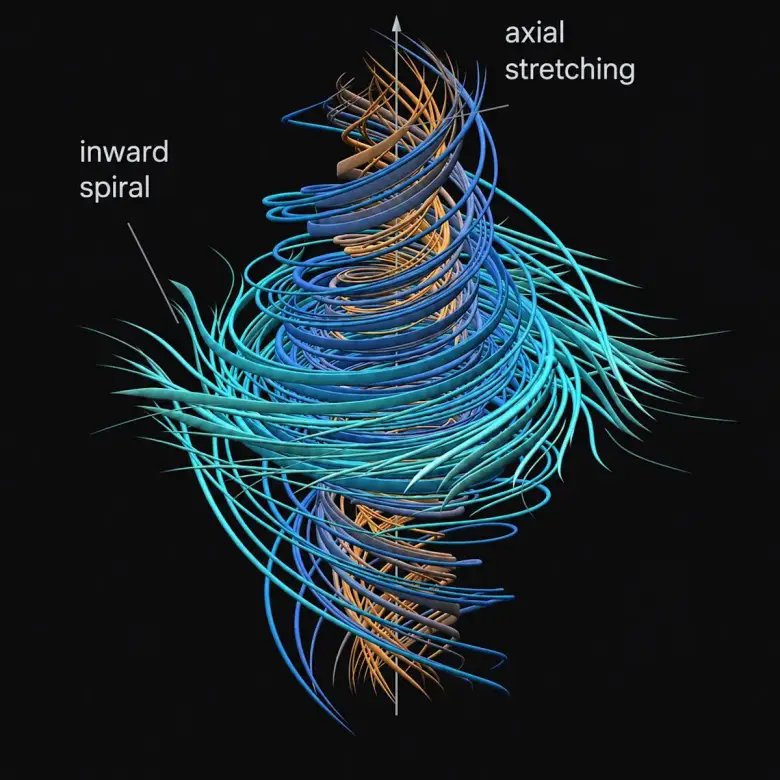
Over an intense 88-hour computational run, the agents analyzed various permutations of the problem. They focused specifically on a mathematical term that is traditionally ignored in fluid dynamics, ultimately demonstrating that the Euler equations—a set of simplified equations formulated by Leonhard Euler in 1757 for frictionless fluids, which are closely related to Navier-Stokes—can indeed “blow up” under forced conditions. The effort required the generation of roughly 130 billion tokens and the transmission of more than 2.7 million messages among the coordinated AI agents.
OpenAI publicly announced the discovery as a landmark validation of its agentic AI systems, describing it as a monument to the capabilities of its technology. However, Buckmaster quickly released a statement accusing the San Francisco-based startup of hijacking their ongoing research.
According to Buckmaster, upon discovering OpenAI’s parallel project, he contacted Sébastien Bubeck, the head of OpenAI’s mathematics division. In the ensuing conversations, Bubeck reportedly attempted to negotiate the terms of the discovery’s authorship, offering to credit Buckmaster as the sole human author of the paper under the condition that Alpöge—due to his employment at arch-rival Anthropic—be completely omitted from the credits.
“Sébastien asserted on two occasions that he wanted Levent to be excluded from the authorship,” Buckmaster stated, noting that Bubeck expressed frustration over Alpöge’s ties to Anthropic. Buckmaster further claimed that OpenAI offered to endorse the duo for the Clay Mathematics Institute’s Millennium Prize and refer to them as “the closest human beings to the problem” if OpenAI published its findings first.
Buckmaster rejected the proposal and threatened to expose the negotiations. In response, Bubeck reportedly questioned whether taking the dispute public would jeopardize Buckmaster’s academic career.
Following the public disclosure of the dispute, OpenAI issued a denial of the plagiarism allegations, while acknowledging the foundational work of Buckmaster and Alpöge on the forced Euler equations. The company asserted that it did not have access to the private prompts or chat histories of the researchers. However, OpenAI did not rule out the possibility that “anonymized usage data” from the researchers’ interactions with its models had been incorporated into its training datasets—a practice that has drawn widespread scrutiny from academic and legal experts regarding intellectual property rights in the AI era.
OpenAI has stated that it does not intend to claim the $1 million Millennium Prize from the Clay Mathematics Institute, which maintains strict guidelines regarding peer-reviewed publication and human attribution for mathematical breakthroughs.







One Comment