Hawks 2026-27 NBA Season Preview: Roster, Odds and Outlook
Atlanta added Lu Dort, Aaron Wiggins and Dorian Finney-Smith to build a deeper, more versatile defense around Jalen Johnson.
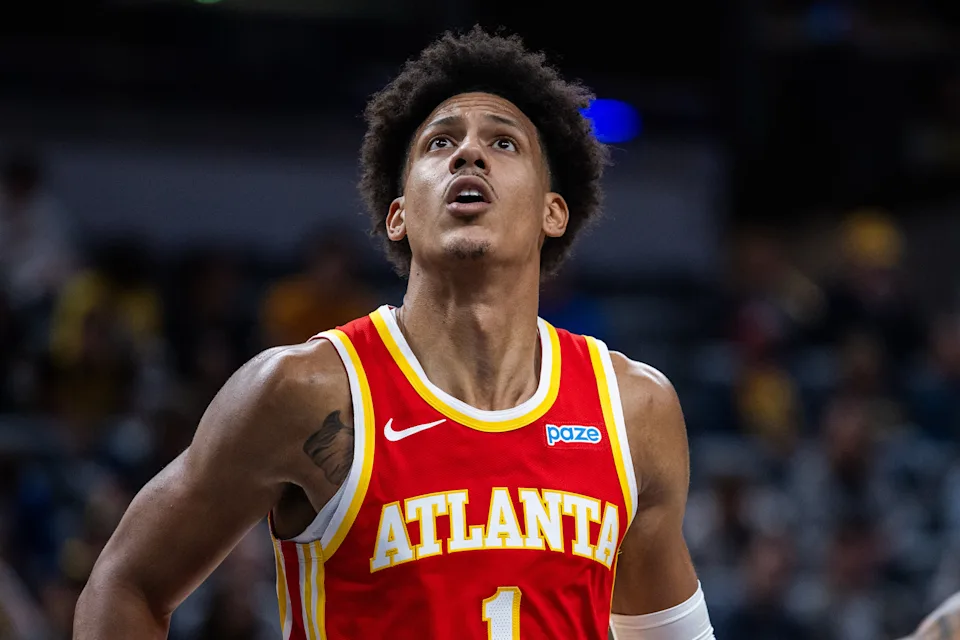
The Atlanta Hawks enter the 2026-27 NBA season with a roster engineered for depth rather than star dependency. After finishing 46-36 last year and falling to the New York Knicks in six games during the first round of the Eastern Conference playoffs, the front office spent the offseason stockpiling wings and defensive specialists to insulate Jalen Johnson from carrying every possession.
Atlanta opens the regular season on Oct. 21 against the Orlando Magic, followed by road and home matchups against the Charlotte Hornets on Oct. 23 and the Houston Rockets on Oct. 24.
**Roster overhaul prioritizes defense and wing versatility**

General manager Landry Fields executed three notable trades to reshape the rotation. The Hawks acquired perimeter defenders Lu Dort and Aaron Wiggins from the Oklahoma City Thunder, while bringing in veteran forward Dorian Finney-Smith from the Charlotte Hornets. In exchange, Atlanta parted ways with former No. 1 overall pick Zaccharie Risacher, sending him to the Dallas Mavericks.
Dort immediately slots in as a primary point-of-attack defender alongside Dyson Daniels, giving head coach Quin Snyder one of the most disruptive backcourt defensive pairings in the league. Wiggins provides secondary scoring on the wing, filling a role previously occupied by Nickeil Alexander-Walker. Finney-Smith adds switchable size that allows Atlanta to deploy versatile small-ball lineups without sacrificing rim protection.
Free agency brought CJ McCollum back on a one-year, $21 million extension. Backup center Jock Landale also re-signed for one year at $14 million, ensuring Onyeka Okongwu has reliable frontcourt support.
Jonathan Kuminga, who joined Atlanta earlier, departed in free agency to sign with the Minnesota Timberwolves, removing a rotational piece but clearing minutes for younger players.
**Draft class targets immediate depth**
Atlanta used three picks in the 2026 NBA Draft to address specific gaps. Kingston Flemings was selected eighth overall to develop as a secondary ball-handler behind McCollum. Zuby Ejiofor went 23rd to add physicality inside, and Henri Veesaar was taken 52nd as a developmental big man.
Flemings represents a critical investment. Snyder’s system requires guards who can initiate offense when primary actions break down, and pairing a young playmaker with McCollum prevents the offense from stalling when Johnson rests.
**The isolation problem persists**
Despite the influx of talent, Atlanta’s half-court execution remains its most significant vulnerability. Playoff basketball routinely strips away transition opportunities, forcing teams into late-clock isolation possessions. According to Synergy tracking data from last season, McCollum generated just 0.82 points per isolation possession, placing him below the 50th percentile. Alexander-Walker posted 0.85, while Johnson managed 0.78.
None of those figures project confidence in tight postseason games where switching defenses neutralize ball movement. If opponents continue to flatten Atlanta’s sets by switching one through five, the Hawks must find a reliable one-on-one creator or risk early playoff exits again. Johnson’s development as a pressure point in the half-court is the single most important variable for this franchise. His counting stats surged last season — averaging 22.5 points, 10.3 rebounds and 7.9 assists — but translating those numbers against elite playoff defenses requires refined footwork and counter-moves he has yet to consistently display.
**Post-Trae Young identity solidifies**
Atlanta’s trajectory shifted dramatically following the midseason trade of Trae Young last year. From Jan. 9 onward, the Hawks played at a 53-win pace, going 28-15 with a chaotic, turnover-forcing defensive scheme fueling an egalitarian transition attack. That identity carries over fully into 2026-27, marking the first complete season under Snyder without Young dictating the offensive tempo.
Historically, teams that lose a high-usage All-Star guard struggle to replace shot creation. Atlanta circumvented this by distributing responsibilities across multiple wings and leaning heavily on defensive conversion points. The strategy mirrors the early-2020s Miami Heat model, where positional versatility and defensive intensity compensated for the absence of a traditional isolation scorer.
**Betting markets and fantasy implications**
Sportsbooks have set Atlanta’s win total at 43.5, reflecting skepticism about their ceiling despite the improved roster. The Hawks sit at +275 to win the Southeast Division and +6600 to capture the NBA Finals. Preseason power rankings place them 15th overall, projecting a best-case scenario as a No. 3 seed in the East and a worst-case outcome landing them in the Play-In Tournament if rebounding deficiencies resurface.
For fantasy basketball managers, Johnson’s draft position requires caution. While his raw production suggests first-round value, his efficiency fluctuates based on personnel. Last season, Johnson ranked ninth in per-game fantasy value in the 36 games McCollum missed, but dropped to 34th in the 36 games they shared the floor. That two-round swing makes the second round a safer target in nine-category leagues, where McCollum’s shooting percentages and assist totals absorb some of Johnson’s usage.
The Southeast Division presents a congested path. The Orlando Magic continue to build around Paolo Banchero and Jalen Suggs, while the Miami Heat remain a perennial playoff threat. Atlanta’s margin for error in the standings is narrow, making health among its newly assembled wing corps essential to avoiding the 7-through-10 seeds.
Atlanta finalized its opening-week itinerary with the back-to-back road trip through Orlando and Charlotte before returning to State Farm Arena to host Houston.