Trump’s ‘Triumphal Arch’ Now Includes Sniper Positions and Military Drones
The proposed monument now faces regulatory hurdles, litigation, and questions from the Pentagon
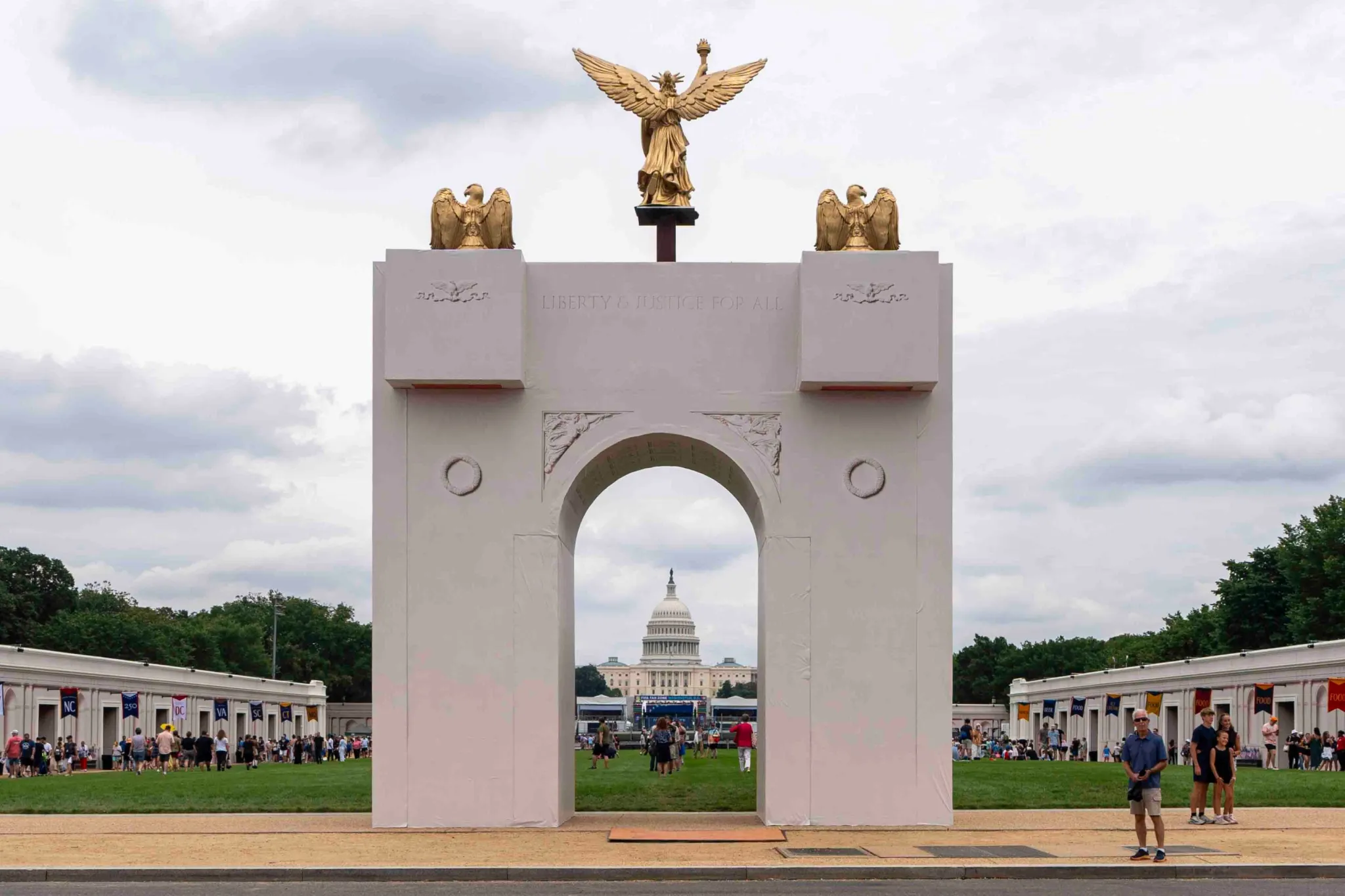
WASHINGTON — President Donald Trump announced on social media that he had agreed to convert a proposed 250-foot, or 76-meter, triumphal arch into a “top grade Military Complex/Triumphal Arch.” The structure is planned for a federal traffic circle at the eastern terminus of the Arlington Memorial Bridge, between the Lincoln Memorial and Arlington National Cemetery.
Under the modified specifications outlined by Trump, the arch would be equipped with elevated sniper positions on its roof and plaza, storage for large quantities of high-caliber sniper ammunition, and fleets of military drones. Trump stated that the tactical additions were requested directly by military leadership. The Department of Defense said it has no information about the project beyond the president’s public comments.
The contested site is a critical traffic hub connecting Washington’s monumental core with Northern Virginia. The circle links to the Arlington Memorial Bridge, an arterial route carrying thousands of daily commuters over the Potomac River, as well as to major thoroughfares including the George Washington Memorial Parkway and Route 50.


The bridge was authorized by Congress in 1923 and completed in 1932 by the architectural firm McKim, Mead & White. It was designed as a symbolic physical connection between the North and South, aligning the Lincoln Memorial—dedicated in 1922—with Arlington House and Arlington National Cemetery, established during the Civil War in 1864.
Construction on public land in the District of Columbia must navigate the federal regulatory framework established by the Commemorative Works Act of 1986. Major monuments on land managed by the National Park Service or the General Services Administration in the National Capital Region require explicit legislative authorization from the U.S. Congress, along with multistage approvals from federal design and planning review bodies.
The proposal received preliminary aesthetic clearance from the U.S. Commission of Fine Arts, an advisory panel whose current members were all appointed by Trump. The National Capital Planning Commission, the central planning agency for federal property in the Washington area, has not granted final approval. It approved the preliminary site selection and conceptual designs during its July meeting, but final regulatory clearance remains pending and the commission is expected to review the project again in the fall. Groundbreaking had originally been targeted for this month.
An architectural historian and three military veterans have filed a federal lawsuit against the effort. They contend that the administration is proceeding without the requisite statutory approval from Congress and argue that executive authorities cannot unilaterally construct a major monument on federal parkland without legislative authorization.
The project’s framing as a dual-use military facility follows the administration’s repeated attribution of defense functions to executive capital projects. A separate initiative to construct a new ballroom at the White House has also been described by the administration as a “military complex” vital to national security operations.
The arch is part of a broader effort to alter federal monuments, culture venues, and public spaces across the capital. Other projects include extensive structural renovations and naming changes at the John F. Kennedy Center for the Performing Arts, a presidential memorial established by Congress in 1964, and rehabilitation work at the Lincoln Memorial Reflecting Pool.
The administration is also advancing a redevelopment plan for the public golf facility at East Potomac Park. The park sits on Hains Point, a peninsula created by federal dredging projects between 1882 and 1912, and its golf course opened in 1920. Local residents have raised concerns that the proposed modifications could restrict public access to the perimeter running and cycling paths along the Potomac and Anacostia rivers.