Federal Judge Curbs Warrantless Immigration Arrests Across Southern California
Agents must document flight risk before making warrantless civil arrests
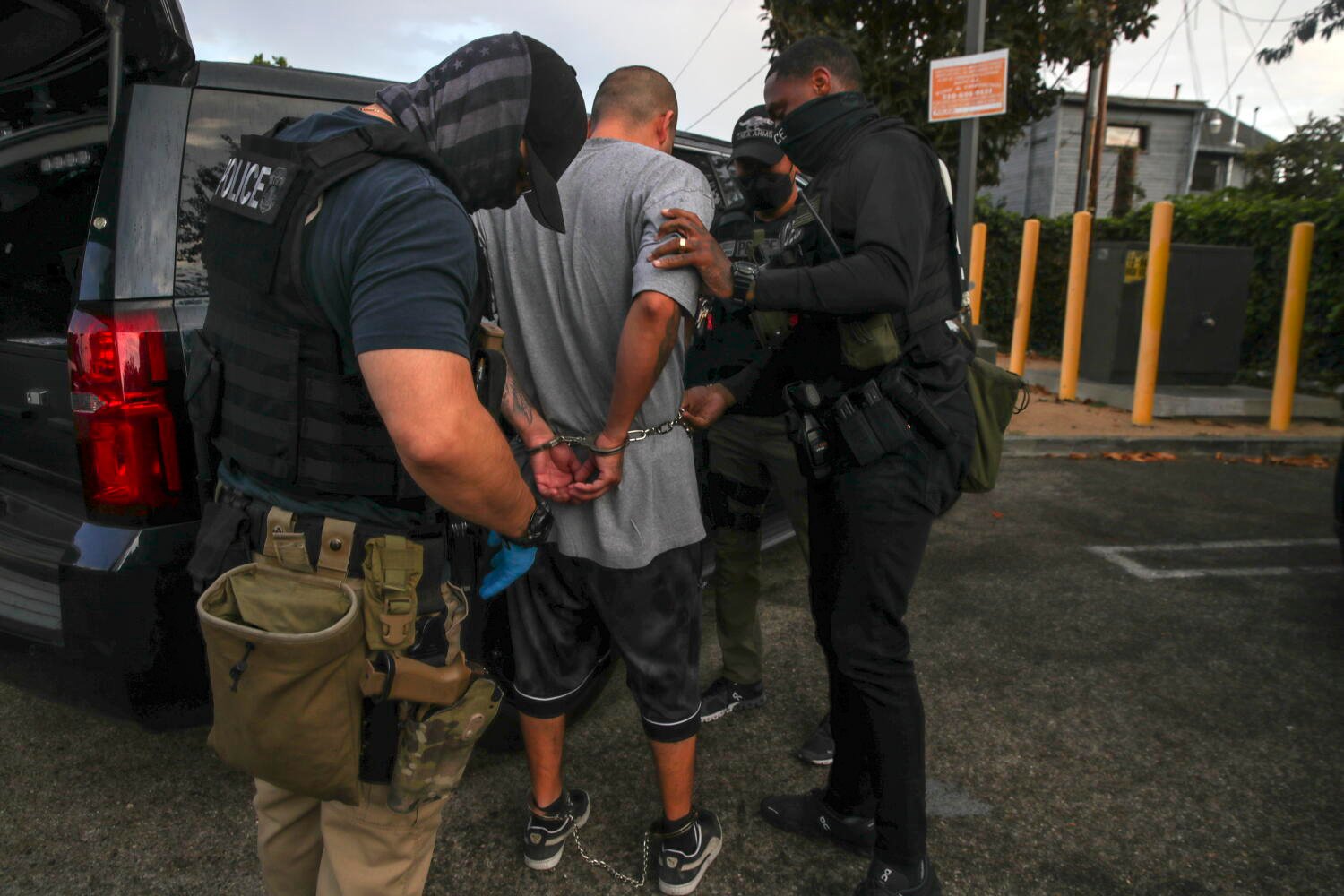
LOS ANGELES — Immigration officers operating across seven Southern California counties must now document specific facts showing that a person is likely to flee before making a warrantless civil arrest, under a preliminary injunction issued by U.S. District Judge Maame Ewusi-Mensah Frimpong.
The order applies to the Central District of California, the most populous federal judicial jurisdiction in the United States. It covers approximately 20 million residents in Los Angeles, Orange, Riverside, San Bernardino, Ventura, Santa Barbara, and San Luis Obispo counties, and affects agencies overseen by the Department of Homeland Security (DHS), including Immigration and Customs Enforcement (ICE) and Customs and Border Protection (CBP).
Frimpong’s ruling was filed under seal on Sept. 2 and appeared on the public docket Wednesday. It requires federal agents to assess the “totality of the circumstances” known to them before making an arrest without a warrant. Agents must document “specific, particularized facts” establishing probable cause that a suspect was likely to escape before a warrant could be obtained.


The case began with a class-action lawsuit filed last year by the American Civil Liberties Union (ACLU) of Southern California, the public interest law firm Public Counsel, and other advocacy groups and private attorneys. The plaintiffs are seeking to halt what they describe as systemic unlawful stops and to secure stronger due process and legal representation rights for immigrants held in federal detention.
During a June hearing on the preliminary injunction, plaintiffs’ attorneys examined DHS arrest records. In 113 cases, 89—nearly 80 percent—either contained no escape-risk assessment or used generic, pre-drafted “template” language. Frimpong found that the federal government “is regularly abstaining from conducting a likelihood of escape analysis at all” during warrantless arrests.
Federal law, under Section 287(a)(2) of the Immigration and Nationality Act (8 U.S.C. § 1357(a)(2)), permits an immigration officer to arrest someone without a warrant only when the officer has reason to believe the individual is in the United States in violation of any law and is “likely to escape before a warrant can be obtained for his arrest.”
“Mere presence within the United States in violation of United States immigration law is not, by itself, sufficient to conclude that a person is likely to escape before a warrant for arrest can be obtained,” Frimpong wrote. President Joe Biden nominated Frimpong to the federal bench in 2021, and the Senate confirmed her later that year.
The judge’s order cited arrest records that did not match physical evidence or video footage. In one incident, ICE agents wrote that a car wash worker had been arrested after attempting to flee from law enforcement. Surveillance video instead showed the man standing still from the time an agent entered the business until the agent called him over.
In another case, footage showed agents following a vehicle, pursuing the driver immediately after leaving their car, and arresting the individual without first asking questions about identity or flight risk.
Department of Justice attorney Daniel Mummolo urged the court to deny the injunction. He argued that the federal government has no written or unwritten policy allowing agents to bypass flight-risk assessments. Mummolo said the “overwhelming majority” of arrest files discussed flight risk, while also arguing that federal agents were not legally required to document those assessments.
Frimpong rejected the government’s arguments and found that two plaintiff organizations are likely to succeed in proving the existence of an illegal enforcement policy. She also denied a Department of Justice request to stay the injunction for 14 days while federal attorneys decide whether to appeal. The Department of Homeland Security did not immediately respond to requests for comment.
The Southern California restrictions follow similar rulings in Portland, Oregon, Colorado, Washington, D.C., and the Eastern District of California, where federal courts have blocked or limited warrantless civil immigration arrests on similar grounds.
Mohammad Tajsar, an attorney with the ACLU of Southern California, said the number of warrantless arrests in Washington, D.C., fell significantly after a federal court there issued a similar injunction. He said agencies in other jurisdictions have attempted to adapt by using “field warrants,” or administrative warrants signed quickly on-site by agency supervisors rather than by a judge, to avoid the escape-risk requirement.
“They’re trying to do fancy paperwork,” Tajsar said, adding that advocates would legally challenge similar workarounds if they were used in Southern California.
Although the injunction does not explicitly direct agents to consider a person’s local family or employment ties, Tajsar argued that those factors are necessary to conduct a proper escape-risk assessment. “How can you say someone is an escape risk by ignoring the fact that they have U.S. citizen kids, a job here, or their wife lives here?” Tajsar said.
Mayra Joachín, an attorney with the ACLU of Southern California, welcomed the order, saying it “should put an end to hundreds—if not more—of unlawful arrests that continue throughout Southern California.”
The preliminary injunction will remain in effect while the lawsuit proceeds. Frimpong emphasized that it is a temporary measure addressing ongoing practices, not the court’s final judgment on the merits, which will be determined at trial.