

Georgia’s Voting System Can Be Decoded by Public AI Tools
AI exposes a flaw that can connect Georgia voters to their ballots
ATLANTA — Georgia’s statewide voting configuration is currently unique in the nation, and its unpatched machines are paired with robust public disclosure laws. Mark Lindeman, policy and strategy director at Verified Voting, a nonpartisan organization focused on election technology, said other jurisdictions using Dominion systems have either applied a manufacturer-issued software patch or restricted the public release of sensitive casting data. Georgia’s combination has created what he called a “perfect storm.”
The vulnerability does not let bad actors alter vote tallies or manipulate election outcomes. It threatens ballot secrecy, a cornerstone of democratic elections intended to prevent voter coercion and bribery. Article II, Section I of the Georgia Constitution says elections “shall be by secret ballot,” while state statutory law requires voting equipment to ensure “absolute secrecy so that no person can see or know any other elector’s votes.”
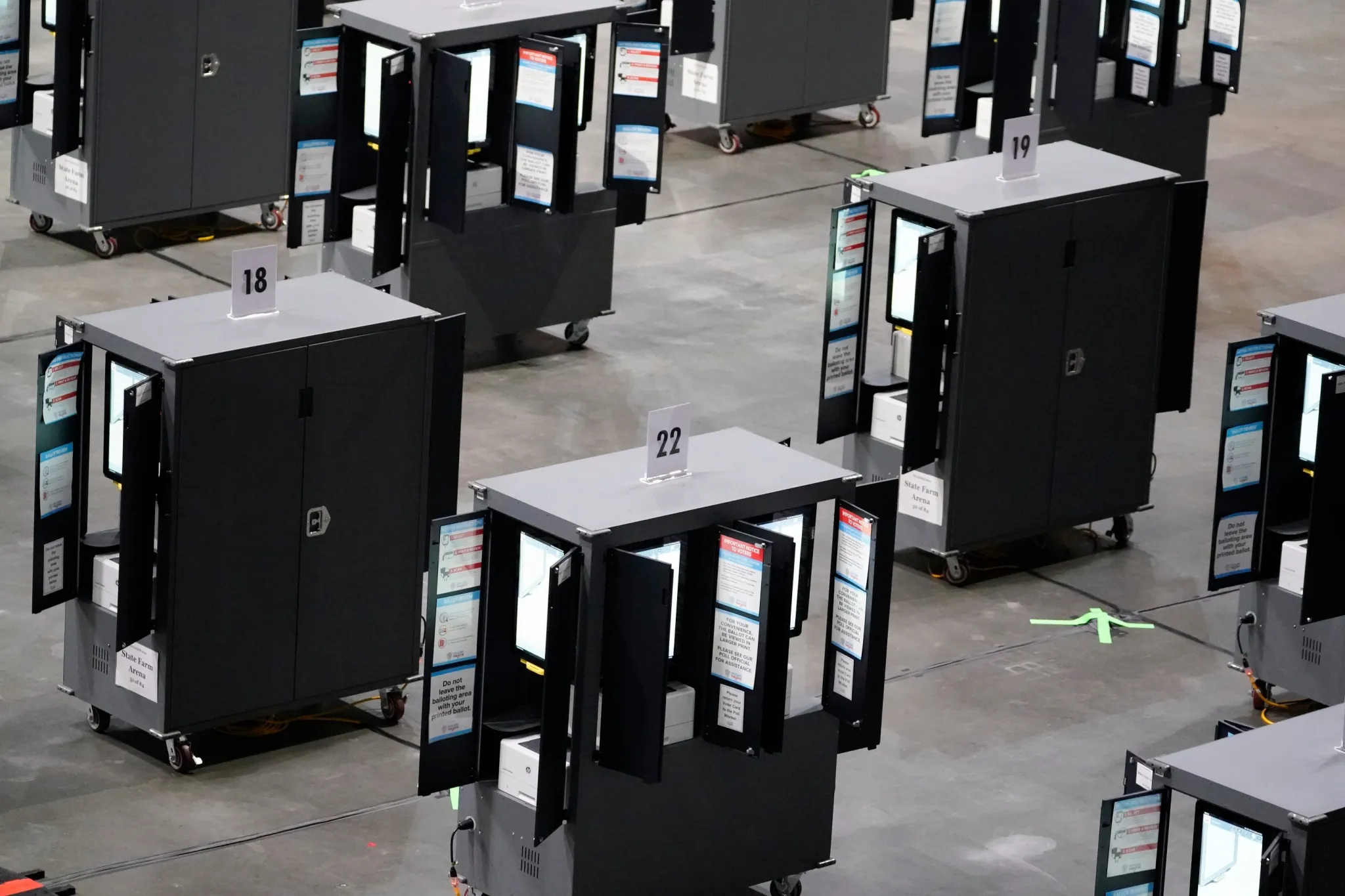
The equipment at issue is part of Georgia’s $107 million Dominion Voting Systems system, purchased in 2019 after years of legal battles over the state’s previous paperless voting machines. Dominion has since been sold and renamed Liberty Vote. Voters make selections on touchscreen ballot-marking devices, which print paper ballots containing a bar code and a written list of their choices before the ballots are fed into optical scanners.


In August, Georgia State Election Board member Salleigh Grubbs proposed an emergency rule requiring the Secretary of State’s office to install the manufacturer’s software update before the November election. “Each voter has one vote, and no one is entitled to know how it was cast,” Grubbs argued. “That privacy protects more than the individual voter. It protects the integrity of the entire election.”
The board rejected the proposal. Legal counsel for the Secretary of State’s office wrote that the update had not been fully certified by the state, that deployment across tens of thousands of voting machines statewide would require months of preparation, and that the state legislature had not provided the funding needed for such a rapid rollout.
Georgia election officials say the system’s integrity remains intact and that administrative workarounds are sufficient, even as election security advocates demand an immediate fix. The dispute has taken on new urgency as Georgia prepares to serve as a pivotal battleground in the upcoming presidential election, raising questions about technological vulnerability, transparency laws and the state’s administrative readiness.
The software loophole was first identified in 2022 by a research team that included J. Alex Halderman, a prominent voting technology specialist and computer science professor at the University of Michigan. Halderman called the emergence of sophisticated generative AI “a bit of a wake-up call because it illustrates how much more easily vulnerabilities can be exploited now that AI can do all of the technical work for you.”
Digital ballot images and cast-vote records generated by the scanners are supposed to be randomized. The flaw, however, allows an outside observer to reconstruct the chronological order in which ballots were cast. Georgia’s use of this specific voting configuration statewide makes the issue especially significant.
Max Springer, a researcher at Princeton University, demonstrated the increased risk by entering public data into a widely available commercial AI assistant. He used public cast-vote records from Georgia’s May primary and early voting lists, both of which can be obtained through open records requests. The AI reverse-engineered the randomized ballot order and grouped ballots with potential voters. Springer then cross-referenced the information with precinct check-in files and scanner audit logs, successfully matching specific ballots to the voters who cast them.
“AI coding tools are essentially supercharging laymen people to exploit vulnerabilities,” Springer said. The accessibility of advanced artificial intelligence has sharply reduced the technical expertise required to exploit the software flaw.
Mark Lindeman said the situation was “really embarrassing” because the possibility remains. Board member Sara Tindall Ghazal, who voted against Grubbs’ mandate, also expressed frustration that the software is still unpatched. She noted, however, that revealing how an individual voted is a felony under Georgia law. “I hate the fact that it’s even physically possible, but there are very, very severe penalties if somebody were to actually do this,” she said.
The Secretary of State’s office has responded with stopgap measures. Gabriel Sterling, the office’s special projects manager, said Georgia is working with an external vendor to scramble the original sequence of ballot images and cast-vote records before releasing them in response to public records requests. County election offices have also been instructed to send specific open records requests to the state, where officials plan to redact sensitive identifying information.
Sterling said political campaigns or other bad actors seeking to buy votes or coerce voters would be more likely to use mail-in ballots or standard demographic outreach because those methods would be more cost-effective than applying complex data-matching techniques to cast-vote records.
Marilyn Marks, executive director of the Coalition for Good Governance, a nonpartisan group that has long sued Georgia over voting machine security, said administrative redactions are not an adequate replacement for a secure system. She also argued that limiting public records access damages necessary transparency. “When Georgia’s election records contain identifiers that can be used to trace ballots to voters, the only legal and acceptable answer is to stop recording that information — not restrict public access to sensitive unlawful information to insiders and commercial vendors,” Marks said.
Marks proposed a low-tech interim measure for the approaching general election: paper ballots could be collected in secure, locked boxes at polling precincts and physically shuffled before being run through tabulating scanners at centralized county facilities.