The Ebola Outbreak Passed 10,000 Cases. The One Nobody Can Trace Is Bigger.
Fewer than one in four new cases come from a known contact, and 307 of the last 482 deaths happened in communities, not treatment centres — while the US, Uganda and Europe tighten the borders around an outbreak they can already count.
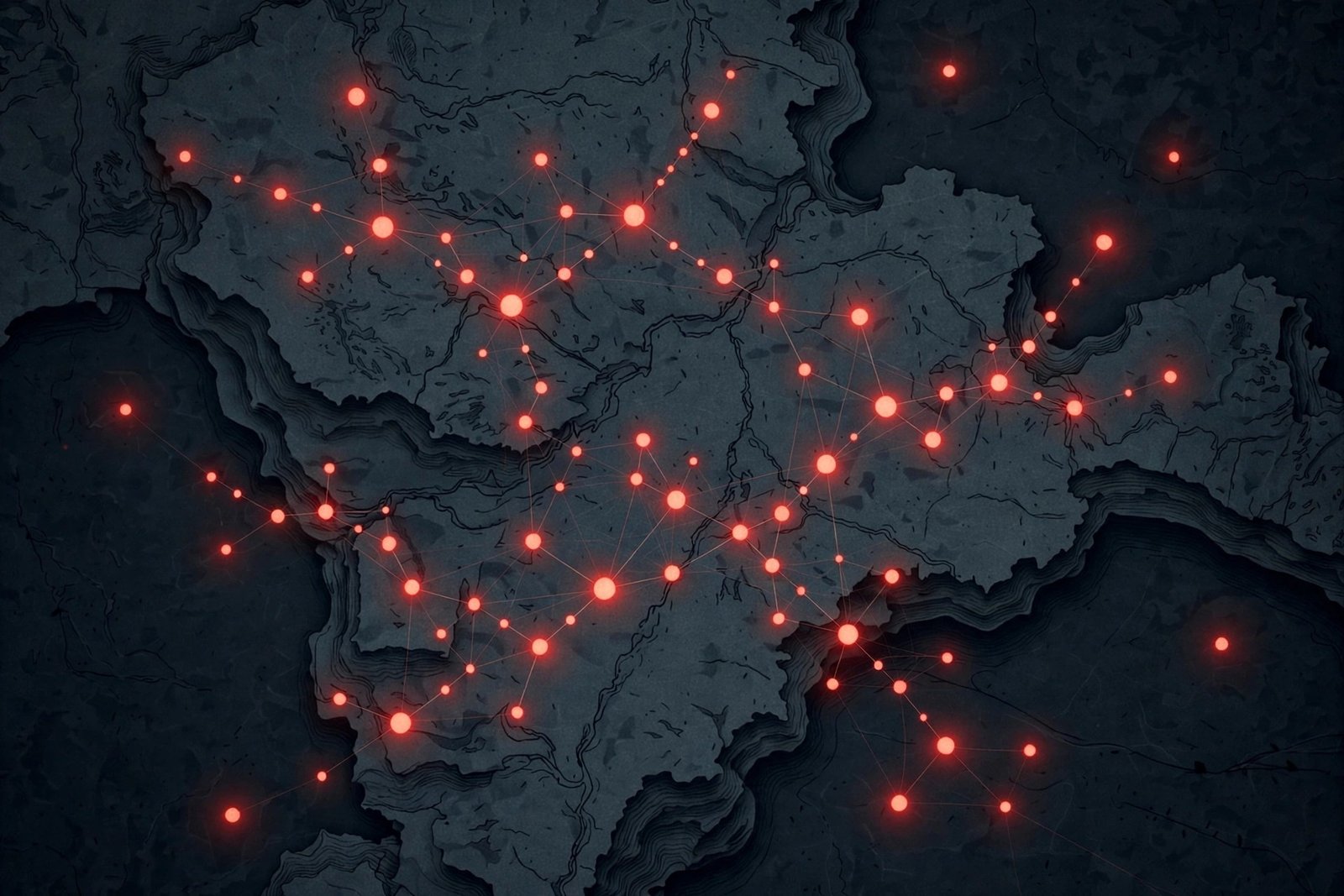
Fewer than one in four new Ebola cases in Congo comes from a person already known to have been in contact with an infected patient. The rest arrive from chains the response has not found. The counted outbreak passed 10,193 confirmed cases and 4,960 deaths in the European Centre for Disease Prevention and Control’s update of October 29. That already makes it the country’s largest Ebola outbreak on record. Those are the cases with names, lists and beds attached, and the response’s own reports say they are now the smaller half of the story.
The ECDC figures, drawn from data through October 27, put the case fatality rate at 48.7 percent. The two latest counts show how fast the counted side is still growing. The Congolese public-health institute’s report for October 25 listed 10,060 cases and 4,887 deaths, so 133 cases and 73 deaths were added in two days. That pace matches the 400 to 500 new cases a week that specialists have called a plateau. The word describes the shape of the curve. It says nothing about the search. Eight provinces and 66 health zones have now reported cases, and Ituri alone accounts for 7,040 of the 9,704 cases the World Health Organization counted through October 20, more than seven in ten.
WHO‘s October 23 update lists 30,130 contacts under follow-up across six provinces. Teams saw 24,017 of them in the previous 24 hours, a rate of 79.7 percent against the 95 percent threshold the response sets for itself. That leaves 6,113 listed contacts unvisited in a single day. The weakest province, Nord Kivu, managed only 73.3 percent, while only Bas-Uélé and Sud-Ubangi cleared the bar. Of the 482 deaths added since WHO’s previous update, 307 happened in communities and 175 in treatment centres. Nearly two thirds of the recently dead never reached care at all, and their contacts were never listed in the first place.


In Bafwasende, in Tshopo province, a nurse was killed and another health worker seriously wounded on Saturday, October 24, after local youths accused them of trying to infect residents with tablets, according to AFP reporting. The treatment centre where they worked has since shut down. The zone then filed no data at all in the Congolese situation report, a blank where a health zone should be. “Part of the community does not fully believe that Ebola disease exists,” Nicodeme Kabuyaya, the Doctors Without Borders deputy project coordinator in the area, said in an MSF statement, adding that community outreach was the top priority to stop the epidemic spreading. A response that cannot enter a village cannot list its contacts, and a zone that files nothing still counts its dead somewhere else.
Nord Kivu, the province with the highest fatality rate at 55.9 percent, is where the strain on care is most visible. “It is like fighting a megafire,” Stephanie Hoffmann, coordinator of the MSF Ebola treatment centre in Butembo, said in early October, when her organisation warned that treatment capacity in the province was stretched to its limit. As of September 28, MSF said, 34 percent of confirmed patients in Nord Kivu were being treated in non-specialised facilities because dedicated beds were full or diagnosis came late. The province has also produced new cases in Kayna and Alimbongo, in territory under AFC/M23 control, where an MSF mobile team arrived on October 6 after nine confirmed cases were flagged on October 2. Road closures imposed as part of the response complicate the supply of essential goods to communities already cut off by fighting.
Kenya’s imported case travelled from Congo by road through Uganda and flew to Nairobi on October 3. The patient died on October 5, and produced eight secondary cases, four family members and four health workers, all of whom were already in quarantine when symptoms began. Kenyan authorities traced and quarantined all 135 contacts, screened 709,093 travellers by October 22, and have reported nine cases in total. Nigeria’s imported case developed symptoms on October 7, sought care in Abuja on October 11 and tested positive on October 20. That patient was medically evacuated to Switzerland on October 26 with a close contact, while 62 contacts were under follow-up and the source of infection remained unidentified. Four more patients have been evacuated or imported to Europe since May, two to Germany, one to the Netherlands and one doctor in France, and a British resident was evacuated after potential exposure. The October 3 date matters for another reason: on that same day, our own earlier reporting covered two passengers cleared at two airports, and the screening question that piece raised is no longer hypothetical, because the Kenya case flew that day and the chain behind it is still being reconstructed.
Governments abroad are now building machinery for the outbreak they can see. The US Centers for Disease Control and Prevention signed an order on October 22 requiring every passenger on an international flight to the United States to attest, from November 3, that they have not been in Congo in the previous 21 days. Airlines must refuse boarding to anyone who does not sign, and the order runs to December 18. Uganda has imposed a 21-day quarantine on returning citizens with recent Congo travel, and the ECDC has deployed three experts to Nigeria. WHO, for its part, advises against any restriction on travel or trade with affected countries. Its regional director for Africa, Mohamed Janabi, described the situation at a briefing as a more complex outbreak landscape than the single-country emergency the border measures imply. The attestation form asks about a country, not about a chain, and a chain nobody has traced cannot be declared on any form.
The TUMAINI trial, a Phase 2/3 study launched in Bunia on October 23, is testing Ervebo, a vaccine licensed against the Zaire strain of Ebola, against a virus it was never designed for. WHO says the trial measures whether it reduces severe illness or death rather than whether it prevents infection. Bundibugyo-specific candidates from Oxford and Moderna are expected to join the trial, but the Oxford candidate is still in Phase 1 safety testing. Researchers told ThePrint that even on the fastest timelines no vaccine would be ready for deployment within six to nine months. There is no licensed vaccine and no specific treatment for Bundibugyo disease, so until the trial reports, the response has only the tools that are already failing to find three quarters of new cases.
Bundibugyo’s history explains part of why the counted outbreak started late. The virus caused an outbreak in Uganda in 2007 with a 30 percent fatality rate and another in Congo in 2012 at 50 percent. The current outbreak was declared on May 15 even though medical evidence suggests infections were occurring months earlier, in part because initial testing was geared toward the Zaire virus rather than the related Bundibugyo strain. The West Africa outbreak of 2014 to 2016 remains the largest on record, with more than 28,000 infections and 11,000 deaths. But the current outbreak has already produced roughly three times the cases and deaths in the time since its declaration that West Africa had at the same point, according to AP’s comparison. Fifty of the 66 affected health zones reported at least one new case in the 21 days before October 20, and the October 25 situation report listed 2,684 recoveries against 10,060 cases.