NFL Week 6 Film: Stafford’s Deep Ball Collapse, Cowboys’ Scheme Flaws
Schematic breakdowns expose the Rams' vertical passing collapse, Dallas' protection failures, and Chicago's multi-tight end evolution.
The Los Angeles Rams rank fourth in the NFL this season in both rushing success rate (56%) and pass protection, allowing pressure on just 26% of dropbacks. They employ Puka Nacua, one of the league’s most productive receivers, and Davante Adams remains a premier isolation threat when healthy. Yet through six weeks of the 2026 season, Los Angeles has fallen out of the top tier of passing offenses. The culprit is not personnel or scheme. It is Matthew Stafford abandoning the deep ball.
Stafford’s reluctance to push the football downfield represents the most significant schematic shift in the NFL this year. In 2025, the Rams led the league with an 18% explosive pass rate, attempting throws of 20 or more air yards outside the red zone on 18% of their dropbacks—the third-highest mark in football. This season, that figure has cratered to 11%, ranking 23rd. The explosive pass rate has dropped to 14th overall. Instead of challenging safeties, Stafford is consistently checking down to Tyler Higbee or Kyren Williams early in his progressions, opting for low-risk completions over high-reward shots.
This conservatism extends directly into the play-calling. According to game charting, the Rams have dialed up a screen pass on 15% of third downs requiring three or more yards—trailing only the Minnesota Vikings and Denver Broncos. The league average sits at 7%. When factoring in run calls on those same downs, nearly a quarter of Los Angeles’ critical third-down plays signal a coaching staff that no longer trusts its quarterback to attack vertically. With Adams sidelined for the next six to ten weeks, the Rams lack the outside threats—relying instead on Konata Mumfield, Jordan Whittington, and TuTu Atwell—to stretch the field, exposing a roster construction flaw that typically requires a midseason trade to fix.

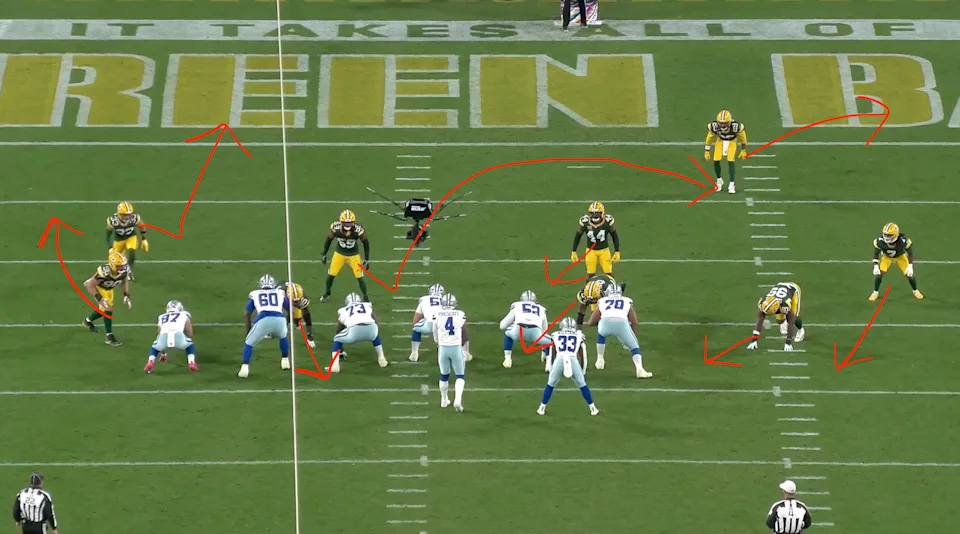
Dallas faces a parallel schematic crisis, though driven by defensive manipulation rather than quarterback hesitation. The Cowboys’ offensive infrastructure carries two structural flaws dating back to 2025: targets to running backs, fullbacks, and tight ends average a league-worst 6.8 yards per reception and rank 27th in expected points added (EPA) per target. Ground attempts reaching 10 or more yards occur on just 9.8% of carries, ranking 28th. Javonte Williams provides short-yardage reliability, but neither he nor Jake Ferguson generates production after the catch. Consequently, Dak Prescott and his wide receiver trio must operate near perfection to sustain the unit.
They failed to do so against Green Bay. Packers defensive coordinator Jonathon Gannon dismantled Dallas’ protection rules by disguising coverages and rotating defenders post-snap. Prescott recorded six plays ending in an interception or throwaway—his worst single-game total since 2025. The red-zone interception thrown by Prescott was the direct result of safety Evan Williams bailing from a blitz look into a quarters coverage shell, reading out the backside of the play. As Yahoo Sports analyst Nate Tice noted, the specific “4 weak pressure” package stressing the running back side of the protection has repeatedly compromised the Cowboys’ blocking assignments. Even with left guard Tyler Smith returning from injury, Dallas lacked a counter-plan to exploit the intermediate and deep zones against Green Bay’s elite safety group.
In Philadelphia, the Eagles are navigating a severe offensive line breakdown at left guard and center by leaning heavily on backup quarterback Tanner McKee. Separating McKee’s individual performance from the surrounding roster issues reveals a highly efficient processor operating between the hashes. Since 2024, McKee has targeted the 0-to-20-yard middle-of-the-field range on 29% of his dropbacks, completing 86% of those passes for 9.6 yards per attempt without throwing an interception. By comparison, Jalen Hurts targets that same area on 24% of his dropbacks, yielding 8.3 yards per attempt and a 76% completion rate.
McKee does not possess Hurts’ scrambling ability or capacity to escape unblocked pressures—a necessary skill given Philadelphia currently holds the worst under-center success rate in the NFL. However, as a rhythm passer who manipulates zone defenders and delivers accurate sideline throws to Devonta Smith, McKee’s floor appears remarkably stable. For the Eagles to maximize him midseason, they likely need to abandon under-center formations entirely and operate exclusively out of spread alignments.

Chicago’s offensive adjustments following Caleb Williams’ return from a hamstring injury offer a contrasting example of successful schematic adaptation. The Bears deployed multiple tight end sets on 33 snaps in Week 6, the fifth-highest total by any offense this season. Rookie Colston Loveland functioned as a hybrid receiver within these packages, scoring a 14-yard touchdown and converting a 16-yard first down on play-action—all while operating as the primary read ahead of other targets. His usage profile ranked fourth among all tight ends for the week.

Elsewhere on film, New York Giants wide receiver Malik Nabers showed no lingering effects of his knee injury, displaying elite route agility and open-field burst alongside quarterback JJ McCarthy, whose arm talent and athleticism project favorably over Jameis Winston. Kansas City’s Xavier Worthy fully absorbed Rashee Rice’s vacated underneath role, operating as the primary short-area target while other receivers ran clear-out routes. Tennessee rookie Carnell Tate delivered his best tape of the season, showcasing sideline body control and a reliable catch radius on fade balls. Finally, San Francisco strong safety Malik Mustapha continued to establish himself as the most physically imposing defender in the league on a pound-for-pound basis.