China’s Treasury Holdings May Be $500B Higher Than U.S. Data Shows
Analysts say Beijing is routing hundreds of billions in U.S. debt through Canadian and European custodians to mask its true exposure.
Official U.S. figures showing China’s Treasury holdings plunging to an 18-year low of $591 billion in August obscure a massive rerouting of those assets through custodian banks in Canada and Europe, according to former Treasury officials and market analysts.
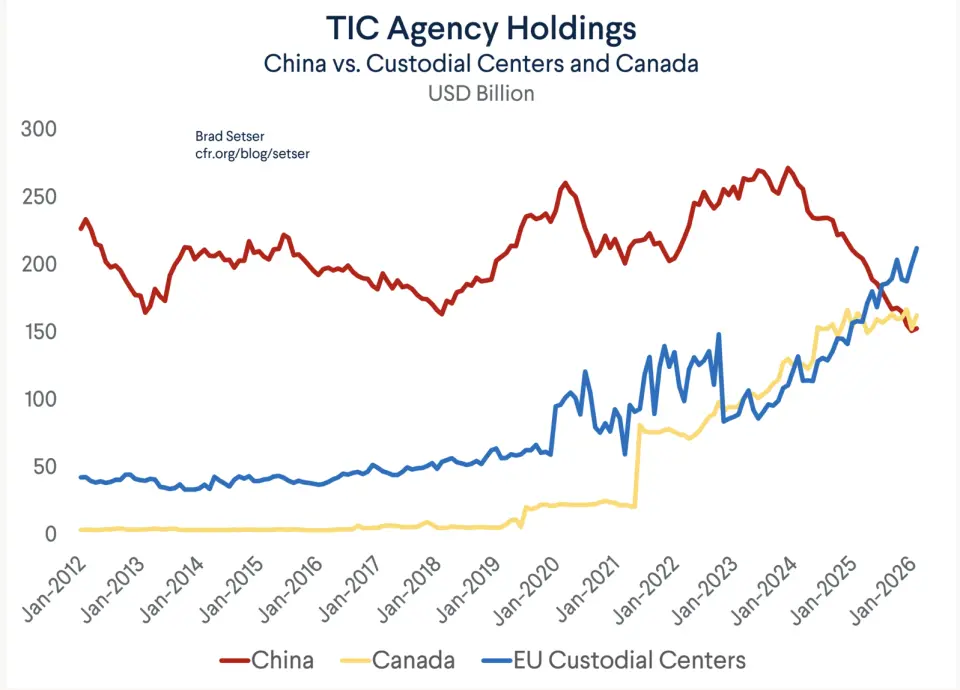
The gap between Beijing’s reported selloff and its actual exposure could be as large as $500 billion. Brad Setser, a senior fellow at the Council on Foreign Relations and former Treasury official, said Wednesday that China is likely using multiple non-U.S. custodians to mask its true holdings.
Treasury Department data relies primarily on U.S.-based custodians and broker-dealers. Securities held in overseas custody accounts often fail to register under their actual owners. That blind spot has widened significantly since 2021.


Canada’s Treasury holdings hit $465 billion in August, up from $169 billion five years earlier. Belgium’s stockpile nearly doubled over the same span to $490.5 billion. When bonds backed by federal housing agencies are included, the totals climb further. Setser noted that adding China’s direct holdings to those parked in Canadian and European custodial centers yields an adjusted total potentially reaching $500 billion. A narrower calculation focusing only on Canada, Luxembourg, and France since 2022 still adds roughly $300 billion to Beijing’s official tally.
“The evidence that China uses a Canadian custodian for some of its Agencies is especially strong — note the sudden jump in Canada’s holdings and the big impact of the detailed June survey at some early points,” Setser posted on X while highlighting reporting on the subject. He added that both the Treasury and agency portfolios require adjustment for bonds kept in Canadian and European custody.
The mechanics of this shift trace directly back to China’s export engine. Despite escalating trade friction with Washington, Beijing posted a record $1.2 trillion trade surplus in 2025, growing three times faster than global goods trade. The first nine months of 2026 pushed that surplus to $938 billion. Stagnant domestic demand and a prolonged property crash have forced Chinese manufacturers to rely almost entirely on foreign buyers.
Those dollars must be recycled. Rather than liquidating them—which would crash the yuan and undercut the very exports generating the revenue—the People’s Bank of China appears to be shifting custody arrangements offshore. This allows Beijing to reduce its visible footprint in U.S. financial data without triggering the currency volatility that accompanies outright dumping.
U.S. sanctions against Russia following its 2022 invasion of Ukraine accelerated central bank diversification away from dollar reserves toward gold. President Donald Trump’s trade war targeting China provided additional incentive to decouple. Yet Setser estimated that even with these pressures and a deliberate pivot toward short-term bills over long-term Treasuries, China’s total U.S. financial holdings remain between 50% and 55% of its reserve portfolio.