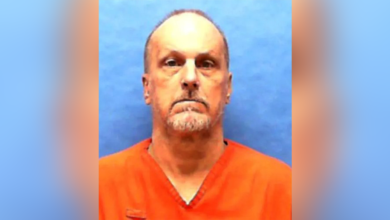
Ex-Chicago Detective ID’d as Killer in 1960 Girl’s Murder
Investigators are now reviewing other cases handled by Thomas McInerney Jr. during his 28-year career on the force.
A man who spent nearly three decades investigating homicides for the Chicago Police Department has been identified as the killer of an 8-year-old girl whose 1960 abduction and murder remained unsolved for more than 65 years.
Thomas F. McInerney Jr., who joined the force in 1959 and eventually rose to the rank of homicide detective, murdered Gloria Kowalewicz just months after beginning his law enforcement career, authorities confirmed Thursday. McInerney died in 2006 at age 70 without ever facing charges.
The identification raises immediate concerns within the Cook County State’s Attorney’s Office, which is now reviewing other violent crime cases McInerney handled or had access to during his 28-year tenure with the department before his retirement in 1987. The prospect that a sitting homicide detective may have manipulated investigations, buried evidence, or committed additional crimes while carrying a badge has prompted a sweeping look back at his caseload.


Gloria vanished on the morning of Nov. 12, 1960. She left her home shortly before 8 a.m. to walk a few blocks to morning Mass at St. Mary of Mt. Carmel Church. Roughly four hours later, her body was found in a ditch at a forest preserve southwest of the city. She had been shot.
The original investigation was massive by mid-century standards. Detectives interviewed more than 1,300 people and canvassed hundreds of homes. Yet the case stalled entirely. At the time, forensic science relied heavily on blood typing and basic fingerprint matching against known suspects. Without a direct match in existing files, physical evidence often reached a dead end.
What ultimately broke the case was the preservation of that physical evidence. Investigators in 1960 retained a bullet recovered from the scene, Gloria’s coat and shoes, and a white communion purse containing her prayer book. A single fingerprint lifted from the purse’s strap survived decades in storage.
Modern investigative genetic genealogy — a technique that gained prominence following the 2018 capture of the Golden State Killer — allowed investigators to build a family tree from degraded biological material. By partnering with the FBI and Illinois State Police, Chicago detectives matched the DNA profile and the preserved fingerprint directly to McInerney.
Forensic laboratories such as Othram, based in Texas, have pioneered these sequencing methods, routinely extracting usable genetic profiles from trace amounts of biological material that would have been useless to 20th-century crime labs.
McInerney’s trajectory after leaving the Chicago police force took him out of state. He eventually worked for the Federal Public Defender’s Office in Nevada, remaining in the legal system until his retirement in 2004. His employment in a federal defender role means he had continued access to sensitive legal proceedings and criminal justice infrastructure long after his policing days ended.
Chicago police condemned their former colleague in a statement, saying McInerney “should never have worn the CPD star” and acknowledging the devastation of realizing he evaded accountability for the rest of his life.
Gloria’s parents died without knowing who killed their daughter. The Cook County State’s Attorney’s Office is currently working to determine the full scope of McInerney’s involvement in other cases across his nearly three-decade career.