

Tech Stocks Plunge Globally as U.S. Inflation Hits 3.7%
Rising energy costs and a stalling labor market outside healthcare compound fears that prolonged high rates will fracture the AI investment boom.
A violent repricing of risk swept through global markets Thursday after September inflation data shattered expectations, forcing investors to confront a Federal Reserve that may have no choice but to tighten monetary policy further.
The consumer price index accelerated to 3.7% last month from 3.4% in August, defying consensus estimates and reigniting fears that the central bank’s fight against rising prices is far from over. The hotter-than-expected reading immediately erased hopes for a pause at the Fed’s upcoming meeting. Markets are now pricing in a 50 percent probability of another rate hike in October, according to Pimco economist Tiffany Wilding, a sharp reversal from prior expectations that policymakers would hold steady.
The inflation surprise triggered indiscriminate selling in technology equities, the sector most sensitive to shifts in the cost of capital. South Korea’s KOSPI plummeted nearly 8%, triggering temporary trading halts. Japanese stocks followed with a 4.9% drop in the Nikkei 225, while Nasdaq futures pointed to a 1.03% decline at the New York open. S&P 500 futures fell 0.24% premarket after the benchmark index lost 1.11% on Wednesday.


Heavyweights across the semiconductor and cloud infrastructure space absorbed severe losses. CoreWeave plunged 15.46% during regular trading and extended those declines by 5.89% overnight. Oracle dropped 8.83%, slipping another 1.57% after hours. Chipmakers broadly retreated even as Taiwan Semiconductor Manufacturing Co. reported third-quarter earnings that exceeded Wall Street targets and projected increased capital expenditures over the next two years. Apple closed at a record high, becoming only the second company after Nvidia to reach a $5 trillion market capitalization, but the milestone did little to stabilize broader sentiment. Anthropic separately disclosed adjusted profitability, though its $17 billion in third-quarter revenue suggested growth was decelerating compared to earlier projections.
Higher borrowing costs threaten to choke off the artificial intelligence investment boom that has propped up corporate spending throughout the year. Mark Zandi, chief economist at Moody’s Analytics, warned that if elevated rates persist beyond a quarter or two, the AI buildout could become the specific area of the economy that fractures. Rising capital costs make massive data center investments significantly more expensive, while declining valuations complicate fundraising for startups and established tech firms alike.
The pressure on the real economy is already visible beneath the surface of headline employment figures. Outside of healthcare, monthly payroll growth has averaged roughly zero over the past year, according to Zandi. Overall job creation has hovered around 40,000 per month, masked by an unemployment rate that remains artificially low due to shrinking labor force participation driven by retirements and reduced immigration.
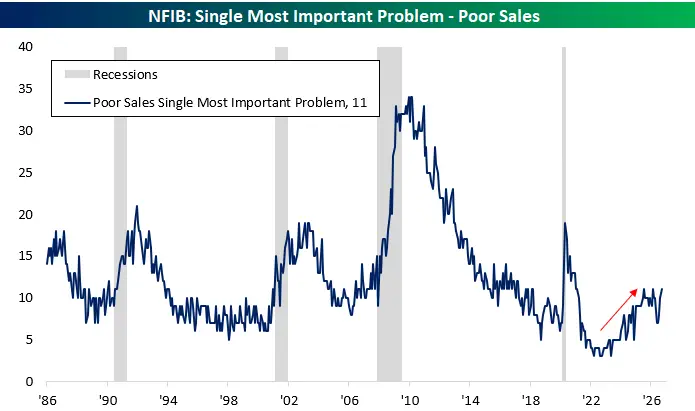
Small businesses are sounding early alarms about deteriorating demand. Bespoke Investment Group flagged a troubling shift in the National Federation of Independent Business survey, where owners increasingly cited poor sales as their primary operational challenge. Historically, spikes in this specific metric have preceded economic contractions. The NFIB optimism index slipped to 97.9 in September from 98.7 in August. Pantheon Macroeconomists Samuel Tombs and Oliver Allen noted that broader business surveys indicate activity lost momentum late in the third quarter, burdened by rebounding global energy prices. They also cautioned that the NFIB survey’s respondent pool has shrunk to 411 companies, down from approximately 1,200 a decade ago, potentially amplifying volatility in the readings.
Energy costs remain a stubborn driver of price pressures. Brent crude traded at $106 per barrel, sustained by ongoing geopolitical conflicts that constrain supply. Jamie Cox of Harris Financial Group argued that the current inflation impulse stems directly from these energy shocks, warning that the Federal Reserve risks repeating its earlier error of misjudging price dynamics—this time underestimating the persistence of supply-driven inflation rather than dismissing it as transitory.
The bond market reflected deep uncertainty about the trajectory of interest rates. The yield on the benchmark 10-year U.S. Treasury swung wildly between 5.32% and 5.08%, an unusually large intraday range for government debt. Investors struggled to determine whether Treasuries should function as a safe haven amid equity turmoil or require a higher risk premium to compensate for sticky inflation.
European markets opened mixed, with the Stoxx 600 down 0.10% and the U.K.’s FTSE 100 gaining 0.48%. India’s Nifty 50 advanced 1.68%, bucking the regional trend, while China’s CSI 300 fell 1.23%. Bitcoin dropped to $81,265.









