
Regulatory Clock Ticking: U.S. Crypto Markets Brace for Major Shifts Within 30 Days
Coinbase CEO: Regulatory Clarity Coming Within 30 Days as Senate Vote Nears

WASHINGTON — The U.S. Senate is scheduled to hold a vote on Sept. 15 on the Clarity Act, legislation designed to establish comprehensive statutory oversight for digital asset markets. Coinbase Global Inc. Chief Executive Officer Brian Armstrong stated during an interview on CNBC’s “Squawk Box Asia” that federal regulators and lawmakers are preparing to finalize long-awaited rules. The primary remaining hurdle in Senate negotiations centers on ethics guidelines regarding digital asset ventures associated with the sitting U.S. president’s family.
Should Congress fail to pass the Clarity Act, federal financial regulators are moving to establish rules through existing administrative powers. Armstrong emphasized that regulatory clarity will take effect within 30 days regardless of whether the Senate measure passes. Both the Securities and Exchange Commission (SEC) and the Commodity Futures Trading Commission (CFTC) have prepared formal rulemakings and innovation exemptions.
The bill has gained broad momentum among lawmakers, traditional banking institutions, digital asset companies, and law enforcement organizations, according to Armstrong. Coinbase previously raised operational concerns regarding earlier drafts of the bill, but Armstrong noted those issues have been resolved. While the White House offered an ethics framework covering presidential family holdings, congressional Democrats have insisted on full divestiture. Negotiations over the ethics language remain active as lawmakers attempt to reach a compromise ahead of the vote.

Industry leaders point to last year’s passage of the Genius Act, which established federal standards for fiat-backed digital assets, as a blueprint for market expansion. In the three months following the enactment of the Genius Act, more than 150 major corporations integrated stablecoin payment settlement systems into their operations. Clearer regulatory guidelines would allow U.S.-based trading venues to launch a broader suite of financial services.
Coinbase has been positioning its infrastructure to become an “everything exchange,” integrating traditional spot asset trading, tokenized securities, and complex derivatives under a single regulated umbrella. In May, Coinbase became the first U.S. exchange to receive regulatory authorization to offer crypto perpetual futures—derivative contracts without fixed expiration dates that allow investors to trade leveraged positions continuously. In June, the company outlined plans to launch tokenized stock trading featuring automated dividend distributions directly on the blockchain.
Armstrong contrasted Coinbase’s structured equity model with offshore competitors that offer equity derivatives or contractual IOUs. Coinbase is also planning to offer options contracts across both digital tokens and traditional equities. The product rollout follows a broader market downturn that impacted corporate earnings across the digital asset sector. Coinbase previously reduced its total workforce by 14 percent and missed financial expectations in its second-quarter earnings report as overall trading volumes declined.
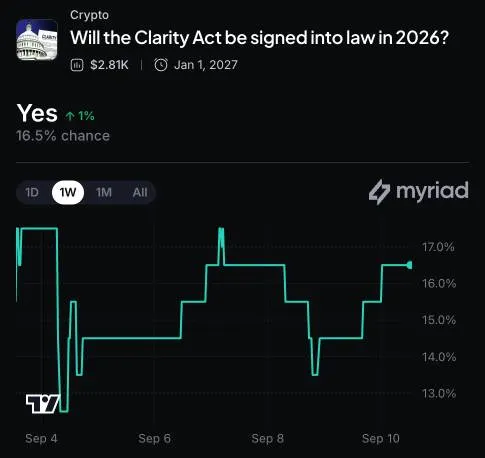
Despite Armstrong’s confidence in legislative progress, sentiment on prediction market platform Myriad—owned by Decrypt’s parent company Dastan—remains cautious, with users assigning a 17 percent probability that the Clarity Act will be enacted into law.
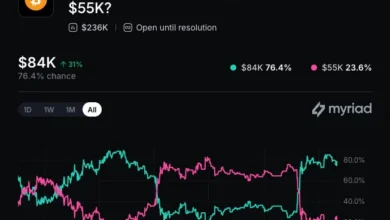
Addressing broader market cycles, Armstrong stated that Bitcoin has likely passed the bottom of its latest downward cycle, rebounding from earlier lows near $60,000. Bitcoin traded at approximately $77,015 on Thursday, down 2.32 percent over a 24-hour window that saw prices fluctuate between $77,719 and $79,606 on daily volume of $1.2 billion. Bitcoin historically operates on a four-year cycle tied to its underlying network mechanics, characterized by market run-ups followed by approximately one year of price consolidation.
The network’s next halving event—which automatically cuts the reward for mining new blocks by 50 percent every 210,000 blocks—is expected in approximately 18 months. Armstrong noted that historical price cycles show market appreciation typically accelerates in the period leading up to halvings, projecting favorable conditions for the digital asset market over the next one to two years. He reiterated his long-term price forecast, stating that a Bitcoin valuation of $400,000 by 2030 remains a “reasonable target.” Reaching that level would represent more than a fivefold increase from current trading levels over the next three years.