TikTok Food Hacks Tested: Which Viral Tricks Actually Work?
From cinnamon roll waffles to Kool-Aid pickles, a breakdown of the science and failures behind 17 viral internet recipes.
Canned cinnamon rolls pressed into a waffle iron, Jell-O shattered into chewy boba pearls, and cheese melted into taco shells emerged as the only genuinely useful techniques after chef Nick DiGiovanni and YouTuber Faze Rug stress-tested 17 viral TikTok food hacks in a joint kitchen experiment.
The collaboration targeted a persistent friction point in modern cooking content: the gap between visually satisfying short-form videos and functional recipes. Millions of food clips circulate on TikTok daily, but very few survive contact with a real kitchen. DiGiovanni, a former MasterChef Junior finalist who built a digital media empire around high-production culinary content, partnered with Faze Rug, whose channel commands over 23 million subscribers primarily through challenge and prank formats, to separate practical shortcuts from engagement bait.
Several experiments revealed legitimate culinary mechanics disguised as internet stunts. Pressing store-bought canned cinnamon roll dough into a heated waffle maker produced a structurally sound, evenly caramelized pastry that held frosting better than traditional baking methods. The hack works because waffle irons apply direct, dual-sided conductive heat, accelerating the Maillard reaction — the chemical process responsible for browning and flavor development — far more efficiently than a standard oven.

Similarly, melting shredded cheese directly on a skillet or baking sheet until crisp, then draping it over a mold to cool, yielded a sturdy, low-carb taco shell. This technique mirrors established ketogenic cooking practices, relying on the structural integrity of coagulated casein proteins once moisture evaporates from the dairy.
A Jell-O-based boba alternative proved unexpectedly viable. Setting gelatin firmly in a glass, layering milk on top, and piercing the mixture with a wide boba straw fractured the gelatin into chewy, fruit-flavored spheres. Traditional bubble tea relies on tapioca starch extracted from cassava root to achieve its signature texture. The gelatin method bypasses the boiling and kneading required for authentic tapioca pearls while delivering a comparable mouthfeel through protein-based gels rather than starch-based ones.
Other tests exposed the limits of algorithmic recipe design. Popping Skittles alongside corn kernels generated colorful popcorn coated in a sour, synthetic residue. The candy’s sugar and citric acid burned at the high temperatures required to pop corn, which typically exceeds 350 degrees Fahrenheit. Tossing McDonald’s chicken nuggets in a bag with dipping sauce achieved full coverage but created unnecessary mess compared to standard dipping. Drawing shapes in a hot skillet with a raw garlic clove to contain a cracked egg failed repeatedly; the garlic oils were insufficient to break the surface tension of the egg whites, causing them to spread immediately upon hitting the pan.
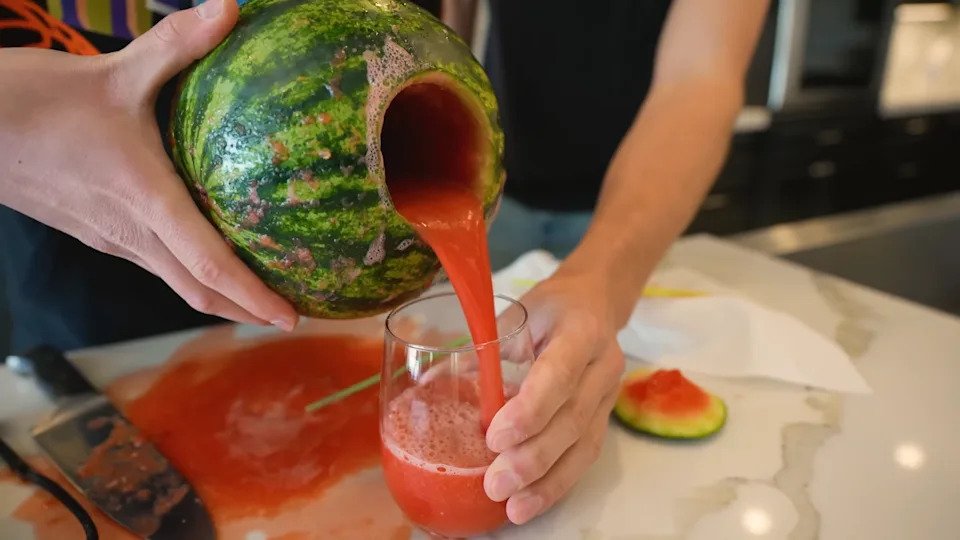
Some successes relied on basic physics repackaged as novelty. Using an immersion blender inside a hollowed watermelon effectively turned the fruit into a self-contained juice dispenser. Pouring pancake batter through a thoroughly washed ketchup squeeze bottle allowed for precise portion control and uniform shapes, a method long used by commercial diners employing commercial batter dispensers.
The duo also tested a fizzy milk beverage combining 7UP, ice, and citrus. While seemingly unappetizing to Western palates accustomed to curdling warnings regarding dairy and acid, carbonated milk drinks have deep roots in Middle Eastern and South Asian culinary traditions. Iranian Doogh and Indian lassi variations frequently incorporate carbonation or acidic mix-ins, stabilizing the dairy through specific preparation ratios.
Baking bread using only melted ice cream and self-rising flour technically succeeded. Self-rising flour contains pre-mixed baking powder and salt, while melted ice cream supplies the necessary fat, sugar, and liquid to form a crumb structure. Corn on the cob quartered lengthwise into “ribs” and roasted curled into heavily caramelized strips, maximizing surface area for seasoning adhesion. Blended Oreo cookies rolled with their own creme filling and sliced mimicked sushi aesthetics, and stacking Fruit Roll-Ups before freezing them created a dense, layered confection similar to fruit leather.
Kool-Aid pickles, a regional Southern delicacy historically known as “Koolickles” that originated in Mississippi Delta convenience stores, delivered vibrant red coloring but polarizing flavor results when replicated with standard dill spears.
Not every trend requires specialized equipment. Inverting a bell pepper and slicing along its natural vertical grooves allows the flesh to peel away cleanly from the core, eliminating seed scatter and reducing prep waste without any tools beyond a standard paring knife. A foaming soap pump dispenser successfully aerated milk into microfoam suitable for coffee, utilizing the same mechanical mesh screen found in dedicated handheld frothers sold for three times the price.
DiGiovanni continues to release weekly culinary challenges across YouTube and TikTok, frequently collaborating with other digital creators to test unconventional cooking methods.