Ukraine Disables 51% of Russian Oil Refining Capacity
Kyiv deploys AI-controlled turrets against jet-powered drones as cross-border shelling hits a Moldovan checkpoint
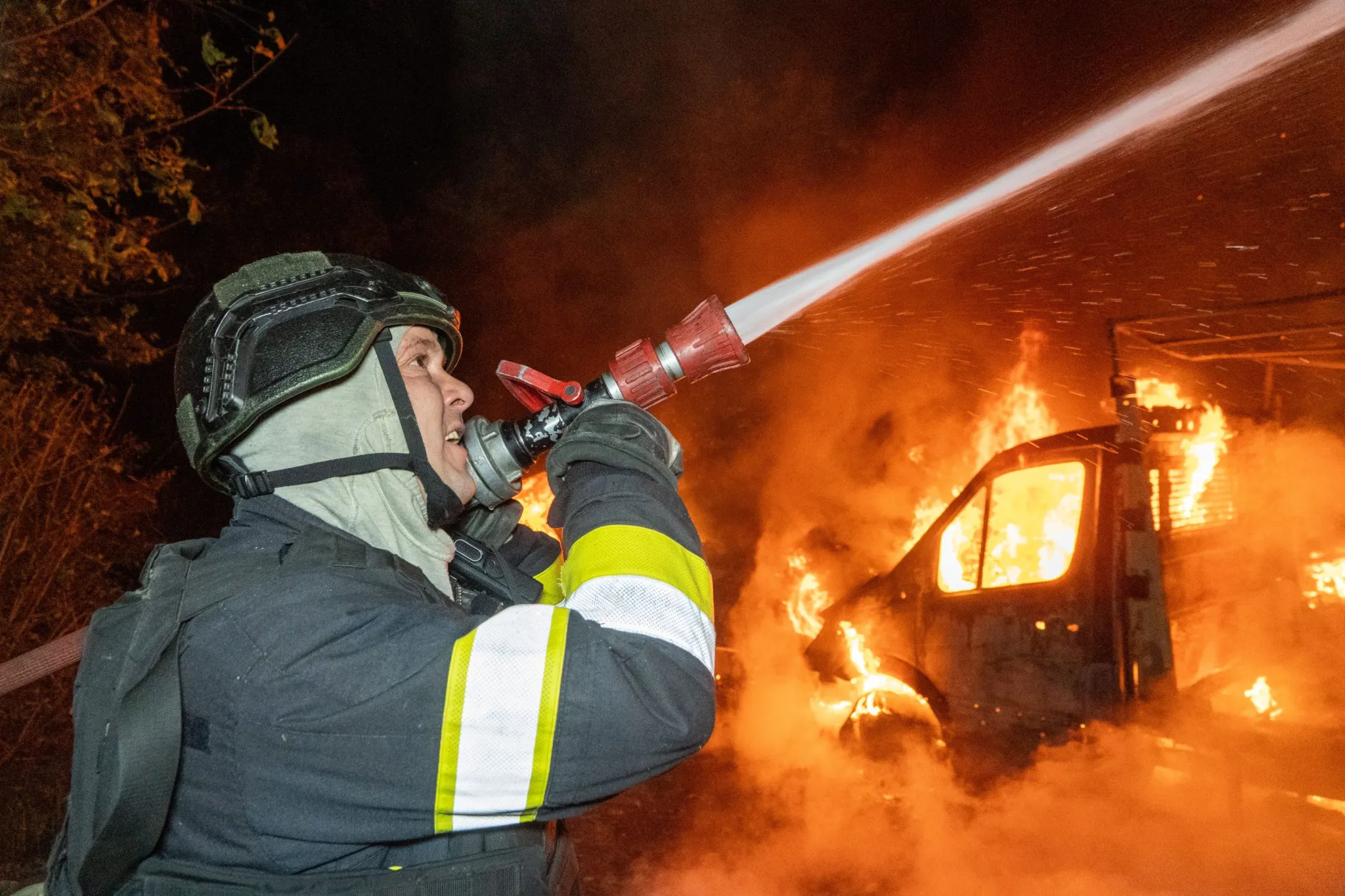
Ukrainian long-range drone strikes have knocked out more than half of Russia’s oil refining capacity, according to Kyiv’s Defense Ministry, inflicting structural damage on an industry that funds Moscow’s war effort and supplies its military logistics network.
Defense Minister Yevhenii Khmara said late Sunday that coordinated assessments by Ukrainian intelligence services and the General Staff confirmed 51% of Russian refining infrastructure is now non-operational. The strikes targeted facilities across a vast geographic footprint, including plants in Moscow, Yaroslavl, Ust-Luga, Perm, Saratov and Syzran. While independent verification remains difficult due to restricted access to Russian industrial sites, President Vladimir Putin acknowledged on Oct. 1 at the Valdai Club forum that the campaign had cost Russia roughly 1% of its gross domestic product.
Russia historically ranks as the world’s third-largest producer of refined fuel products from crude, trailing only the United States and China. The sustained attrition of its 32 refineries has disrupted that position. According to the International Energy Agency, some individual plants have been struck up to 15 times since the invasion began in February 2022, with attacks occurring at a pace of one every three days in recent months. This relentless cycle prevents full repairs, forcing operators into emergency patching that degrades processing units over time.


The most consequential Ukrainian targeting shift has focused on secondary processing equipment — specifically catalytic cracking and hydrotreating units responsible for removing impurities from crude oil to produce usable diesel and high-octane gasoline. Unlike primary distillation columns, which can sometimes be bypassed or repaired relatively quickly, these complex units require specialized Western-manufactured components subject to international sanctions. Sourcing replacements through intermediaries takes months. As a result, the IEA reports Russian diesel output has plummeted by approximately 30%.
To manage severe domestic shortages, Russian authorities imposed restrictions on gasoline sales earlier this year. Drivers in some regions faced wait times of up to 40 hours at fuel stations. Refiners attempted to compensate by delaying scheduled maintenance, reactivating mothballed Soviet-era units, and lowering official fuel quality standards to maintain volume — a stopgap that risks damaging civilian engines and disabling vehicle emissions control systems.
The Kremlin also banned diesel exports to keep fuel inside the country, a move that tightened global supply and pushed international prices higher. The resulting market volatility prompted U.S. President Donald Trump on Sept. 13 to urge Ukraine to halt its refinery campaign, highlighting how Kyiv’s asymmetric strategy has generated diplomatic friction even among its allies.
As the ground war along the 1,200-kilometer front line remains largely static, both militaries have escalated aerial operations. Russia launched 205 drones overnight into Monday, according to Ukraine’s air force, which reported intercepting or suppressing 172 of them. Russian forces continued targeting Ukrainian energy grids and port infrastructure, claiming strikes on an electrical substation in the Kharkiv region alongside maritime vessels used by Kyiv’s military.
In Kharkiv, a guided aerial bomb destroyed a residential building on Monday, killing at least one person and wounding 10 others, Mayor Ihor Terekhov said. Search and rescue teams were digging through rubble for potential survivors. A separate drone strike on the city’s Industrialnyi district late Sunday killed another resident and ignited vehicles and administrative buildings.
To counter increasingly fast Russian threats, Ukraine deployed a new defensive technology in its capital. Presidential adviser Serhii Beskrestnov confirmed the installation of 12 automated turrets in Kyiv equipped with artificial intelligence and machine vision designed to track and engage targets without human intervention. Ukraine’s air force stated the robotic guns successfully shot down Russian jet-powered Geran-5 drones for the first time, marking a significant milestone in autonomous air defense integration. Air force spokesman Yurii Ihnat noted that the AI-driven tracking systems are specifically calibrated to handle the higher speeds of jet-propelled munitions compared to traditional propeller-driven Shahed variants.
The widening scope of Russian bombardment also affected neighboring Moldova on Monday. Operations at the Palanca-Mayaky-Udobne border crossing were suspended after a shell fired during a Russian attack on Ukrainian infrastructure skipped off the ground and struck a parked passenger bus near the checkpoint barrier. Moldovan Border Police reported minor injuries to one employee and damage to a security booth, advising travelers to avoid the area.