Netflix’s ‘East of Eden’ Miniseries Restores Cathy Ames to the Center of Steinbeck’s Epic
Screenwriter Zoe Kazan restores the full generational timeline of Steinbeck's novel, moving beyond the 1955 James Dean film to center Florence Pugh's portrayal of Cathy Ames.
Florence Pugh anchors Netflix’s seven-episode adaptation of John Steinbeck’s “East of Eden,” premiering Thursday, in a production that shifts the narrative weight of the 1952 novel away from its famous brotherly rivalry and onto the sociopathic matriarch who engineers it. By foregrounding Cathy Ames, screenwriter Zoe Kazan and co-showrunner Jeb Stuart have constructed a television event that functions less as a traditional literary adaptation and more as a psychological character study spanning three decades.
Steinbeck published his sprawling Salinas Valley epic during the early Cold War, a period when American literature was deeply preoccupied with inherited guilt, moral determinism, and whether individuals could escape the sins of their fathers. The novel operates as a dual retelling of the biblical Cain and Abel story—first through half-brothers Charles and Adam Trask on a Connecticut farm in the late 19th century, and later through Adam’s fraternal twin sons, Cal and Aron, leading into World War I. While the book is famously anchored by the Hebrew word “timshel,” meaning “thou mayest,” which argues for human free will over predestination, the new series leans heavily into the mechanics of manipulation rather than theological debate.
The adaptation opens not with the pastoral rhythms of the Trask farm, but with a battered woman dragging herself through the dark toward a porch. This immediate physical violence establishes Cathy as the gravitational center of the story. Narration adapted from Steinbeck’s own philosophical digressions—delivered here by a female voice—introduces her as a person born without a conscience, though the script complicates this by exploring how such a person navigates a world that demands normalcy. Before reaching the Trask brothers, she has already burned down her childhood home with her parents locked inside and survived a beating from a pimp whose operation she infiltrated and robbed.


Charles Trask, played by Mike Faist, recognizes her nature instantly. His brother Adam, portrayed by Christopher Abbott, does not. Where Charles sees a threat, Adam sees someone to save. This fundamental difference in perception drives the first half of the series, culminating in Adam forcing a reluctant Cathy westward to California. She eventually gives birth to Cal and Aron before abandoning domestic life entirely to return to prostitution, a trajectory the series treats not as a tragic fall but as a calculated reclamation of autonomy.
Viewers familiar only with Elia Kazan’s 1955 film version will find this television iteration structurally unrecognizable. The mid-century CinemaScope classic, which served as James Dean’s feature debut and earned him a posthumous Academy Award nomination, excised the entire first generation of the story. Kazan’s film began in media res with the teenage Cal and Aron competing for their father’s affection. Zoe Kazan—who is adapting her grandfather’s source material—reclaims the full chronology. Yet despite restoring the complete timeline, the Cain and Abel dynamic between the younger generation feels secondary here, overshadowed by Cathy’s machinations and the adults surrounding her.
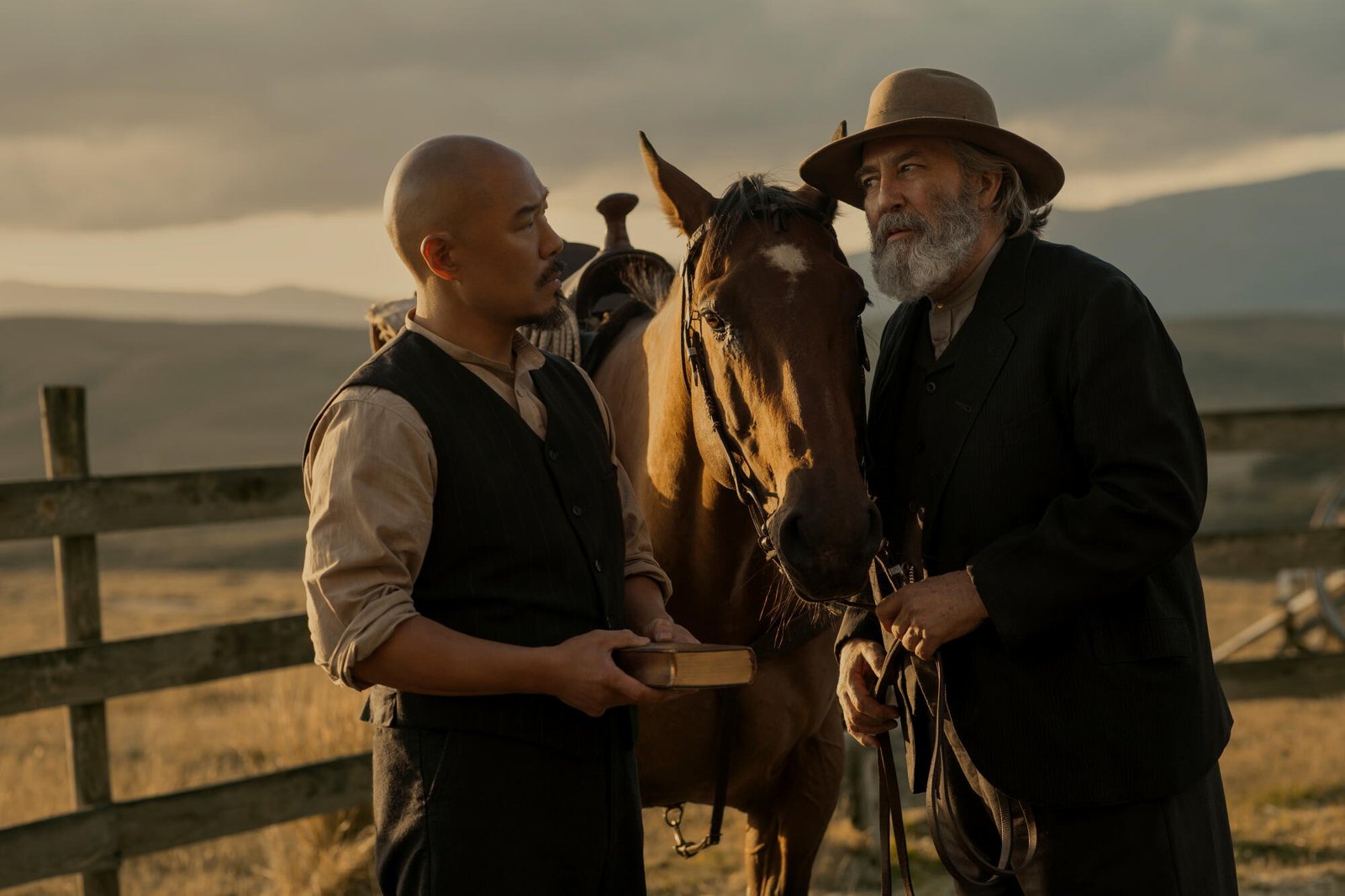
Supporting performances provide the necessary texture for a story that requires balancing intimate family drama with sweeping historical change. Hoon Lee plays Lee, the Chinese American philosopher-servant who becomes the emotional surrogate for the Trask children, a role that historically offered one of the few nuanced depictions of Asian Americans in mid-20th-century Western literature. Ciarán Hinds appears as Samuel Hamilton, an Irish immigrant based directly on Steinbeck’s own maternal grandfather. In the novel, the Hamilton family serves as a parallel lineage to the Trasks, representing warmth and community against the Trasks’ isolation. The series condenses this sprawling clan almost entirely into Hinds’ singular presence. Martha Plimpton plays Faye, the brothel madam who employs Cathy, while Joe Anders and Joseph Zada take on the older versions of Aron and Cal, respectively.
Translating a 600-page novel heavy with internal monologue into visual media requires aggressive structural surgery. Kazan and Stuart convert Steinbeck’s narrative exposition into spoken dialogue and expand single-paragraph descriptions into fully realized scenes. Internal thoughts previously confined to Cathy’s perspective are externalized into concrete action. The adapters largely resist inventing new plotlines, relying instead on the novel’s dense architecture of backstory and social criticism to fill out the runtime.
The physical realization of Steinbeck’s California, however, reveals the constraints of modern streaming budgets. Filmed in New Zealand, the landscape visually approximates the rolling hills of the Central Coast during a dry season, but the cinematography by directors Garth Davis and Laure de Clermont-Tonnerre favors muted palettes and mournful string scores over the vibrant, sun-drenched agricultural paradise Steinbeck mythologized. Where the 1955 film used WarnerColor to saturate the Salinas Valley in melodramatic hues, this production opts for a restrained, earthbound aesthetic that occasionally flattens the emotional peaks of the source material.
All seven episodes of “East of Eden” are available to stream globally on Netflix beginning Thursday, October 1.