
AI takes the factory floor as skilled machinist shortage reshapes precision manufacturing
AI assistant CAM Assist targets manufacturing labor gap with $128M total funding

CloudNC, a United Kingdom-based software developer, announced Wednesday that it has raised $20 million in a Series B extension funding round. The investment was led by venture firm Nimble Ventures, alongside Calculus Venture Capital, Entrepreneur First, and LM Capital, the corporate venture capital arm of U.S. aerospace and defense prime contractor Lockheed Martin.
An acute shortage of skilled machine operators and a push to reshore critical industrial supply chains to North America are accelerating the adoption of artificial intelligence on the factory floor, driving new investment into automated precision manufacturing technology.


The extension round brings CloudNC’s total raised capital to $128 million. The company last closed a major funding round four years ago, according to co-founder and Chief Executive Officer Theo Saville.
Before a physical part can be cut on a factory floor, a skilled machinist or Computer-Aided Manufacturing (CAM) programmer must establish a manufacturing plan. This manual workflow involves determining how raw material should be fixed within the machine, selecting specific cutting tools, defining toolpath approach angles, and setting precise operational parameters, including spindle speeds and feed rates.
While headquartered in London, CloudNC’s commercial operations are heavily centered in North America. Approximately 80% of the company’s customer base is situated in the United States, where more than 1,000 machine shops currently utilize its platform. CloudNC, which maintains a total workforce of 80 employees, plans to use the capital to scale market adoption, strengthen its commercial sales infrastructure, expand into new geographic regions, and finalize new product lines.
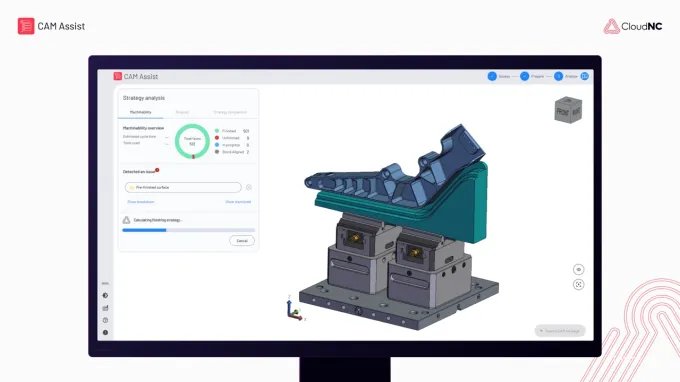
At the core of CloudNC’s product lineup is CAM Assist, an AI-powered software tool designed to streamline Computer Numerical Control (CNC) machining. CNC machining is a fundamental subtractive manufacturing process invented in the mid-20th century that relies on pre-programmed computer code to drive automated machine tools—such as mills, lathes, and routers—to shape raw metals, alloys, and plastics into finished components. These precision-engineered parts are essential components across defense, aerospace, automotive, medical device, and industrial equipment manufacturing.
To create these strategies, programmers traditionally rely on established CAM software platforms such as Autodesk Fusion and Mastercam. While conventional CAM software provides robust drafting toolsets and can automate individual feature geometry, the software still requires human operators to manually program every step of the machining strategy to generate the final G-code—the standardized programming language that dictates machine movements.
The drive to streamline these workflows comes amid severe labor shortages across the industrial sector. In the United States, trade groups and economic data report hundreds of thousands of open precision manufacturing positions, compounded by an aging workforce of tool-and-die makers and CAM programmers. Concurrently, geopolitical shifts and federal trade policies have incentivized manufacturers to move production back from overseas, placing unprecedented demand on domestic machine shops.
CAM Assist integrates directly as a plug-in within traditional CAM software environments, acting as an automated assistant during the initial planning phase. The software analyzes part geometry to select cutting tools, calculate approach directions, optimize feeds and speeds, and generate preliminary programming code for the CNC machine.
“Machine shops need to quote faster, program faster, and deliver more with the people and machines they already have,” Saville said.
Rather than fully replacing human operators, the system is designed to generate a draft strategy that experienced machinists review, edit, and approve before production begins.
“Traditional CAM systems are powerful, but in most workflows, they are still tools that allow programmers to manually specify how a part should be machined,” Saville said. “CAM Assist is more like an expert assistant sitting alongside the programmer, automating much of the first-pass thinking and repetitive setup so the human can review, improve, and approve the approach.”
To address the business quoting bottleneck, CloudNC plans to launch a secondary AI product next month called Quote Agent. Target customers for the tool are contract machine shops that must quickly assess project risk and calculate production costs to bid on incoming work orders.
Saville pointed out that the mathematical challenge of programming multi-axis machine toolpaths is exceptionally complex, noting that for a standard CNC part, the theoretical variations in machining strategies exceed the number of atoms in the observable universe.
CloudNC was founded in 2015 by Saville and Chris Emery, who serves as the company’s chief science officer. The company developed its core AI algorithms by operating its own specialized manufacturing testing factory, combining software engineering with real-world machining data to refine its toolpath generation models.