Nscale’s $35 Billion IPO Bid Exposes the AI Economy’s Deep Losses
Nscale’s IPO filing reveals the financial strain behind the AI infrastructure boom
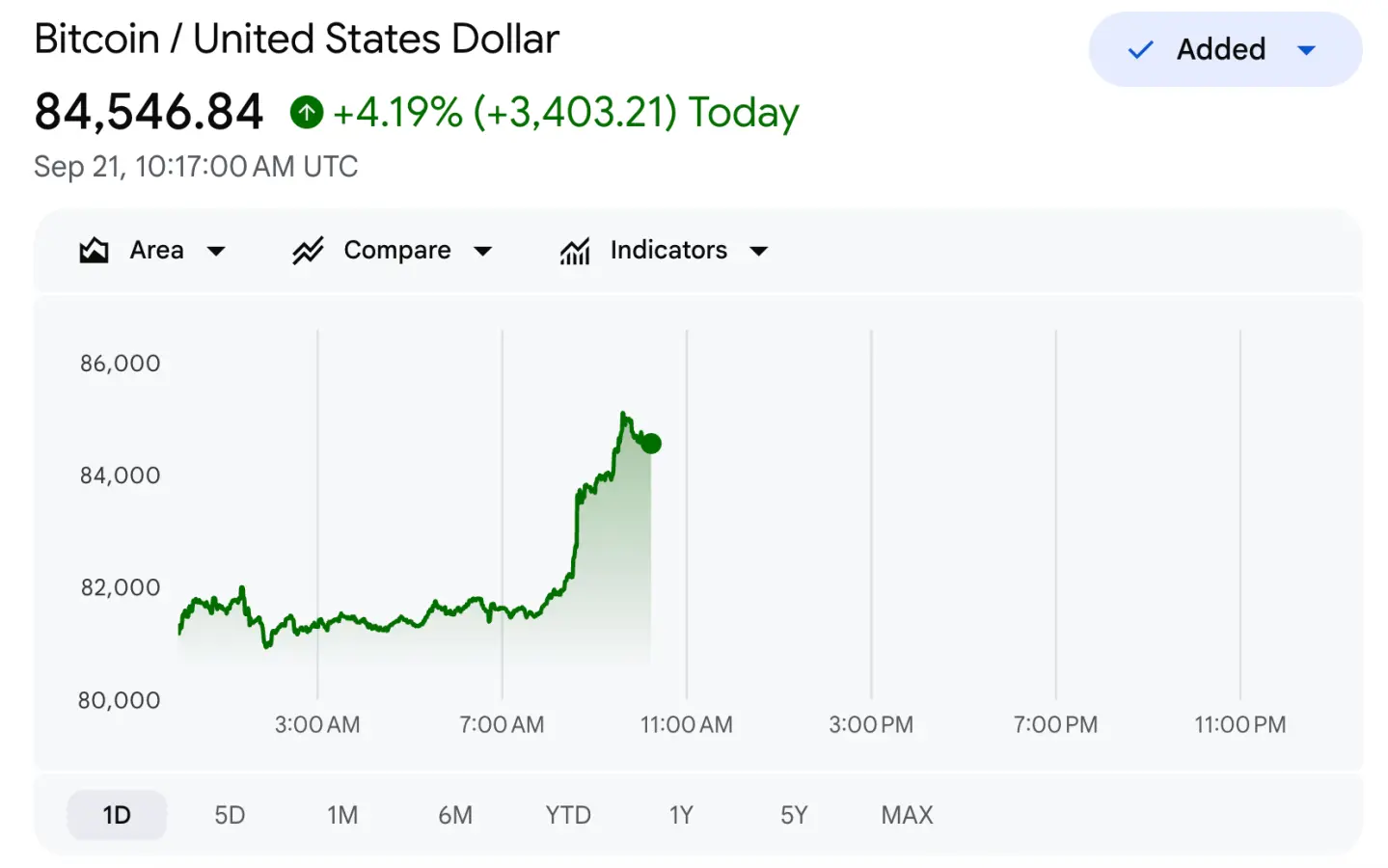
WASHINGTON — Bitcoin rose 5% in early trading, peaking at $84,959 and crossing above its 50-week moving average, a technical indicator closely watched by cryptocurrency investors. European and Asian indexes also posted gains: the Stoxx 600 rose 0.94%, the U.K.’s FTSE 100 gained 0.79%, South Korea’s KOSPI increased 1.65%, China’s CSI 300 grew 0.71%, and India’s Nifty 50 ticked up 0.35%. Japanese markets were closed for a holiday, while Brent crude oil hovered at $101 per barrel.
The market moves came during a broader period of macroeconomic adjustment. Global financial markets recently reacted to an interest rate hike delivered by the Federal Reserve. Rising interest rates typically exert downward pressure on equities by increasing the cost of borrowing, yet U.S. stock indexes rallied immediately after the central bank’s decision.
Institutional buying was unusually large during the week ending September 16. According to data from Wells Fargo, S&P 500 ETFs attracted $54 billion in net inflows, the Nasdaq recorded $28 billion, and the small-cap Russell 2000 saw $7 billion in net buys. Yuri Seliger, a strategist at Bank of America, estimated total weekly inflows into equity ETFs at $62 billion, the largest single-week inflow in three months.


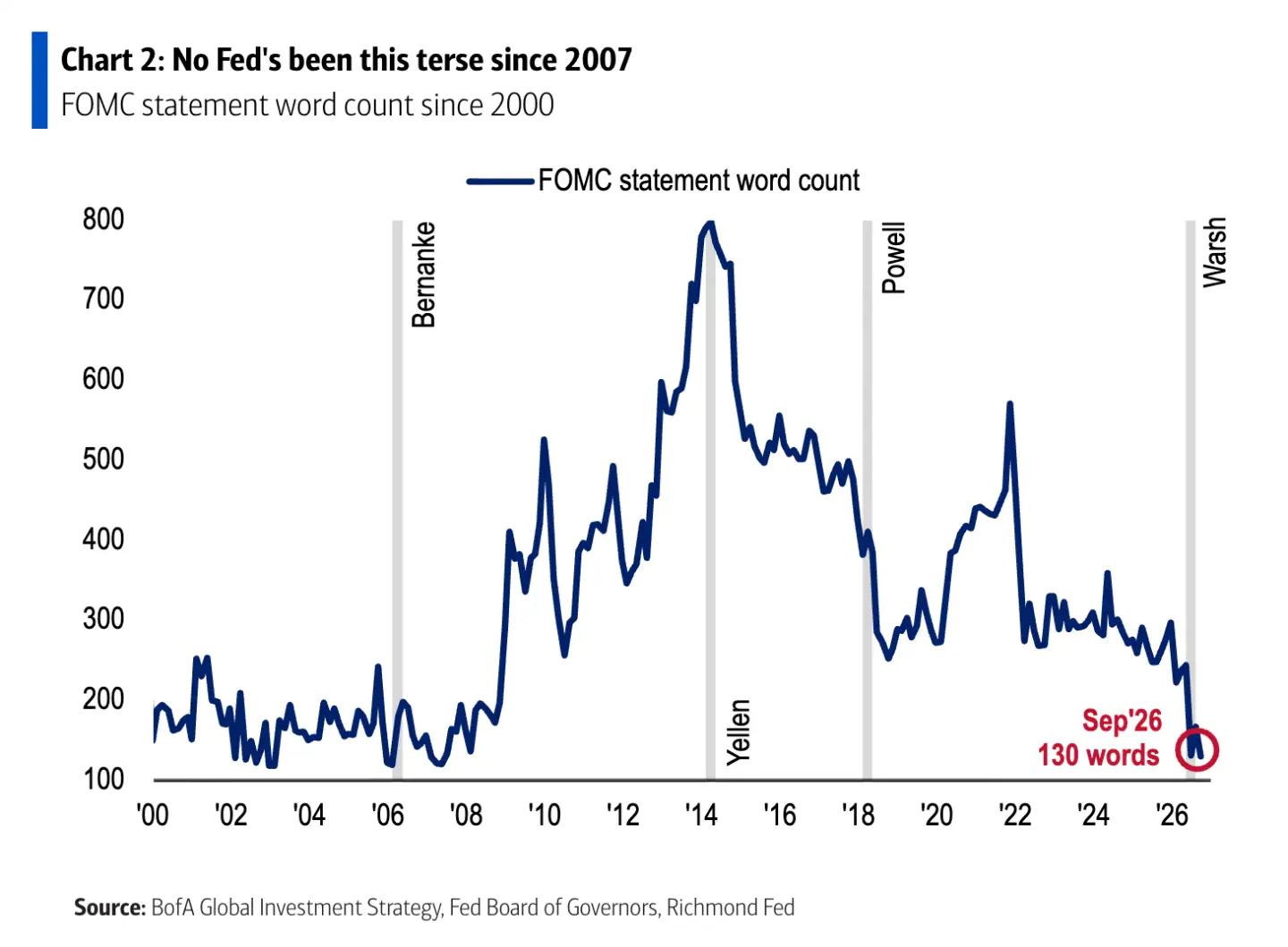
The Federal Reserve’s latest policy statement contained only 130 words, making it the shortest official Fed statement issued since 2007. Jared Woodard, an analyst at Bank of America, said the “end of oversharing” could signal increased long-term market resilience, but might also require investors to demand higher bond risk premiums to account for sparser forward guidance.
A structural shift is underway in the American economy: capital spending on data centers and information-processing hardware has surpassed private residential housing investment for the first time. The reallocation reflects the intensity of the artificial intelligence boom, while startups building the infrastructure face steep financial challenges and complex, circular funding mechanisms.
Nscale, an AI data center and cloud-compute provider, recently filed its Form S-1 registration statement with the U.S. Securities and Exchange Commission (SEC) ahead of a planned initial public offering. According to reports from the Financial Times, the company is seeking a valuation of $35 billion.
The company’s recent financing includes $3.1 billion from chipmaker Nvidia, secured on September 15 in exchange for a series of unsecured convertible loan notes. Nscale also disclosed “remaining performance obligations”—contracted future business that has not yet been realized as revenue—totaling $56.4 billion over the next seven years.
Its prospectus gives a different picture of current operations. During the first half of 2026, Nscale generated $140.6 million in revenue but posted a net loss of $1 billion. Cost of revenue for the same six-month period reached $189.6 million, so the direct cost of delivering its services exceeded total incoming revenue and the company operated at a gross loss.
Nscale’s 2024 results had been more modest: revenue was $19.1 million and gross profit was $6.3 million. Capital expenditures have escalated rapidly since then, driving wider losses and forcing management to address liquidity constraints.
The filing states that Nscale’s leadership team previously identified “substantial doubt” about the company’s ability to continue as a “going concern,” the standard accounting terminology for a material risk of liquidation or bankruptcy. “Management identified that the Company’s forecast funding requirements included reliance on uncommitted debt and equity financing, which initially raised substantial doubt about the Company’s ability to continue as a going concern,” the filing states. “Management has evaluated its ability to defer, reduce or cancel capital expenditure if such financing is not obtained as forecast and has concluded that this plan is probable of being effectively implemented and, if necessary, would provide sufficient liquidity to alleviate the substantial doubt about the Company’s ability to continue as a going concern.”
The financing pattern involving Nscale is part of a wider technology-sector development. A study by Sona Asset Management examined $3.6 trillion transacted in 176 deals across 202 companies and explored the extent to which the AI economy has become “circular.”
In such structures, capital flows repeatedly among a small group of highly interdependent players. The study tracked Amazon’s investment of approximately $50 billion in OpenAI alongside OpenAI’s commitment to purchase $100 billion in computing power from Amazon. Nvidia’s $100 billion investment in OpenAI was subsequently used by the AI developer to purchase cloud services from Oracle, Microsoft, and Amazon, which in turn represent Nvidia’s primary customer base for advanced semiconductor chips.
Nscale’s executive compensation has also drawn attention as the company prepares to enter public markets. Founder and CEO Josh Payne received $23,206,898 in total compensation, according to the filing. Jing Yin, President of the APAC region, received $24,731,208, while Chief Accounting and Finance Operations Officer Ron Huisman received $3,543,946 and Chief Legal Officer Phoebee Gahan was compensated $2,591,670.
The board includes figures from technology and political circles. Nicholas Clegg, the former Deputy Prime Minister of the United Kingdom and current Vice President of Global Affairs at Meta, was granted 917,460 shares in the company. Sheryl Sandberg, the former Chief Operating Officer of Meta, holds 1,911,420 shares.
High-profile public figures have increasingly become equity holders in growing companies. Jacob Fortinsky, CEO of the sports prediction market Novig, recently disclosed that actress Sydney Sweeney approached his firm to negotiate an equity stake, choosing to become a shareholder rather than accepting a standard cash advertising arrangement.
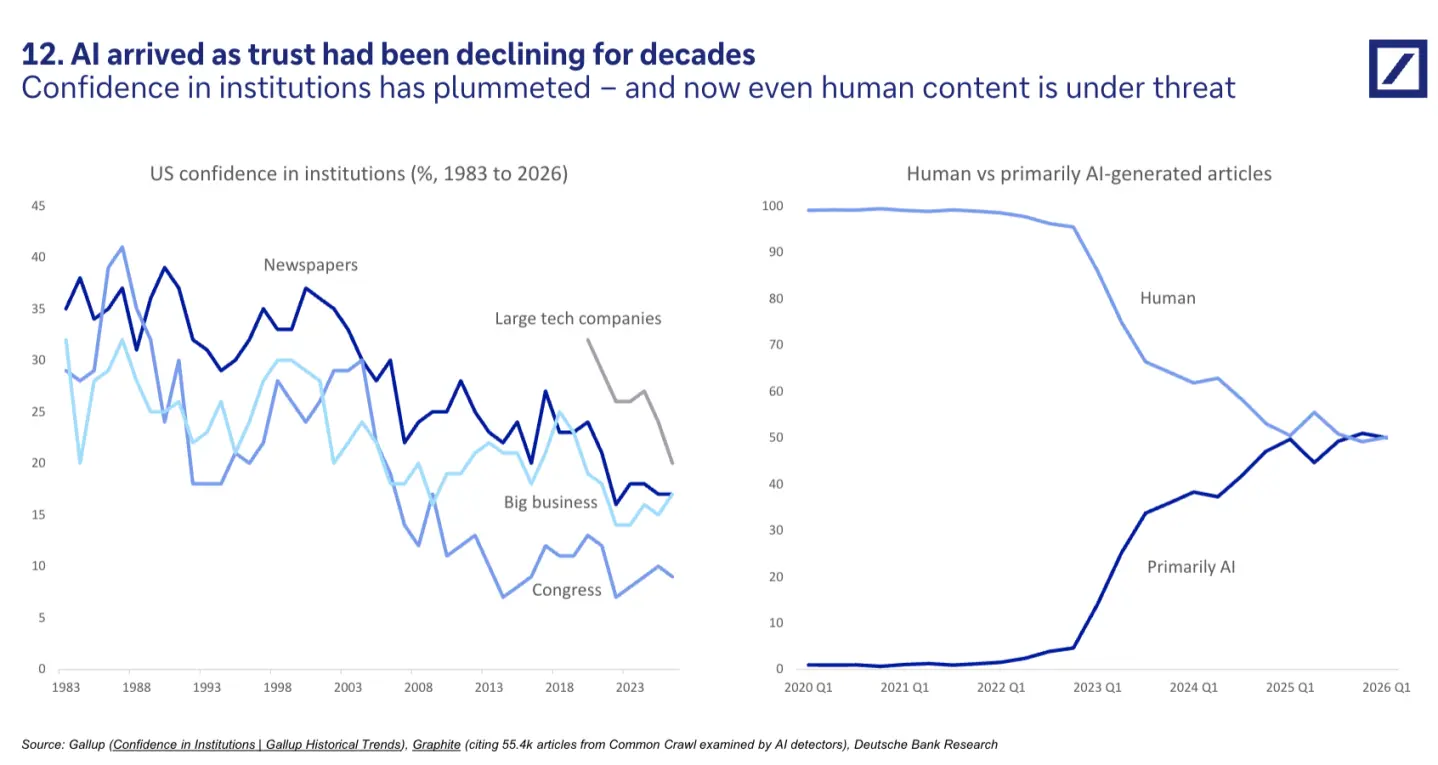
While capital continues to move into physical hardware, the output of those investments is reshaping digital media. Research published by Adrian Cox at Deutsche Bank, using data from the digital marketing firm Graphite, indicates that synthetic content has reached a critical threshold. An analysis of more than 55,000 online articles concluded that half of all newly published digital articles are now generated by artificial intelligence. Analysts noted that the surge in automated content generation is occurring while public trust in media and civic institutions has been in a multi-decade decline.
The coming months will test whether public markets are willing to absorb high-valuation, capital-intensive infrastructure plays like Nscale, or if the mounting losses and circular nature of AI expenditures will prompt a reassessment of valuations across the technology sector.