

A Forgotten Garage Server Yielded $12,000 in DDR4 RAM—Exposing a Scramble for Obsolete Silicon
Why decommissioned DDR4 is becoming valuable enterprise infrastructure
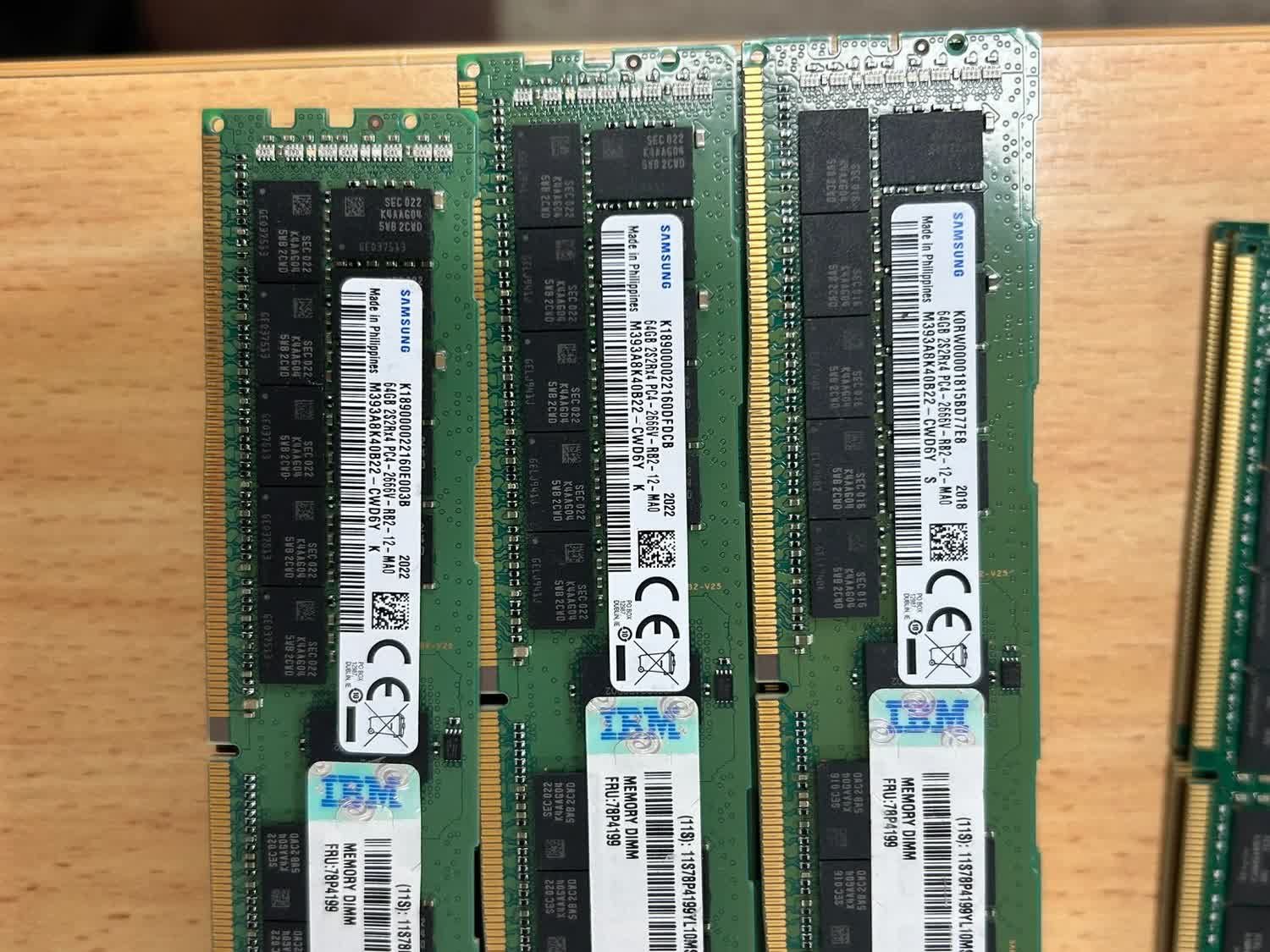
Australian Redditor VastOption875 found 30 64GB DDR4-2666 ECC memory modules in a decommissioned enterprise server stored in a garage. The modules total 1.92TB of high-density server memory. At current retail prices, the lot could be worth about $12,000, placing an apparently forgotten hardware surplus inside an inverted DRAM market.
Individual 64GB DDR4 modules sell for around $400 through retailers such as Newegg and Amazon. The full specifications were not disclosed, but dual-rank ECC server memory typically commands a premium over non-ECC desktop DIMMs. The 64GB DDR4 ECC server memory value therefore depends on more than a retail comparison.


Enterprise compatibility narrows the immediate buyer pool. These ECC modules are generally intended for servers and high-end workstations using Intel Xeon or AMD Epyc processors, rather than ordinary gaming systems. That restriction does not eliminate demand. Secondary enterprise hardware channels, including r/homelab, r/hardwareswap, and dedicated refurbishers, have sustained liquidity for high-density RDIMMs as local LLM fine-tuning clusters and self-hosted container virtualization expand.
For buyers in those channels, the relevant calculation is often capacity per platform rather than compatibility with a consumer motherboard. A 1.92TB cache of registered DIMMs can support dense virtualization, private AI inferencing, or a refurbished compute node. The owner could liquidate the modules into a used server RAM secondary market homelab ecosystem, although platform lock-in and shipping costs would affect the final return. Another Redditor recently found 64GB of Corsair Vengeance RGB Pro DDR4 while dumpster diving at a landfill and kept it to upgrade a gaming rig, but the Australian stash belongs to a different class of hardware.
The same enterprise refresh cycle that left the server in the garage is forcing larger operators to reconsider what gets discarded. Meta said in July that it was reusing DDR4 RAM from decommissioned servers in new DDR5-only machines. Its custom CXL ASIC is designed to work around the compatibility issues and latency penalties that normally arise when different memory generations are combined. The project gives the Meta CXL DDR4 reuse decommissioned servers trend an industrial-scale counterpart to the Australian discovery.
At hyperscale, Compute Express Link 2.0/3.0 memory pooling and tiered memory architectures have emerged as primary tools against memory stranding, in which expensive CPU cores sit idle while available DRAM remains unallocated. CXL memory expanders can route legacy capacity into a broader memory pool instead of requiring every DIMM to attach directly to a processor’s native bus. That does not turn every DDR4 module into a desktop component, but it can make older enterprise memory useful inside a carefully engineered infrastructure stack. The CXL bridge latency, channel routing, and capital cost become part of the decision alongside the price of replacement DDR5.
That architecture changes the comparison between Enterprise DDR4 vs DDR5 cost. Meta’s engineering effort is not simply a one-off thrift measure. Hyperscalers are managing total cost of ownership while DDR5 adoption remains expensive, and decommissioned enterprise DDR4 can retain operational value when it is pooled, tiered, or assigned to less latency-sensitive workloads. The garage server’s 30 modules came from the same corporate hardware cycle that now makes legacy capacity worth preserving.
DRAM manufacturers have also changed the supply picture. SK Hynix, Samsung, and Micron reallocated major cleanroom wafer capacity away from mature DDR4 lines toward HBM3e, HBM4, and high-density DDR5 for AI accelerator pipelines. That reduction in mature-node capacity created a structural shortage of high-density enterprise DDR4 even as companies continued moving toward newer platforms. The result is an Enterprise DDR4 market price surge 2026, not because DDR4 became technically superior, but because supply contraction collided with replacement costs and continuing secondary demand.
Manufacturers have responded by ramping production of DDR4 and compatible motherboards. One unnamed semiconductor maker said DDR4 sales grew by a double-digit percentage in the second quarter of 2026. The broader Enterprise DDR4 market price surge 2026 is reflected in the continued demand for 64GB modules, the reuse of decommissioned servers, and the DRAM supply shortage HBM reallocation affecting older enterprise memory.