Three Bans Came From Five Interviews in the Sandpapergate Investigation
Five interviews, three bans, one missing witness — and a chief executive defending a book he hasn't read.
On 27 March 2018, three days after the ball was caught on camera, Cricket Australia’s chief executive announced that only three players had known about the sandpaper, and said in the same breath that the investigation was not complete.
The announcement itself said the work was unfinished. “While that investigation is not complete, preliminary findings have been considered and discussed by the CA board earlier today,” he said. “The key finding is that prior knowledge of the ball tampering incident was limited to three players.” The three, Steve Smith, David Warner and Cameron Bancroft, were charged and sent home on a preliminary finding. The board met the next day, for more than two hours, and the bans followed: twelve months for Smith and Warner, nine for Bancroft, each with 100 hours of community cricket.
Cricket Australia’s chief executive, Todd Greenberg, said on Tuesday there was no compelling reason to reopen the matter. “We don’t see any compelling reason to open the investigation or revisit this again,” he told SEN radio. “I don’t think there’s anything that can be gained from that.” Greenberg has seen the interview transcripts from 2018, and he has spoken to many of the players who were in Cape Town. He has not read the book he is dismissing. Cricket Australia has never published the report, or the transcripts. Usman Khawaja’s autobiography, Sabr, was released on Tuesday, and Greenberg said he had received a call from Khawaja about it but had not read it. Greenberg was not at Cricket Australia in 2018. He ran the players’ association from 2020 to 2025, and the transcripts he cites are ones he saw in that role.
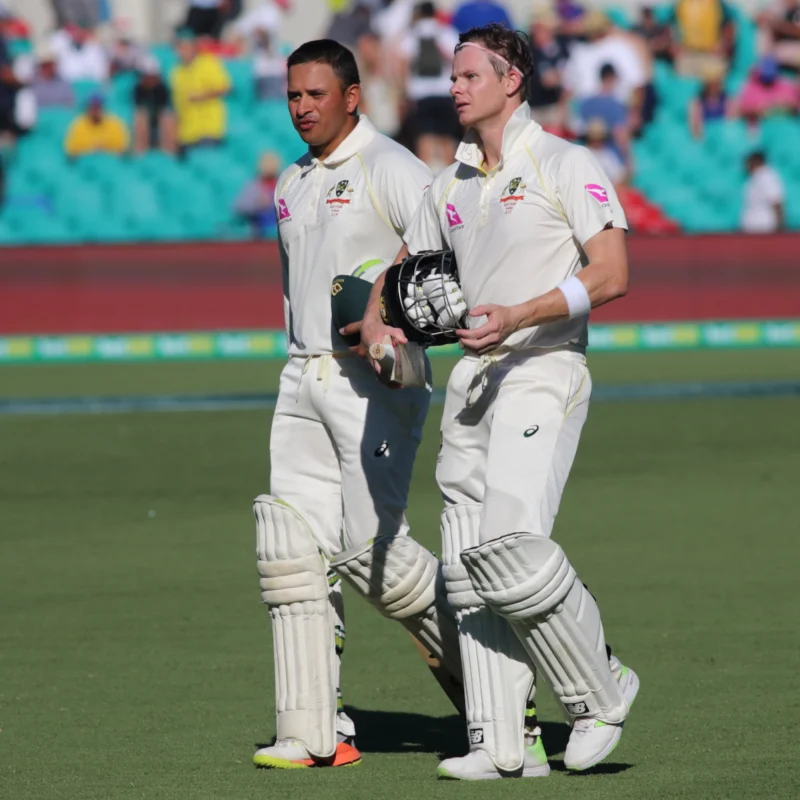
Iain Roy, the head of integrity who ran the interviews in South Africa, spoke to five people. The list is on the public record: Warner, Smith, coach Darren Lehmann, Bancroft and Peter Handscomb. The inquiry was led by Pat Howard, the executive general manager of team performance, with Roy and Cricket Australia’s senior legal counsel, and Sutherland joined them in South Africa. Khawaja was not on the list. He sat beside Bancroft through the whole Cape Town Test, and he says he waited for a call that never came. “I was waiting for my phone to ring,” he told the Sydney Morning Herald. “It just never rang, and then the penalties were given, and I couldn’t believe it.” Warner said the same thing in plainer terms from Nepal on Monday, where he is playing in the Nepal Premier League. “Uzzy was sitting next to Cameron Bancroft. Uzzy was not interviewed.” He called the 2018 investigation “rushed and botched”, and he called Khawaja’s account “100% accurate”.
Khawaja’s account starts a Test earlier, at St George’s Park in Port Elizabeth, now Gqeberha. He says sandpaper was first discussed and used there, in the second Test, and that a player applied it to a ball in the changeroom during that match. His teammates saw how scuffed one side became, he says, and realised how much it would swing. Bancroft volunteered to use it in South Africa’s first innings at Gqeberha. Smith, according to Khawaja, “essentially threw his hands in the air and said he did not want to know”, and walked out of the discussion. The player who applied the sandpaper in the changeroom is not named in the extracts released so far. A member of the coaching staff, Khawaja says, encouraged Bancroft to ramp up whatever he was doing with the ball. “It was all of us,” Khawaja said in the interview that preceded the book. “Not the batters, not the bowlers, not the staff. All of us.” He also says South Africa were “far better” at working on the ball, and that Australia were “trying to keep up with them”. He says the book carries particulars of what South Africa were doing.
The three men named in that preliminary finding paid for it in full. Smith and Warner missed eight Tests between them: two against Pakistan in the United Arab Emirates, four against India, two against Sri Lanka. Both had A$2.4 million Indian Premier League contracts torn up when the Board of Control for Cricket in India barred them from the 2018 season. Smith was expected to lose more than $5 million in total, Warner more than $4 million. LG did not renew Warner, Asics ended its deals with Warner and Bancroft, and Sanitarium and the Commonwealth Bank dropped Smith. Magellan ended its three-year naming-rights partnership with Cricket Australia, a deal reported at around $20 million to terminate. Bancroft’s county deal with Somerset was cancelled within days. Warner’s lifetime ban from leadership was lifted only in October 2024, by a unanimous three-member independent panel, after a change to the code; Cricket Australia did not oppose the application, and Warner went on to captain Sydney Thunder. The bowlers kept playing, and Pat Cummins, one of the four who issued a joint statement in 2021, became captain.
The men who ran the inquiry all left Cricket Australia within months. Roy was dismissed on 1 June 2018, his position terminated on the spot with a redundancy payout. Cricket Australia said it was by mutual agreement and unrelated to the match-fixing allegations in an Al Jazeera documentary. Sutherland resigned the same week, after seventeen years as chief executive. Howard left in November 2018, after the culture review. Greenberg has defended the speed of the original process, saying the urgency was necessary given the circumstances, and that second-guessing past decisions is “an impossible task”. The Sandpapergate investigation was restricted to what happened in Cape Town, and it had to be finished quickly because Australia had another Test to play days later in Johannesburg.
Seven months after the bans, Cricket Australia commissioned its own answer to the question of how far the problem reached. The Ethics Centre review, written by Dr Simon Longstaff, ran to 145 pages, consulted more than 450 people, and made 42 recommendations. It said the leadership of Cricket Australia should accept responsibility for its failure to create a culture in which the will to win was balanced by moral courage and ethical restraint. It said players were reluctant to challenge the errant behaviour of teammates, “just in case it puts them off their game and leads to a loss”. And it said this: “To prescribe that event as aberration or a sudden ‘brain snap’ by a handful of players would be a mistake.” The same review called the sanctions “creditable” and the overall response “exemplary”.
Cameron Bancroft brought it back in 2021, in an interview with The Guardian. Asked whether the bowlers knew about the sandpaper, he said: “Yeah, look, I think, yeah, I think it’s pretty probably self-explanatory.” The four bowlers, Cummins, Mitchell Starc, Josh Hazlewood and Nathan Lyon, replied with a joint statement. “We did not know a foreign substance was taken onto the field to alter the condition of the ball until we saw the images on the big screen at Newlands,” they said, and asked for an end to “the rumour-mongering and innuendo. It has gone on too long and it is time to move on.”
Khawaja says he spoke extensively with Langer and with Greenberg, then the players’ association chief, in 2021 about taking collective responsibility, and that two team members objected to the proposal. He says he tried to come clean in 2018 and Smith talked him out of it. “I told Smudge that I was going to come clean to the media,” Khawaja said. “But Smudge being the man and leader he was, he talked me out of it. He wanted to take the blame.” He tried again in 2021, after Bancroft’s interview, and he briefed Cummins about the book before the 2026 tour of South Africa. “In an ideal world, I don’t want to do this,” he said. “I genuinely thought after eight years the truth would have been out by now.”
Michael Clarke, who captained Australia before Smith, said on Tuesday the matter should be reopened. “We haven’t moved on. Australian fans have not moved on. They can’t trust what’s real. They don’t know the truth. Until this gets reopened and the truth comes out,” Clarke said on 2DayFM, and he added that the chances to settle it had already passed. “We had the chance in 2018. The truth didn’t come out. We had the chance in 2021.” He added that Smith would still be captain if the scandal had not happened, and that Cummins would never have captained a game. “I can’t believe we haven’t heard from Pat Cummins yet, the Australian captain,” Clarke said. Warner, according to CODE Sports, is furious at Greenberg’s refusal, while Starc is due to face the media at a Fox Cricket launch on Tuesday and Cummins is expected to speak soon. Smith has not publicly answered the new claims, and the bowlers, the AAP reported on Sunday, “continue to maintain their silence”. South Africa won the 2026 series 2-1, the first Test series between the teams in South Africa since 2018, and took the number one Test ranking. Proteas supporters brandished sheets of sandpaper from the terraces during the series and heckled the Australians.
The comments under Khawaja’s own posts split on one question: who should have said something, and when. Dan, a cricket fan from Australia posting on Instagram, put it in four words: “No way. They all knew.” Aj Edwards, a tradesman and gym coach, posted a video asking how bowlers who inspect the ball before every delivery could claim ignorance, and kept asking his viewers “Yes or No???” about whether the whole team knew.
“If anything — this is just cheap,” one X user wrote. “And 8 years later when you can afford to take the hit, you come out with the ‘truth’? Ridiculous. If this case can be reopened — Ban everyone.” Another asked how a man of principle could play for seven years without disclosing it and then speak “when there was a substantial financial incentive to do so”. Chadd Sayers, who played one Test for Australia, asked the same question from inside the game. “Everything Usman says in his article is accurate,” Sayers said, “but if he felt so strongly about it, why didn’t he say something at the time?” Khawaja says he tried twice: talked out of it in 2018, outvoted in 2021. Greenberg, on Tuesday, would not accept that account. “Usman’s version of events is inconsistent with what others have had to say,” he said. “I can assure you there are lots of other players who have a very, very different version of events.” Neither answer addresses the interview list, which names five men and does not include Khawaja.
Bancroft scored 32 off 40 balls for Western Australia against England at the WACA, and took three catches. Western Australia lost by 92 runs.