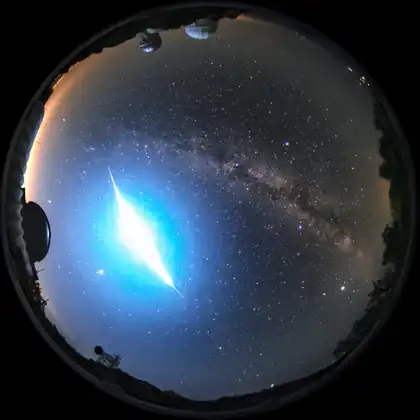
At 7:40 p.m. Eastern on Wednesday, a blue-green light crossed the sky over Michigan, Ohio, Indiana and Ontario, bright enough that drivers on Interstate 75 watched the sky turn green. Chelsea Vargas wrote: “Didn’t get it on camera, but was driving on 75 and thought the world was ending because the sky turned green.” The American Meteor Society logged the event at 00:40 UTC on November 26, near Detroit, with 1,323 eyewitness reports, an average magnitude of minus 13 and an average duration of 3.5 seconds. Witnesses were spread across a radius of 1,042.5 kilometres.
The society’s event viewer puts the ground path at 43.3, -83.3 to 43.0, -84.7, a track 119.7 kilometres long running westward across Michigan at a descent of minus 5 degrees, close to level. Its velocity for the object is 34.2 kilometres per second. The same page flags its own heights as inverted and unreliable, start altitude 63 kilometres against an end altitude of 73.46 kilometres, so the geometry is still shaky. The speed estimate comes from the same witness triangulation.
Leonids enter the atmosphere at 71 kilometres per second, according to the International Meteor Organization’s outlook for November 21 to 27. At 34.2 kilometres per second, Wednesday’s object was moving at 48 percent of Leonid speed. The Northern Taurids, active the same week, arrive at 29 kilometres per second and the Southern Taurids at 27. A CTV News report put the London, Ontario sighting at 90 times the speed of sound, which works out to 30.9 kilometres per second, near the Taurid figures and less than half the Leonid figure. The society’s 34.2 kilometres per second equals 99.7 times the speed of sound.


The shower peaked on November 17 and 18 and stays active through November 30, so a bright meteor on November 25 sits inside its window. The radiant tells a different story. The IMO table gives the Leonid radiant a culmination time of 06:00 local, the hour when it stands highest in the sky. At 19:40 the constellation Leo is still below the horizon, hours from rising, and shower meteors stream outward from their radiant. The Taurid radiants culminate at midnight and stand in the evening sky. The full Moon on November 24 had already cut visible meteor counts by at least 75 percent, the IMO notes, leaving only the brightest meteors in view.
Spencer Allison wrote: “Saw it in Wallaceburg Ontario while driving on my way to work. It lasted about 5 seconds. It was very bright green. It was like a green fireworks in slow motion and had a smoke trail.”
John Mitchell wrote: “Saw it from Harwich Township near Blenheim. At first I thought it was a drone. It was so bright and big! It was like a bright blue and green firework moving across the sky. It looked like it was on fire and moving very slowly.” Leonids at 71 kilometres per second cross a witness’s field of view in a blink, the fastest of the major showers. Witnesses in Wallaceburg and Harwich Township both reached for the word slow, and a 3.5-second average duration in the society’s record backs them.
A Toledo television meteorologist reported that NOAA’s GOES-19 weather satellite recorded the flash near Saginaw Bay with its Geostationary Lightning Mapper. The mapper watches a single near-infrared colour, the 777.4-nanometer oxygen emission line, at 500 frames per second, and NOAA puts its nighttime detection threshold at an apparent magnitude of about minus 14, slightly brighter than the full Moon. Ordinary shower meteors run fainter than minus 13 and stay invisible to it. A detection therefore sorts Wednesday’s object into the bolide class, the large meteoroids NOAA describes as several feet across. Altitude, speed and size come from camera video and eyewitness analysis, the work the society’s viewer is assembling.
belabaaabe wrote: “oh my gosh!! just saw a huge greenish blue object go across the sky tonight! 7:40PM EST NOV 25, 2026 we were driving from niagara falls to toronto shooting star / meteor SUPER COOOOL!!!!” jillaroo2020 wrote: “I was on the 403 west between Ancaster and Brantford at 7:40 and saw the same thing – a large brilliant green & blue streak – accept it was nose diving – straight down – just off the highway – likely closer to Lynden”
Three weather cameras agree on the minute. Michigan Storm Chasers’ Dearborn camera carries a 07:40:22 p.m. overlay for November 25, its Hudson camera 07:40:27 p.m., and a Wyze camera in London, Ontario stamped 19:40:26. A London dashcam timed around 7:35 p.m. in Yahoo News Canada’s account and a roundup placing the satellite detection just after 7:30 sit outside that five-second spread. In Fort Wayne, Indiana, the crowd at the city’s Night of Lights celebration was already outdoors watching a drone display when the fireball crossed.
NASA published analyses for three Great Lakes fireballs earlier this year. On March 23 an object about 4 inches across broke up 23 miles above Saginaw Bay at about 28,900 mph, drawing on NASA meteor cameras, Western University’s Southern Ontario Meteor Network and society eyewitness accounts. On March 17 an object nearly 6 feet across and about 7 tons broke apart about 30 miles above Valley City, Ohio, and fragments produced meteorites in Medina County. On June 19 an object about 5 feet across fragmented 11 miles above Cockburn Island, Ontario. Wednesday’s event carries a reported boom in the society’s record, marked with an asterisk for delayed sound, and its coverage describes no fragments reaching the ground.
The society associates green light with nickel, and a meteor’s makeup and speed both shape what people see. Witnesses described green in Wallaceburg, blue and green in Harwich Township, green and orange in Amherstburg, and a blue trail over Troy, Michigan. Michigan Storm Chasers captioned its Dearborn video “A meteorite falls across the sky over southern Michigan.” Denyse LeBrun wrote: “Meteors are not objects…meteoroid is the object flying through space…meteor is the light phenomenon…meteorite is what lands and is collected. This is why it’s called meteor shower…and not meteorite shower.”
The society’s viewer lists nine events for November 26 in UTC, with 1,378 grouped reports and 15 ungrouped. Event 20261126_0040 holds 1,323 of the grouped reports, and its trajectory line still carries the inverted-heights warning beside the 34.2 kilometres per second.