Mike Pileggi filmed the Fort Lauderdale flooding as it came through his front door on Wednesday morning. It ran over his yard and his driveway and down a street too deep to drive out of, a recycling bin floating past the parked cars. He had filmed a flood at the same house before. “Back in 2023, we lost everything.”
The rain that put the water there fell Tuesday night into Wednesday, 12 to 15 inches across Broward County in a day. Plantation measured 15.3 inches in 24 hours. The National Weather Service put 14.3 inches near Driftwood Acres and 12.6 near Riverland. Fort Lauderdale’s airport set a daily record of 5.72 inches, and the city’s November total reached 15.18 inches, the wettest November since records began in 1912 and more than four times the month’s average. Broward County, Fort Lauderdale and Hollywood all declared states of emergency. Schools closed Wednesday and stayed closed Thursday. The airport stopped flights for a morning ground stop, Interstate 95 closed beside it, and the city said it pulled 12 people from flooded cars overnight, mostly in Hollywood. In a Hollywood apartment west of the interstate, water reached a resident’s knees within about five minutes.
Six weeks ago, the city told Axios the system these storms were testing was working. Residents of River Oaks had asked whether about $50 million of stormwater improvements, including a pump station running since December 2024, had protected their neighborhood during flooding in September. The city answered with the pump station’s numbers: it had run for 132 hours that month and moved more than 50 million gallons of stormwater. The improvements, the city said, were functioning as intended. The pump stations are part of a $37 million project the city started in the fall of 2021 for River Oaks and Edgewood, with 278 drainage structures and more than 21,000 feet of new pipe. One resident quoted in that October report put the doubt in two words: “It’s worrying.”
The project is one piece of a program the city calls Fortify Lauderdale. After the April 2023 flood, the city put the cost of fixing 25 neighborhoods at $700 million over a decade, $200 million for the first eight and $500 million for the next 17. In September 2025, Mayor Dean Trantalis put the expanded program, stormwater and sewers together, at more than $1.6 billion. The city’s own page for the first phase lists four neighborhoods finished, Dorsey-Riverbend, Durrs, Edgewood and River Oaks, two under construction, Progresso Village and Victoria Park, and two still in design, Melrose Manors and Riverland and Southeast Isles. Victoria Park’s work, 43,000 feet of pipe and a new pump station, started in January and is expected to finish in early 2028.
The city had taken water three times already since that October exchange. On October 27, the tide gauge at Virginia Key measured 2.54 feet above the normal high tide, the third highest reading there since 1994, behind only Hurricanes Wilma and Irma, and Fort Lauderdale recorded the highest tide in its history. The Las Olas Bridge closed. Victoria Park residents were trapped in their homes. Record rain fell on November 1 and 2. On November 6, raw sewage bubbled out of manholes across Fort Lauderdale neighborhoods, tanker trucks hauled it between neighborhoods, and warning signs went up along the canals from Coral Ridge to Las Olas. Then the rain came back on Tuesday, 15 inches in a day, and the flood watch runs through Thursday evening.
Kevin J. Clevenger woke to his neighbor banging on his door on Wednesday morning. “Thank god my neighbor woke me up! I have half inch inside my office but got flood dam up soon as I found out. 13” in middle of the street. 10” of rainfall.” His photographs show a ruler at the door and a flood barrier held up by a car jack. Hank Alvarez, writing under the weather service’s rainfall map, reported “20 inch of water on the road” at Southwest 30th Terrace and 17th Street, in the same southwest corner of the city where the weather service measured its heaviest rain.
David McKenzie wrote, on the city’s own flood update post: “I guess this is a once in 100 year flood that happens every year.” Amy Vince asked how the city could offer garage parking when the streets were flooded, with cars stranded east of Interstate 95, and described buying sandbags at Home Depot and hauling them from a park. The city did not have to rescue anyone from a home in Fort Lauderdale this week. In Hollywood, firefighters pulled residents from first-floor apartments.
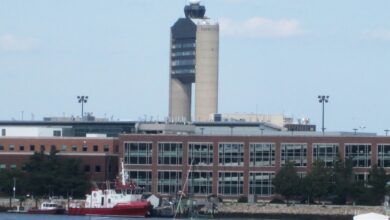
Fort Lauderdale has measured this kind of rain before, and each time the airport has marked it. In April 2023, 25.91 inches fell in 24 hours, the most ever recorded in the city in a day, more than 1,000 homes were damaged, and the airport closed for about 40 hours. In June 2024, more than 20 inches fell in four days, the weather service declared a rare flash flood emergency, and half the airport’s flights were delayed or cancelled. This week the airport stopped flights for a morning and 125 departures were delayed there, 316 more at Miami International, while the highway beside it closed.
Brevard County, 150 miles up the coast, had already taken the same storm once this month. In the first days of November, about 24 inches of rain fell on southern Brevard County, a flash flood emergency covered Palm Bay and West Melbourne, and Melbourne recorded its wettest day ever. The weather service counted two back-to-back 1,000-year rain events there. The St. Johns River near Cocoa is still rising, expected to reach 17.2 feet by early Friday, high enough for water to enter homes. The Weather Prediction Center says this week’s South Florida event formed under similar atmospheric conditions.
The weather service measured the heaviest rain over Driftwood Acres, 14.3 inches, and Riverland, 12.6. Riverland’s drainage upgrade is still in design. The work in Victoria Park, where residents were trapped by the October tide, is still under construction.