The Macy’s Thanksgiving Day Parade will march on Saturday, November 28, at 8:30 a.m. Eastern, two days after its usual Thanksgiving morning slot. Organizers moved the 100th edition on Wednesday afternoon because a coastal storm was forecast to bring damaging winds, heavy rain and coastal flooding to New York City on Thursday. The parade had been canceled three times before, in 1942, 1943 and 1944, when rubber and helium went to the war effort. It had never been postponed for weather.
Moving a parade that size costs money, and most of the bill arrived at school bands. The Pride of Pearland Marching Band and Color Guard, from Pearland, Texas, had about 500 students in New York when the decision came down. Pearland ISD first estimated that changing hotel and flight reservations for a group that size could cost nearly $400,000. By Wednesday night the band had raised $350,000 in just over three hours. Gringo’s Tex-Mex pledged $100,000, CenterPoint Energy gave $50,000, and Houston furniture retailer Jim “Mattress Mack” McIngvale gave $40,000, with former Pearland mayor Kevin Cole adding $1,000. The band’s own donations page now reads “$350,000 RAISED” and “WE MET OUR GOAL!” The students will ride charter buses back to Texas after they march on Saturday, because the earliest flights that could take the whole group were on Monday or Tuesday.
Ryan Demkovich, the band’s director, learned of the postponement during the second act of a matinee of “Wicked” on Broadway. He told the Associated Press: “I am still shocked at it, to be honest with you, I’m still shocked.” To CBS News he said: “It’s been exhausting and emotional to figure this out, but it has been incredibly humbling to see an outpouring of kindness.”


The money question split the band’s home audience. Beth Dimmick wrote: “The bands that travel from far away should be given some special accommodations by the local tourist chambers. These bands already raised the funds to participate., and shouldn’t be penalized for the weather.”
Lauren Selio Wienecke wrote: “The $350K could provide scholarships to every senior in the band- take the L and get those babies to college!” Cathy LeDoux wrote: “For some of these kids they’ll never have a chance like this again.”
Hawaii’s bill is larger. The Na Koa Ali’i Hawai’i All-State Marching Band brought 200 teenage members from across Hawaii’s eight islands, with 200 family members traveling alongside. The band and the hālau together put more than 350 students in New York. Aloha Music, the nonprofit that runs the band, said in a release that members learned the parade was postponed from the news rather than directly from organizers. The extra two days come to about $700,000 in hotel, flight and meal fees. The band had already lost one New York trip to postponement: it was meant to play the 2021 parade, and the pandemic pushed that trip back. Its members flew 12 hours to get here this time, and because the band is a composite drawn from eight islands, the students only began rehearsing together last weekend, five rehearsals in five days.
The Vitals 808 wrote: “CORRECTION: THERE ARE OVER 350 STUDENTS IF YOU COUNT THE MARCHING BAND @nakoaalii AND THE HALAU @namakastudios” and “Please spread the word and help us keep these kids in the @macys Thanksgiving Parade!!!” The appeal pointed donors to the band’s own site, nakoaalii.alohamusic.org. kristienamer wrote: “The airlines and hotels need to step up!” bigislandclimbing wrote: “We sent $50 and posting”
https://www.instagram.com/reel/DgMZbzcJ810/
Rickey Badua, the band’s artistic director, told the New York Post that donations, mostly from Hawaii, had covered nearly 90% of the $700,000 by Thursday night. Ramsey Sadiarin, a member of the dance contingent, said: “It’s been devastating, especially because we worked so hard to get here, but a lot of us are in good spirits and praying that the weather will be good so we can play Saturday.” Macy’s has made no promise to the Hawaiian band about covering the extra fees. The company said it was working through logistics and staying in touch with all of its bands and performers.
Ten marching bands were on the roster. A status update posted Wednesday night listed eight making plans to march on Saturday. They were Concord Community High School of Indiana, Dobyns-Bennett of Tennessee, the Hawaii All-State Band and James F. Byrnes of South Carolina. The NYPD Marching Band, Pearland, the University of Connecticut and the University of Illinois were also staying. Two could not extend their stay. The University of Alabama’s Million Dollar Band is committed to the Iron Bowl against Auburn, which kicks off at 6:30 p.m. on Saturday in Tuscaloosa. It cannot march in New York in the morning and reach the game in time. Macy’s Great American Marching Band, whose 230 members come from across the country, also cannot stay. Broadway casts from “The Rocky Horror Show,” “Wicked” and “Hamilton” will still perform on Saturday, and UConn will make its first parade appearance.
Daniel Day wrote: “Unpopular opinion: Alabama should stay in New York and march on Saturday. A high school band could take their place at the game. The college students could enjoy the once in a lifetime experience of marching in the parade while high school students could enjoy their own once in a lifetime experience!” Jayne Brandon wrote: “Pearland TX HS band raised the 350K they needed to stay and march Saturday!” Both comments sat under the Wednesday-night status update, which Marching.com said was current as of 8:30 p.m. Eastern on November 25.
Smaller groups felt the same arithmetic at kitchen-table scale. Eight dancers from the Sarah Shaw Dance Studio in Pueblo, Colorado, started collecting donations to stay until Saturday. Donna Lira, a longtime instructor at the studio, told 9News: “We started a Venmo thing to see if people will donate for us. I mean, that’s the only thing we could do.” Dobyns-Bennett told its supporters on Facebook that extending the stay meant “additional expenses that were never anticipated in our original trip budget, including extended charter bus rentals, additional nights of hotel accommodations, and meal stipends for our students.” The band later announced it had secured the funding.
Thursday’s weather, measured as it happened, explains why the balloons were never going to fly. City rules bar the giant balloons when sustained winds exceed 23 mph or gusts exceed 34 mph. At 3 p.m. on Thursday, the National Weather Service reported Central Park winds at 20 mph sustained with gusts of 41 mph, already 7 mph over the gust line, with gusts up to 65 mph expected later. New York City Emergency Management recorded a 56 mph gust at LaGuardia Airport. Governor Kathy Hochul had declared a state of emergency for the city and for Nassau, Suffolk and Westchester counties. By 3:30 p.m., more than 800,000 power outages had been reported nationwide, and FlightAware counted 1,708 delays and 419 cancellations for U.S. flights at 3 p.m.
The balloons would have stayed on the ground. The parade itself could still have marched, and that option was on the table. Officials considered carrying on with the 100th march without the inflatables, and considered starting earlier in the morning to beat the worst winds, before choosing to move the whole event. In 1971, the only previous grounding, fierce gusts and rain kept every giant balloon deflated while floats and marching bands carried the show to Herald Square. That storm produced a peak gust of 63 mph and 1.06 inches of rain in Central Park. The 23 and 34 mph limits came later, after the 1997 parade, when gusts above 40 mph pushed the six-story Cat in the Hat balloon into a lamppost at 72nd Street and Central Park West. Falling debris fractured spectator Kathleen Caronna’s skull; she spent 24 days in a coma. The city then capped balloon size at 78 feet long, 40 feet wide and 70 feet high, required anchor vehicles, and set the wind limits that decided this week.
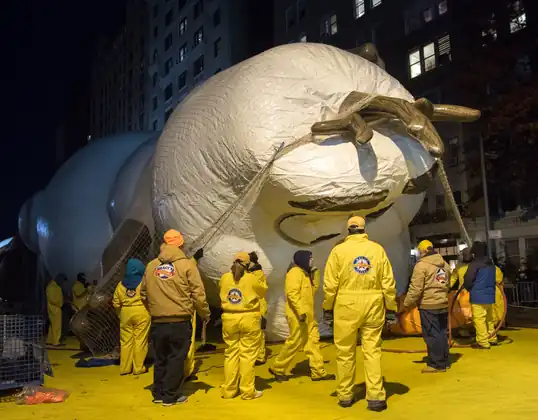
This year’s balloons had already been inflated when the call came. Crews filled them Wednesday afternoon on the streets around the American Museum of Natural History, kept them up for the Wednesday night public viewing, then began deflating them at 7 p.m. The balloons went back to a facility in New Jersey and were to be re-inflated on Friday afternoon, compressing a preparation process that normally runs for weeks into about 24 hours. There will be no second public inflation viewing. Each large balloon uses up to 12,000 cubic feet of helium and about 100 volunteer handlers, and the parade as a whole involves more than 11,000 volunteers and participants, with a record 100 inflatable elements planned for the centennial.
The city has its own Saturday cost. Police Commissioner Jessica Tisch said the department will call in a thousand officers who were planning to have Saturday off. Mayor Zohran Mamdani, who announced the move with Macy’s and the NYPD on Wednesday night, will miss the parade he rescheduled: he has foot surgery, and told reporters, “I will not be able to make it because of the doctor’s orders.” In Philadelphia, organizers first grounded the balloons for the 6abc Dunkin’ Thanksgiving Day Parade, billed as the oldest in the nation, then canceled it outright. NBC filled Thursday’s 8:30 a.m. slot by re-airing the 2025 parade in all time zones.
Jess Rydell, 37, who traveled to New York hoping to see the parade for the first time, spent Thursday morning walking in Central Park in a raincoat instead. She told the Associated Press: “Well, it is quite windy this morning so I think the balloons would have been grounded anyways, so it’s probably best for the safety of everyone, just disappointing when you’re here for it.”
The forecast for parade morning gives the balloons room the storm took away on Thursday. Sustained winds are expected between 10 and 15 mph with gusts around 20 mph, under both city limits, with mostly sunny skies and a high near 54 degrees in Central Park. The parade steps off from 77th Street and Central Park West at 8:30 a.m. Eastern and runs 2.5 miles to Herald Square.