
Robinhood Takes Stakes in Crypto.com and $5B Spinoff OG.com to Clear Surging Prediction Volume
A $5 billion spinoff becomes the latest clearing venue behind Robinhood’s fastest-growing business
$156 million in second-quarter event-contract revenue, up more than tenfold year over year, now sits alongside a 38% decline in Robinhood’s crypto trading revenue. The shift is reshaping how the company allocates capital across its retail trading business.
On Tuesday, Robinhood announced a multi-year deal to route customer prediction-market volume through OG.com, the separately capitalized $5 billion spinoff launched by Crypto.com. Robinhood is also taking minority equity stakes in both OG.com and Crypto.com. The arrangement gives the company a direct financial position in the infrastructure processing its fastest-growing trading activity.
Prediction markets allow customers to trade contracts on whether an event will occur, such as a Federal Reserve rate cut, an election result, or a sports outcome. Robinhood prediction markets have been built across external venues, including Kalshi and Rothera, the CFTC-licensed exchange operated through a joint venture with Susquehanna International Group.

OG.com adds a third venue to that network. Its exchange is regulated by the Commodity Futures Trading Commission, or CFTC, and the company will process and settle trades after Robinhood customers place their contracts.
Domestic retail access to event contracts faces stricter CFTC enforcement than trading through offshore venues, which have faced regulatory bans. Retail brokerages therefore need to route orders through designated contract markets and registered derivatives clearing organizations. The OG.com arrangement places Robinhood’s new flow inside that licensed domestic framework.
Three clearing partners also give the brokerage room to direct orders across venues as conditions change. Multi-clearing architectures can reduce execution latency, limit exposure to exchange outages during election or sports-related volume spikes, and improve negotiations over per-trade clearing fees. The operational implications of Robinhood Kalshi Rothera infrastructure now extend to OG.com.
The commercial pressure behind that network is visible in the revenue figures. Event contracts reached $156 million in the second quarter, while crypto trading revenue fell 38%. The same retail platform is handling a tenfold expansion in one activity and a sharp contraction in another, with clearing capacity distributed across Kalshi, Rothera, and OG.com.
OG.com’s spinoff values it at $5 billion.
That figure is tied to the pricing of Robinhood’s stakes in Crypto.com and OG.com, which matches the benchmark established by Citadel Securities’ July investment. The funding round gave Crypto.com its first institutional financing and valued the exchange at $20 billion, making Crypto.com Citadel valuation a reference point for the new ownership structure.
Crypto.com has also received conditional approval for a U.S. national trust bank charter. Separating OG.com into its own company places the prediction-market infrastructure alongside that institutional push rather than keeping it inside the broader crypto platform. The move follows a difficult period for the exchange’s token after Trump Media Group canceled a separate set of deals with Crypto.com.
Robinhood’s retail volume will begin moving through OG.com in phases for eligible U.S. customers on September 8. The companies have also identified equity-linked perpetual futures as the next product, pending regulatory clearance. Crypto.com CEO Kris Marszalek said the goal is to make OG.com “the most liquid venue globally for innovative derivative instruments,” while Robinhood vice president JB Mackenzie described the ownership position as giving the company “even more skin in the game” as demand rises.
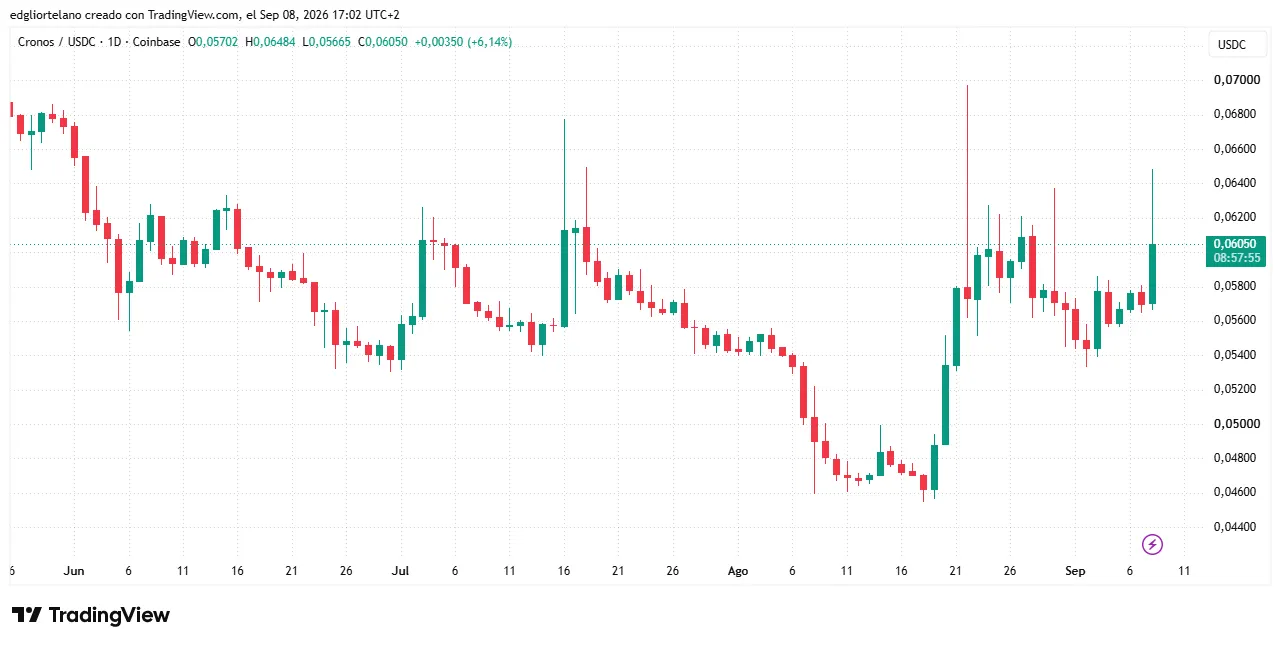
Robinhood shares, traded as HOOD, rose about 3.4% in premarket trading to roughly $126. Crypto.com’s CRO token moved toward a weekly high near $0.063 after gaining more than 6% to about $0.06, with a daily high of $0.065.
The roadmap remains subject to regulators, with equity-linked perpetual futures awaiting clearance.