

Olmo Brings a Bilingual Borderlands Story to the Big Screen
Fernando Eimbcke’s bilingual coming-of-age film brings 1970s borderlands life to theaters

LAS CRUCES, N.M. — Fernando Eimbcke’s “Olmo” opens in theaters on Friday, marking the acclaimed Mexican director’s first project set and produced within the United States. The bilingual coming-of-age film moves his familiar examination of adolescent anxiety to the American Southwest, placing its story in 1970s Las Cruces, New Mexico.
The film’s lead, Aivan Uttapa, was 14 when “Olmo” was shot and is now 17. The Las Vegas-based actor was chosen after a search that reached major casting hubs in Los Angeles and New York, with Eimbcke selecting him from a self-taped audition. Uttapa began acting at age 12 under the guidance of acting coach Frank Parillo.
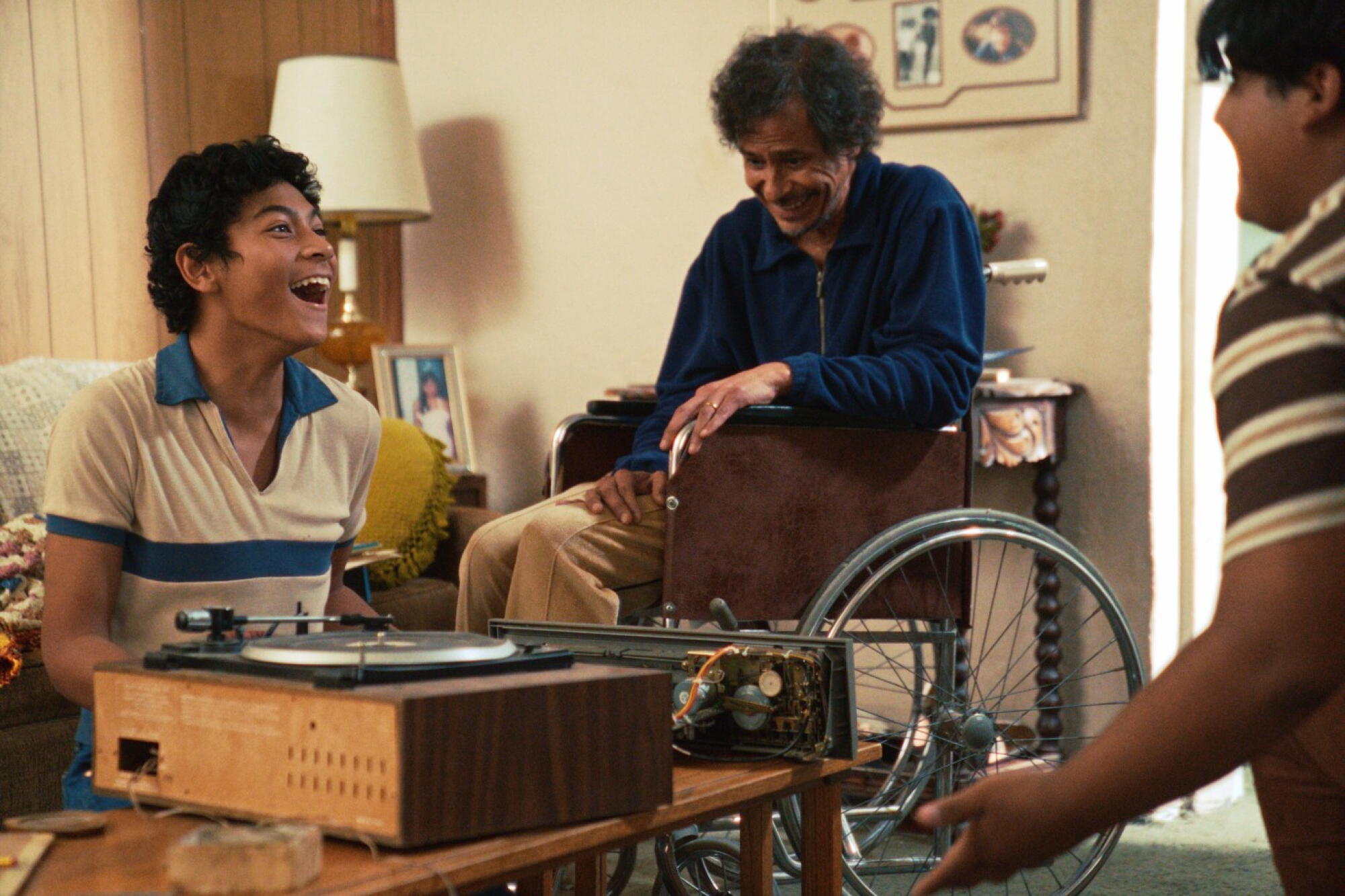
Written by Eimbcke and his long-time collaborator Vanesa Garnica, the story unfolds during a single pivotal Saturday. Fourteen-year-old Olmo must care for his bedridden immigrant father, Néstor, played by Gustavo Sánchez Parra, while his mother, portrayed by Andrea Suárez Paz, is at work. At the same time, Olmo’s crush, Nina Sandoval, played by Melanie Frometa, invites him and his best friend Miguel, played by Diego Olmedo, to a party if they bring a working stereo.


Uttapa has a personal connection to the bilingual household shown in the film. A second-generation Mexican American whose grandmother immigrated from Mexico, he experienced the same domestic language dynamic as Olmo. Since completing the movie, he has continued building his television resume, recently appearing as Grady Barnhill in two episodes of the Max medical drama series “The Pitt.” He considers Olmo a career highlight because of its cultural resonance.
During regional pre-production scouting, Eimbcke observed a recurring pattern in Latino households: immigrant parents spoke to their children in Spanish, while the children answered in English. He used that linguistic split to explore the family’s emotional core rather than treating it as a barrier, with understanding extending beyond literal vocabulary.
The director’s interest in youth was shaped by his upbringing in Mexico and by American coming-of-age films from the 1980s. Government censorship altered some of his early encounters with that cinema. A rented VHS copy of John Hughes’s “The Breakfast Club” (1985), for example, was missing the scene in which the teenage characters smoke marijuana. Hughes’s “Ferris Bueller’s Day Off” (1986) nevertheless left a lasting impression, and Eimbcke noticed that Mexican youth lacked an equivalent kind of cinema.
His influences also included Mexican television, particularly the highly popular Televisa Channel 2 telenovelas. Among them was the 1987 drama “Quinceañera,” starring Thalía. Uttapa’s own musical interests also suited the film’s period: his mother calls him an “old soul” because he enjoys classic rock and pop acts including Elvis Presley, Del Shannon, AC/DC, and Led Zeppelin, along with cumbia.
Eimbcke’s career began in Mexican independent cinema with his 2004 debut feature, “Temporada de patos” (“Duck Season”). The minimalist black-and-white film about two unsupervised teenagers in a Mexico City apartment was selected for Critics’ Week at the Cannes Film Festival and won 11 Mexico Ariel Awards, including Best Picture and Best Director.
His next films expanded that international record. “Lake Tahoe” (2008) won the Alfred Bauer Prize and the FIPRESCI Critics’ Prize at the Berlin International Film Festival, while “Club Sandwich” (2013) earned Eimbcke the Best Director award at the San Sebastián International Film Festival. The geographical shift to New Mexico makes “Olmo” a departure for the 55-year-old director, whose career had been anchored in Mexican cinema.
The project took shape after Eimbcke spent six years living in Germany and was contacted by Plan B Entertainment, the U.S. production company co-founded in 2001 and known for producing Oscar-winning films such as “Moonlight” and “12 Years a Slave.” Plan B’s initial proposal did not materialize, but the exchange led Eimbcke to develop his own script about bicultural dynamics.
For the visual and emotional tone of 1970s New Mexico, Eimbcke and Garnica drew on several sources. The pair, who have been friends since they were 14, looked to the literary work of Dominican American author Junot Díaz, known for bilingual narratives about the immigrant experience, and to photographer Kevin Bubriski’s monograph “The New Mexicans: 1981-1983,” which documented the state’s multicultural communities.
Making his first bilingual project also produced an unexpected challenge for Eimbcke. While filming a scene in which Olmo and Miguel dance to the newly repaired stereo, he urged the actors to behave more wildly by shouting “More caos!”—using the Spanish word for chaos. The assistant director briefly misunderstood the pronunciation as “cows.”
Eimbcke sought natural performances from the young cast by maintaining a playful atmosphere on set. He paired the younger, less experienced actors with veteran Mexican performers such as Sánchez Parra and Suárez Paz, creating a collaborative production environment that combined professional technique with spontaneous performance.
The film’s Las Cruces production took place during a broader filmmaking boom in New Mexico. The state has become a premier production hub, informally known as “Tamalewood,” driven by a tax incentive program administered by the New Mexico Film Office. Olmo’s family dilemma remains caught between those local realities and the teenager’s wish to attend a party: he must choose between caring for his family and pursuing teenage fun.









