

Nvidia Stock Hits Record $237.88 as Market Cap Tops $5.7T
Weak U.S. jobs data and a historic $235 billion buyback authorization fuel the chipmaker's surge past previous valuation records.

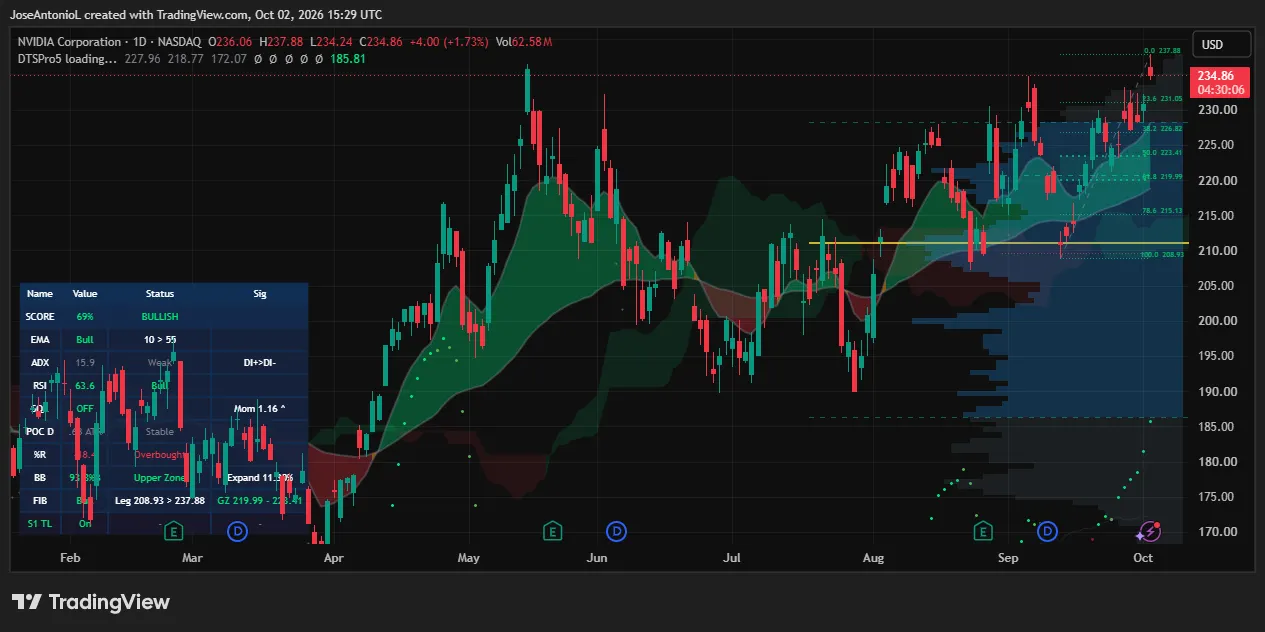
Nvidia shares surged to an all-time high of $237.88 during Friday morning trading, pushing the chipmaker’s market capitalization to approximately $5.7 trillion. The milestone cements Nvidia’s position as the most valuable publicly traded company in history and marks its first record close since May.
The valuation leap arrives just days after a sharp deceleration in U.S. hiring effectively killed expectations for a Federal Reserve interest rate hike. Employers added only 29,000 jobs in September, missing consensus estimates near 90,000, while the unemployment rate ticked up to 4.2%. For capital-intensive technology firms financing massive data center buildouts, lower borrowing costs are critical. Because Nvidia dominates the AI accelerator market with an estimated 80% share or more, cheaper debt disproportionately benefits its hyperscale customers—Amazon Web Services, Microsoft Azure, and Meta—ensuring their purchasing power for GPUs remains intact even if broader economic conditions soften.

Wall Street’s enthusiasm was further catalyzed by a historic capital return program announced Sept. 28. The board authorized an additional $150 billion in share repurchases, expanding the total buyback capacity to $235 billion through fiscal 2028. By retiring outstanding shares, the program mechanically increases earnings per share for remaining investors. At this scale, the authorization exceeds the entire market capitalization of most S&P 500 companies, signaling management’s confidence that current cash flows can comfortably fund both aggressive research and development and massive shareholder returns simultaneously.
Those cash flows are accelerating. Nvidia reported $96.2 billion in revenue for the quarter ended July 26, a 106% increase from the prior year. Data center operations generated $89 billion of that total, underscoring how thoroughly artificial intelligence infrastructure has eclipsed gaming and professional visualization as the company’s primary growth engine. Management guided for $108 billion in revenue for the current quarter ending in October, suggesting demand continues to outpace supply constraints.
A significant portion of that demand is now tied to the Vera Rubin architecture. On Sept. 23, server manufacturer Supermicro confirmed it had begun shipping racks built on Nvidia’s newest platform, with each cabinet housing 72 Rubin GPUs. The transition from the Hopper and Blackwell generations to Vera Rubin represents a critical test of whether hyperscalers will maintain their rapid hardware refresh cycles or begin stretching deployment timelines. Early shipment data suggests the former.
Nvidia has increasingly moved beyond simply selling silicon to actively underwriting the AI ecosystem. The company committed $30 billion to OpenAI in September 2025, following an initial pledge of up to $100 billion, alongside a separate $10 billion investment in Anthropic. These strategic stakes blur the line between vendor and venture capitalist, locking Nvidia into the financial success of the very startups driving global GPU consumption. By funding its largest customers, the company creates a self-reinforcing loop where its capital directly translates into future hardware orders.
The scale of Nvidia’s footprint becomes clearer when measured against other asset classes. In August 2023, the company surpassed the $1.18 trillion valuation of the entire cryptocurrency market at the time. It overtook Apple at the $3 trillion mark in June 2024 and became the first corporation to breach $5 trillion in October 2025. Today, with Bitcoin trading around $84,767 and the total crypto market hovering just above $3 trillion, Nvidia alone is worth nearly double the combined value of all digital assets.
Retail investors are deeply exposed to these swings regardless of whether they actively trade tech stocks. As a heavyweight component of the S&P 500, Nasdaq-100, and virtually every major growth-oriented index fund, Nvidia’s price action directly dictates retirement portfolio performance for millions of Americans. The stock has climbed more than 40% from its March 30 low of $165.17, dragging broad-market indices higher alongside it.
Behind the scenes, Nvidia is securing the physical components necessary to sustain this trajectory. The company disclosed $366 billion in multiyear AI infrastructure commitments, with $279 billion dedicated primarily to memory procurement. High-bandwidth memory (HBM) remains one of the most severe bottlenecks in semiconductor manufacturing. Locking in long-term supply agreements with memory producers ensures Nvidia can fulfill hyperscaler orders without facing the allocation shortages that have periodically constrained the industry.
The Nasdaq composite rallied on Friday following the release of the September employment data, reflecting the market’s immediate pivot toward rate-cut probabilities. Nvidia currently holds $235 billion in authorized buyback capacity available through January 2028.






