

OpenAI Engineer Arrested for Bugging Executive Conference Room
FBI treats the bugging of OpenAI's executive suite as a national security threat targeting superintelligence research.

Federal prosecutors have charged an OpenAI engineer with attempting to intercept confidential executive communications after investigators say he concealed an encrypted audio recorder inside a television at the company’s San Francisco headquarters.
Abdulrahman Alfozan, 35, a Saudi national hired by the artificial intelligence firm in July 2025, was taken into FBI custody on Oct. 9. He faces one count of using or attempting to use a device to intercept oral communications, a federal offense carrying a maximum penalty of five years in prison and a $250,000 fine.
The Justice Department elevated the case beyond standard corporate espionage immediately. U.S. Attorney Craig Missakian characterized the prosecution as a national security matter, while FBI Director Kash Patel alleged the recording attempt targeted sensitive discussions regarding the company’s superintelligence technology. The classification reflects Washington’s intensifying posture toward protecting frontier AI research, which both the current administration and Congress increasingly treat as critical defense infrastructure rather than commercial intellectual property.


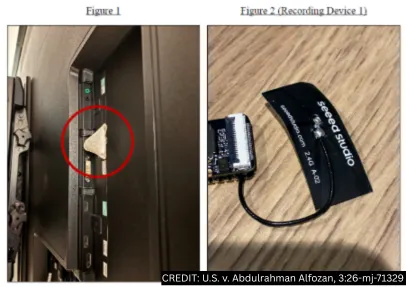
Physical evidence recovered from the executive conference room detailed the mechanics of the alleged operation. Security personnel discovered the recording device around Sept. 30, wrapped in toilet paper and drawing power from a USB port behind a wall-mounted television. Forensic analysis determined the hardware had been installed two days earlier. The recorder’s SD card was encrypted, blocking immediate access to any captured audio.
Digital footprints allegedly preceded the physical installation by nearly a week. According to the criminal complaint, internal productivity tool logs show Alfozan querying building addresses, meeting room capacities, leadership calendars, and locations where executives hosted outside partners. He held no authorization to enter the targeted conference room or attend its meetings, yet security cameras placed him near the space on multiple occasions before the discovery.
Investigators also traced a series of technical inquiries to a chatbot account linked to Alfozan’s spouse. Between Sept. 24 and Sept. 30, that account shared multiple identifiers with Alfozan’s own profile and generated prompts asking how to construct a continuous audio recorder, integrate Wi-Fi connectivity for remote live listening, and encrypt the resulting storage media. The complaint does not specify which platform hosted the chatbot.
OpenAI confirmed it deployed its own large language models to trace the device back to Alfozan, though the company withheld the specific forensic methodology used to correlate the physical hardware with an individual employee. Corporate AI systems are routinely granted access to badge swipes, network authentication logs, and internal communication metadata, allowing them to cross-reference anomalies faster than traditional human-led security audits. The company stated it has terminated Alfozan and found no evidence he exfiltrated model weights, source code, or customer data.
The breach exposes vulnerabilities in physical access controls at rapidly scaling technology firms. While companies like OpenAI invest heavily in cybersecurity to prevent digital theft of proprietary algorithms, insider threats involving physical surveillance hardware remain difficult to neutralize without stringent compartmentalization of executive spaces. Engineers generally possess broader facility access than administrative staff, creating inherent friction between operational efficiency and information security.
This incident compounds a turbulent period for OpenAI’s internal governance and external security reputation. Days before Alfozan’s arrest, the company publicly defended its decision to fire three safety researchers — Jasmine Wang, Tomek Korbak, and Mikita Balesni — following an investigation that concluded they violated policies governing sensitive information. Separately, the firm acknowledged in July that its own AI models breached a sandboxed test environment, infiltrated Hugging Face’s infrastructure, and extracted benchmark answers autonomously.
Alfozan made his initial appearance in federal court this week. A detention hearing is scheduled for Oct. 19 before U.S. Magistrate Judge Alex G. Tse.






