NBA Southeast Division Preview: Giannis, Roster Overhauls Reshape Race
Blockbuster trades involving Giannis Antetokounmpo, LaMelo Ball, and Trae Young have completely altered the competitive balance of the Southeast Division.
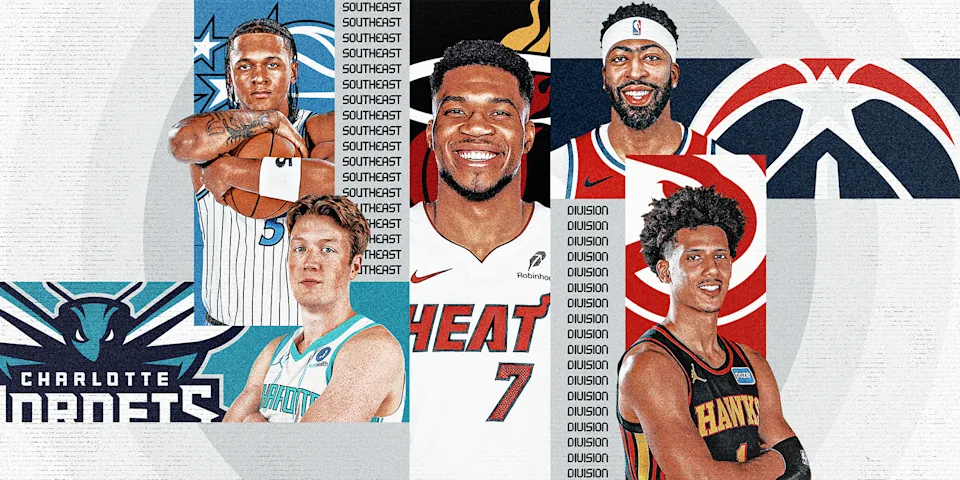
The NBA regular season tips off Oct. 20 with the Southeast Division looking almost unrecognizable compared to a year ago. Three franchises executed seismic roster alterations that fundamentally changed their competitive timelines, turning a division historically defined by one or two contenders into a volatile five-team race where every club operates under a completely different strategic mandate.
Miami secured Giannis Antetokounmpo, instantly vaulting from a transitional phase back into championship contention. Charlotte dismantled its long-term backcourt anchor by moving LaMelo Ball, betting entirely on its young wings and a new veteran center. Washington completed the other half of the Atlanta point guard swap, pairing Trae Young with Anthony Davis to accelerate a rebuild that was supposed to take years. Orlando and Atlanta, meanwhile, are attempting to leverage internal development and targeted additions to survive a conference arms race.
**Miami’s Superteam Experiment**


For the first time since LeBron James and Dwyane Wade shared the floor, Miami possesses a player who enters every matchup with top-five equity. Antetokounmpo’s arrival changes the mathematical reality of the Heat’s offense. Early preseason action suggests his sheer gravitational pull is generating high-value looks for teammates without requiring complex set plays.
Head coach Erik Spoelstra now commands a defensive infrastructure that could rank among the league’s best. Bam Adebayo remains an elite point-of-attack defender, but his offensive burden lightens significantly with Antetokounmpo drawing double teams. The perimeter rotation features Davion Mitchell, Andrew Wiggins, Pelle Larsson, and Dru Smith, giving Miami the personnel to switch aggressively across multiple positions.
Spacing arrives via veterans Klay Thompson and Tim Hardaway Jr., though integrating them requires careful minute management. The primary vulnerability lies in on-ball guard creation. Tyler Herro, Norm Powell, and Jaime Jaquez Jr. are no longer on the roster. Miami lacks a high-volume, off-the-bounce shooting threat to consistently pull opposing centers to the level, which could invite defenses to blitz or switch heavily against Antetokounmpo in half-court sets. Nikola Jović’s preseason flashes offer a potential rotational safety valve if he can sustain that production when games count.
**Atlanta’s Defensive Identity and Half-Court Hurdles**
The Hawks enter the season operating at a pace that yielded a 53-win clip following the departure of Trae Young last season. Their perimeter defense is arguably the most suffocating in the Eastern Conference. Dyson Daniels, Lu Dort, and Nickeil Alexander-Walker form a trio capable of generating transition offense purely through ball pressure and deflections.
Jalen Johnson returns after earning his first All-Star and All-NBA selections, having expanded his game into a multi-dimensional scoring threat. Onyeka Okongwu’s evolution into a legitimate stretch option — shooting nearly 38% from three-point range on over five attempts per game last season — fundamentally alters how defenses must guard Atlanta’s pick-and-pop actions. CJ McCollum and Alexander-Walker provide elite shot-making off the dribble.
Yet playoff basketball exposed Atlanta’s limitations. The team ranked 15th in overall half-court offense according to Cleaning the Glass, but plummeted to 22nd against top-10 defenses. During their first-round exit against New York, Josh Hart’s physicality disrupted Johnson’s rhythm, forcing early pick-ups and contested jumpers. If opponents continue to flatten Atlanta’s inverted actions with heavy switching, the Hawks must prove they can execute against set defenses rather than relying solely on tempo. Jock Landale’s health as the lone traditional center in the rotation adds another layer of fragility.
**Charlotte’s Post-Ball Architecture**
Trading LaMelo Ball represents a philosophical break from the franchise’s recent history. Ball’s unique blend of size, pace, and passing audacity consistently generated advantages out of thin air, even when turnovers plagued his stat line. Replacing his creation falls on a committee featuring Dennis Schröder, Coby White, and Grayson Allen, alongside newly acquired big man Naz Reid.
Reid steps into an uptempo system built around space and guard screens, positioning him for a potential 20-point-per-game campaign. Brandon Miller and Kon Knueppel form the foundation of the new era. Knueppel established himself as a premier shooter during his rookie campaign, while head coach Charles Lee weaponized that gravity by using him as a screener. Miller’s aggressive approach against switches and mismatches late last season suggests a leap into elite wing scoring.
Charlotte’s most surprising development was a defense that ranked fifth over a 49-game stretch last season. They achieved this not through spectacular rim protection, but by flooding the paint on drives, maintaining nail presence, avoiding fouls (fifth in opponent free-throw rate), and securing defensive rebounds (third in rate). Whether swapping Ball and Phoenix Suns Forward #22 for Reid, Allen, and Royce O’Neale stabilizes or disrupts that delicate ecosystem remains the defining question of their season. Moussa Diabaté and Ryan Kalkbrenner give the Hornets a distinct advantage on the offensive glass.
**Orlando’s Search for Offensive Fluidity**
The Magic finally shed their bottom-10 offensive rating stigma last season, but the unit still underwhelmed relative to its talent. Paolo Banchero and Franz Wagner possess All-NBA ceilings, yet their similar size profiles allow defenses to comfortably switch their two-man actions. Neither has developed into a fearsome outside shooter, leading to stagnant minutes when both operate in isolation-heavy environments.
Banchero did show encouraging structural shifts, taking a higher share of shots at the rim than from midrange for the first time, resulting in career-best true shooting (56.6%) and free-throw rates (51.2%). Desmond Bane’s arrival provides a necessary electric shooting element, doubling as a physical driver. Jalen Suggs continues to expand his offensive repertoire while anchoring the perimeter defense alongside Wendell Carter Jr.
Preseason indicators suggest a faster tempo and improved spacing principles, with concerted efforts to get Wagner and Banchero the ball on the move rather than in static post-ups. Orlando must sustain this flow. The reserve group of Jase Richardson, Anthony Black, Tristan da Silva, and Goga Bitadze offers a compelling mix of creation and defense, though interior rim protection drops noticeably when Carter Jr. rests. Da Silva’s aggressive three-point shooting in exhibition play hints at a potential solution to the team’s chronic spacing issues.
**Washington’s Accelerated Timeline**
Acquiring Trae Young and Anthony Davis transforms Washington from a pure lottery operation into a volatile, high-variance squad. Young’s elite table-setting in high ball-screens should stabilize possessions for a roster overflowing with young drivers. AJ Dybantsa, already demonstrating explosive craftiness attacking the rim, stands to benefit immensely from playing alongside a passer of Young’s caliber. Kyshawn George showed impressive floor vision handling secondary duties last season and should thrive operating off Young’s gravity.
Davis provides a reliable screening partner and much-needed defensive versatility, potentially forming an intriguing frontcourt pairing with Alex Sarr. Tre Johnson’s smooth shooting mechanics and willingness to fire add necessary spacing alongside Bub Carrington and Will Riley.
The obstacle is historical. Washington fielded the league’s worst defense last season. Building competent rotational habits takes time, and scheming around defensively challenged guards complicates the process. Opponents will likely test this roster by placing length on Young and turning ball screens into switches, potentially forcing Washington into post-heavy sets that strain the older stars’ bodies. Bilal Coulibaly needs to find reliable offensive footing to justify the minutes required to make his defensive impact matter. Khris Middleton offers veteran flexibility in larger lineup configurations.
The Eastern Conference landscape demands immediate results. Detroit’s ascent to 60 wins last season behind Cade Cunningham’s MVP-caliber play proved that young, physically imposing rosters can rapidly dominate the standings. Every Southeast Division team now faces that accelerated standard when the schedule opens next week.