Industrial Next Unveils AI Robotic Stations at Disrupt, Partners With BMW to Cut Factory Retooling to Minutes
BMW pilot will test if sim-trained dexterity scales from smartphone assembly to automotive production

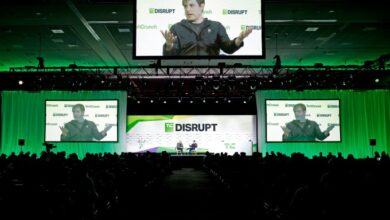
San Francisco robotics startup Industrial Next stepped onto the TechCrunch Disrupt 2026 stage Monday with a claim that could upend decades of manufacturing orthodoxy: its self-contained robotic stations can be retasked in minutes rather than weeks, using proprietary foundation models that fuse vision, task context, and motion control into a single system. The company simultaneously announced a partnership with BMW Group Technology Office to evaluate the technology for dexterous manipulation in automotive production.
The breakthrough centers on solving robotics’ persistent data scarcity problem. Unlike large language models trained on vast internet corpora, industrial robots lack the massive datasets needed to learn complex physical tasks. Industrial Next circumvents this by training its models in a high-fidelity simulation engine that replicates real-world physics with enough precision to enable sim-to-real transfer for high-precision assembly — threading flex cables, snapping microscopic connector caps, peeling protective films from camera modules — at or above human speed with 100% accuracy, even on unseen product variants.
Co-founders Lukas Pankau and Allen Pan trace the insight to their years at Tesla, where they watched cutting-edge vehicle design collide with factory equipment unchanged since the 1980s. Pankau, formerly Tesla’s lead electrical architect and later at Waymo, and Pan, who led Tesla’s autonomous factory efforts before becoming chief architect at Chinese autonomous driving firm Neolix, stayed in touch after leaving. “We’re not getting any younger, and we’re still obviously passionate about it,” Pan recalled. “We should start the company.” They founded Industrial Next in 2021.


The startup’s workstations are already deployed in production of one of the world’s highest-volume smartphones — the customer remains undisclosed — handling tasks that manufacturers had previously failed to automate. A film-peeling station demonstrated the system’s adaptability: moved to a new phone model and production line it had never encountered, the robot maintained performance without reprogramming.
BMW’s involvement signals serious automotive interest. The German automaker has aggressively pursued flexible manufacturing to support its Neue Klasse platform and mixed-model production lines. Industrial Next’s approach — teaching new tasks through simulation and demonstration rather than hard-coded scripts — aligns with the industry’s shift toward software-defined factories. The partnership will test whether the station’s claimed minute-level reconfiguration survives the torque, tolerance, and cycle-time demands of automotive assembly.
If validated, the implications extend beyond retooling speed. Current automation forces product designers to simplify for robotic repeatability. Foundation-model-driven stations that generalize across tasks could reverse that constraint, letting engineers design for function first. Pankau’s stated end goal — “building a full car end-to-end without any human touching ever” — remains distant, but the smartphone deployments prove the architecture works on delicate, high-mix tasks today.
Industrial Next joins a wave of startups — including Intrinsic, Vicarious, and Covariant — chasing the flexible automation holy grail. Its differentiation lies in the vertically integrated station: proprietary sim engine, foundation model, and hardware co-designed. The BMW pilot, expected to begin in coming months, will be the most rigorous public test yet of whether sim-trained dexterity scales to automotive complexity.