Mountain Whitetail Hunting Tactics for Steep Western Terrain
Still-hunting blocked logging roads and timing the late-season rut are critical for tagging high-elevation bucks in the Rockies.
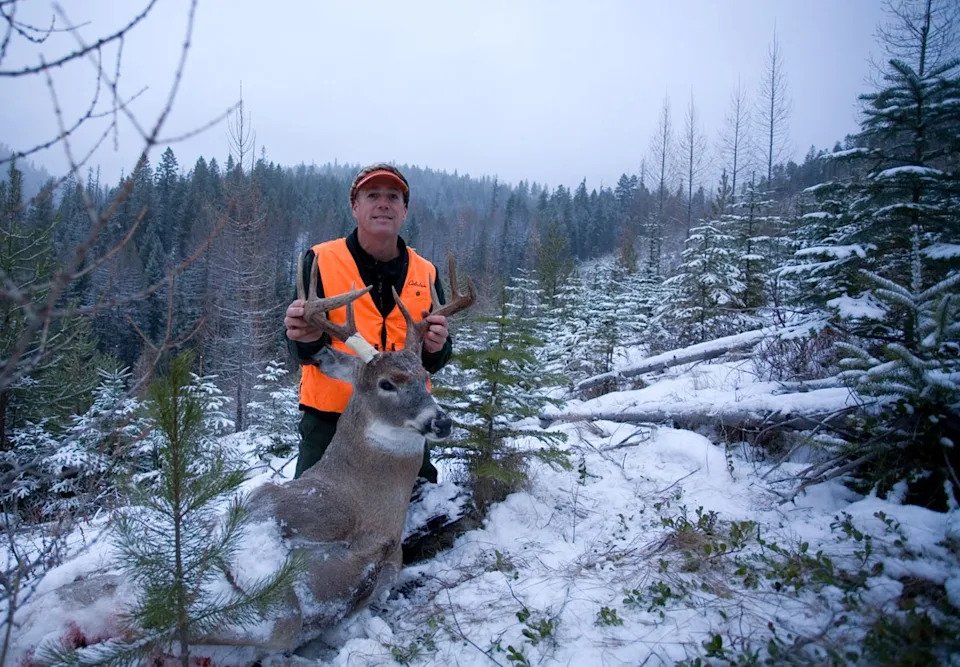
Whitetail deer occupying the steep, conifer-dense mountains of the American West represent one of the most physically demanding and tactically complex pursuits in North American big game hunting. Far removed from the agricultural edges and hardwood bottoms where the species is traditionally targeted, these high-elevation populations—often thriving at elevations up to 6,000 feet—require hunters to completely abandon conventional whitetail strategies.
Unlike mule deer, which naturally evolved to navigate open alpine basins and rocky ridgelines, whitetails are fundamentally edge-habitat animals. Their presence in the Rocky Mountains is largely tied to historical and ongoing timber management. Logging roads carved into otherwise impassable slopes, combined with clearcuts that stimulate new undergrowth, created the fragmented pockets of habitat these deer need to survive. Because human access remains limited by the punishing topography, bucks in these remote drainages frequently reach trophy proportions, maturing without the heavy hunting pressure that suppresses age classes in lower-elevation public lands.
Finding mountain whitetails requires understanding their micro-movements. They do not blanket the landscape evenly. Instead, they concentrate in specific topographical features: the heads of draws, narrow saddles connecting ridges, and finger ridges used as travel corridors. The dense lodgepole pine and Douglas fir thickets flanking these routes often reduce visibility to less than 10 yards, making traditional tracking futile. Pushing through this timber generates enough noise to clear out any animal ahead of the hunter.


Because of this impenetrable cover, blocked-off Forest Service and timber-company logging roads serve as the only practical arteries for still-hunting. These paths offer level travel through terrain where slopes are too severe to walk safely without using tree branches for balance. However, the shooting lanes along these roads are typically restricted to 20-yard gaps. A buck crossing an opening will vanish in seconds.
This reality dictates a radical shift in firearm handling. Slings should be removed from rifles and stored in a pack during active hunting hours. A rifle hanging from a shoulder costs precious seconds when transitioning to a firing position, and a swinging sling compromises off-hand stability. Lightweight platforms, such as the Remington Model Seven or modern chassis rifles like the Seekins HAVAK Pro Hunter, are essential for covering eight to 10 miles of daily foot travel. Bipods add unnecessary front-heavy bulk; compact shooting sticks are far more practical for the rare longer shot across a canyon.
Optics selection must match the environment. High-magnification binoculars designed for glassing distant mule deer on open hillsides are counterproductive here. Low-power optics in the 6x to 8x range provide the wide field of view necessary to detect movement inside nearby brush and scan opposing slopes without causing eye fatigue from constant refocusing. Rangefinding binoculars equipped with integrated ballistics software, such as the Leica Geovid Pro 8×32, eliminate the need to juggle multiple devices when a brief window of opportunity opens.
Clearcuts remain the primary feeding zones. Recent timber harvests expose moss, buds, and low-hanging branches, while older cuts develop dense brush and saplings. When approaching a cut situated below a logging road, hunters should walk the inside edge to prevent their silhouette from cresting the shoulder. Advancing requires a deliberate, step-and-pause cadence—moving forward just enough to reveal a new slice of the opening, then stopping to let the woods settle. Deer alarmed by faint noises will stand motionless for extended periods, meaning a quick glance is rarely sufficient.
Patience in these productive zones yields better results than constantly searching for new sign. Rattling antlers can amplify this stationary strategy. Sound travels exceptionally well off opposing mountain ridges. A sequence of brief rattling followed by a 10-minute pause, repeated over 20 minutes or more, can draw rutting bucks from vast distances.
Timing the hunt for late season maximizes these efforts. In states like Montana, late-season hunts align with the peak of the rut and the arrival of snow. Snow provides critical tracking contrast against dark forest floors and forces deer to move more predictably through saddles and established trails to conserve energy. Cartridges suited for varying ranges and cold-weather performance, such as the Hornady 6mm Creedmoor Precision Hunter loaded with ELD-X bullets, offer reliable terminal performance when temperatures plummet.
Surviving the physical toll demands specialized apparel. Merino wool base and mid-layers, including options like the Voormi Access NXT Pullover, manage moisture during strenuous climbs while resisting odor over multi-day backcountry excursions. Durable outer layers such as Stone Glacier De Havilland pants withstand the abrasion of deadfall and rock. Footwear must support heavy loads on sidehill traverses; heavily constructed boots like the Lowa Tibet GTX have proven durable enough to withstand thousands of miles of steep-country abuse.
Montana Fish, Wildlife & Parks manages several late-season general deer licenses specifically designed to distribute hunting pressure and provide opportunities after rifle seasons conclude in surrounding districts, keeping mountain whitetail access viable into December.