Lucas Museum of Narrative Art Blocks Public Plaza Access With Security Gates After $1 Billion Opening
Security checkpoints now control access to the billion-dollar museum's central courtyard, altering the original open-plaza design on state-owned Exposition Park land.
Visitors arriving at the newly opened Lucas Museum of Narrative Art in Los Angeles this weekend encountered a stark contradiction: a billion-dollar cultural institution built on public land that requires security screening to enter its central courtyard.
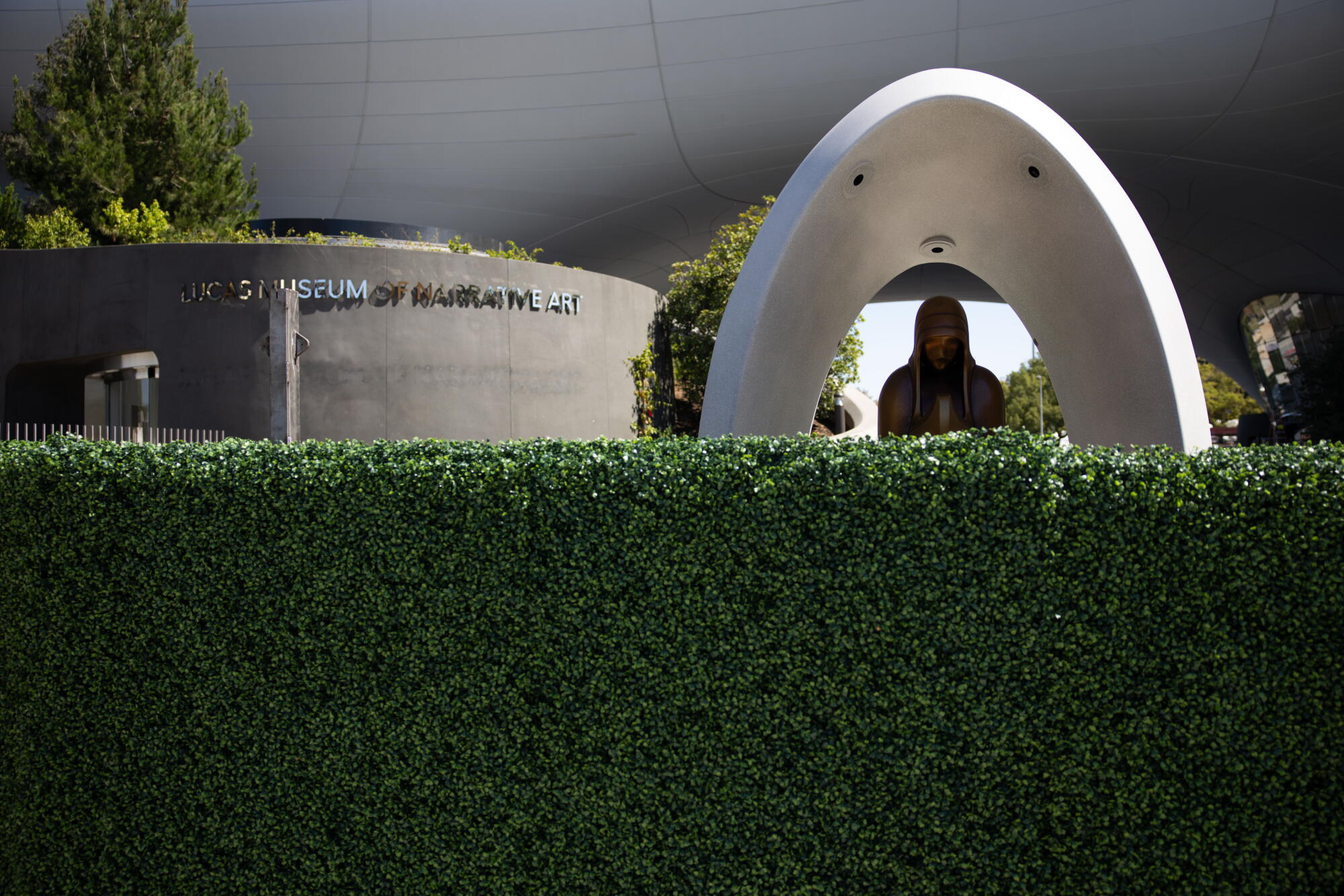
During the museum’s first public operating weekend, temporary fences draped in artificial greenery sealed off the primary entryways to the plaza beneath the building’s sweeping, spaceship-like canopy. To reach the open-air space — originally designed as a free-flowing civic gathering area connecting Exposition Park to South Los Angeles — pedestrians were funneled through two enclosed security booths. Museum officials confirmed that permanent stainless-steel barriers will replace the temporary fencing in the coming weeks, cementing a controlled-access model for the outdoor courtyard.
The decision fundamentally alters the architectural intent of the site. Designed by MAD Architects and led by principal architect Ma Yansong, the building was conceived as a hovering structure meant to draw the surrounding neighborhood inward. Renderings released during the project’s lengthy approval process depicted an entirely open ground plane without perimeter walls or gates. A later physical model displayed inside the museum does show the enclosure, but the shift from an open civic room to a screened perimeter marks a significant departure from the project’s initial public presentation.


Seth Fowler, a spokesperson for the museum, attributed the barriers to visitor safety and crowd management. He cited the need to shield the plaza from vehicle traffic on adjacent streets and to control pedestrian flow. Fowler noted that non-ticketed visitors can still access the plaza, the gift shop, and the cafe after clearing security, subject to capacity limits. An adjacent landscaped park remains accessible without screening, though its hours are restricted from 8 a.m. to sunset, and it closes entirely to non-ticket holders on USC Trojans game days due to the proximity of the Los Angeles Memorial Coliseum.
Dixon Junliang Lu, a principal at MAD Architects, stated that the fence design evolved as operational and security requirements became more defined during the project’s development. The permanent barriers will feature curved stainless steel intended to mimic Art Nouveau filigree, eventually covered in live vegetation rather than the plastic greenery used for the opening weekend. Bizarrely, the current makeshift perimeter is guarded by tall statues blending stormtrooper armor with USC Trojan motifs.
The gating of the Lucas Museum plaza stands in sharp contrast to standard practices at major American cultural institutions. Just miles away, the new David Geffen Galleries at the Los Angeles County Museum of Art allow unrestricted public access to their underlying plazas without security checkpoints. Across the country, landmark civic spaces — including the steps of the Metropolitan Museum of Art in New York and the grounds of the Smithsonian museums in Washington, D.C. — remain open to passersby, with security screening reserved strictly for interior galleries.
This distinction carries weight because of the museum’s unique relationship with public land. The Lucas Museum sits within California state-owned Exposition Park. George Lucas secured the site after a protracted bidding war against San Francisco and Chicago, ultimately agreeing to a lease costing just $30 annually. In exchange, the facility was pitched to city and state officials as a transformative public asset dedicated to “narrative art” — a populist category encompassing illustration, comics, cinema, and digital media aimed at broad audiences rather than traditional fine-art patrons. Lucas and his wife, Mellody Hobson, funded the construction privately, but the footprint occupies taxpayer-held parkland historically utilized as an unrestricted thoroughfare by South L.A. residents.
Architectural security experts note that fortifying a public plaza does not require sealing it behind gates. Hostile vehicle mitigation — a primary concern for high-profile landmarks — is routinely achieved through reinforced concrete planters, sculptural bollards, and grade changes that stop cars without impeding foot traffic. Landscape architecture techniques, including water features and strategic sight lines, establish protective distance while maintaining visual and physical openness. Retractable barriers offer flexibility for large-scale events or elevated threat levels, allowing spaces to function normally day-to-day. The Eiffel Tower represents one of the few global precedents for a fully sealed monument base, a measure implemented following the 2015 Paris terrorist attacks and widely criticized by urbanists for degrading the pedestrian experience.
For residents living west of the museum complex, the new barriers introduce immediate logistical friction. Because the adjacent park closes at sunset and restricts access during football games, locals attempting to cross between neighborhoods outside of operating hours must now navigate around the entire perimeter of the massive structure rather than passing through the plaza.
Museum leadership maintains that the security protocols balance accessibility with the realities of managing a high-traffic venue in a major metropolitan center. The permanent Art Nouveau-style fencing is scheduled for installation over the coming weeks, replacing the temporary barriers erected for the inaugural weekend.