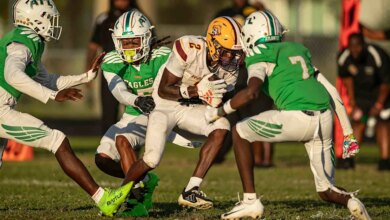
Army football faces tempo test against Florida Atlantic
Black Knights pivot from Tulane's ground game to defend one of the FBS's fastest no-huddle passing attacks on Saturday.

West Point, N.Y. — Army head coach Jeff Monken spent the week preparing his defense for Tulane’s inside rushing attack. Now he has roughly six days to overhaul that entire game plan.
The Black Knights host Florida Atlantic at Michie Stadium on Saturday, Oct. 17, in an American Athletic Conference matchup defined by extreme schematic contrast. Kickoff is scheduled for noon ET, with television coverage on CBS Sports Network.
Florida Atlantic (4-1, 1-0 AAC) operates one of the fastest no-huddle offenses in the Football Bowl Subdivision, ranking second nationally in minimizing play-clock usage. The Owls rely heavily on a high-volume passing attack designed to exhaust opposing defenses before they can substitute or align properly.


That tempo presents a specific vulnerability for Army (3-2, 2-1 AAC). The Black Knights’ triple-option offense is engineered to dominate time of possession and limit total game possessions, keeping their own defense rested. When opponents snap the ball rapidly, Army defenders are forced to stay on the field longer than Monken’s system intends. Stopping quick-tempo spread teams has been a persistent challenge for the program over recent seasons.


Vegas oddsmakers initially installed Army as a three-point home favorite. By Monday evening, that line tightened to 2.5 points. The over-under sits at 55.5 points, a notable departure from the low-scoring projections typical of Army games. Bookmakers anticipate Florida Atlantic will generate significant offensive output, requiring the Black Knights to convert red-zone trips into touchdowns rather than settling for field goals.
The expectation for higher scoring reflects Army’s recent fourth-quarter volatility. The Black Knights have played four one-possession games in the past month alone, extending a two-season stretch of 13 such contests. Army holds a 2-2 record in tight games this season and a 6-7 mark in close matchups since the start of the 2025 campaign.
Those margins have swung both ways violently. South Florida scored twice in the final four minutes, including a go-ahead touchdown with 19 seconds left, to beat Army 28-24 on Sept. 12. Two weeks later at Temple, quarterback Cale Hellums orchestrated a 12-play scoring drive in the final six minutes to secure a 21-17 victory. At Louisiana Tech on Oct. 3, Army mounted two fourth-quarter touchdown drives but failed to recover an onside kick in a 31-29 loss.
Against Tulane last Friday, Army erased deficits of 10-7 and 17-10 in the fourth quarter, consuming the final 3:55 of regulation to set up Dawson Jones’ 25-yard field goal as time expired for a 20-17 win.
“I fully anticipate that we’re probably going to live in that world,” Monken said regarding the frequency of tight finishes. “We’re going to have close games, and we’re going to have to slug it out and find a way at the end. It’s just who we are.”

The service academy model inherently contributes to these razor-thin margins. Unlike Power Four programs that stockpile five-star recruits at every position, Army relies on developmental players executing a highly specialized option scheme. Mistakes carry heavier consequences, and talent disparities often compress late in games when fatigue sets in.
Florida Atlantic arrives in West Point following a dominant run through its non-conference slate, though the schedule featured Texas Southern and Louisiana Monroe after a season-opening 66-21 loss at Florida. The Owls also defeated Navy 38-30 on Sept. 12, providing a direct data point for how their spread attack performs against a service academy opponent. Beating Navy suggests FAU’s offensive architecture translates well against disciplined, assignment-heavy defenses, even if the triple-option differs from Army’s specific execution.

Saturday’s broadcast features Jack Gordon on play-by-play, Taylor McHargue providing analysis, and Tina Cervasio reporting from the sideline. Radio coverage spans WBNR (1260-AM, 96.5-FM), WLNA (1420-AM, 94.3-FM), and WGHQ (920-AM, 92.5-FM), alongside Sirius XM Channel 167 and streaming via CBSsports.com/cbs-sports-network/.
Following the Florida Atlantic game, Army travels to Tulsa for an 8:30 p.m. ET kickoff on Oct. 23 broadcast on ESPN2. Florida Atlantic hosts Rice on Oct. 24.