Golf Simulators and Pickleball Courts Reshape 2026 Home Sales
Listing data shows a 25% surge in sport-specific amenities as buyers replace traditional game rooms with resort-style recreational infrastructure.
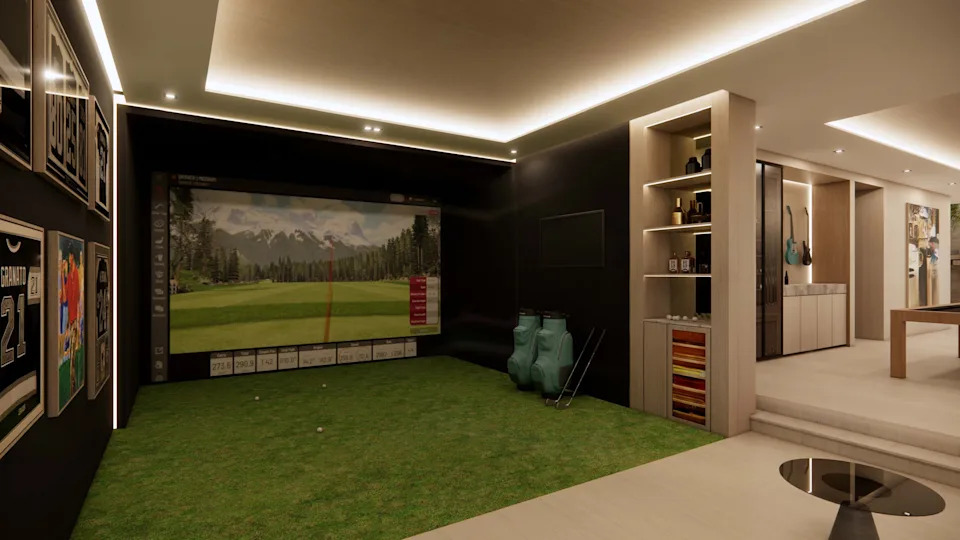
Residential real estate in 2026 is being reshaped by a specific type of buyer demand: dedicated spaces for golf simulators, pickleball courts, and batting cages. As the housing market tilts slightly toward buyers, these sport-specific amenities have moved from luxury novelties to primary decision factors that can determine whether a property receives an offer.
Listing data from Zillow shows mentions of golf simulators and pickleball courts surging 25% year-over-year, while batting cage references climbed 18%. Conversely, the traditional “man cave” — a staple of 2010s home marketing — has dropped 10% in listing descriptions. Because agents operate under strict character limits on major platforms like the MLS and Zillow, this vocabulary shift signals exactly where buyer capital is flowing.
The transition represents a generational upgrade in how Americans use domestic space. Pool tables and ping-pong setups defined the recreation rooms of the 1980s and 1990s. Today’s buyers, many of whom permanently altered their commuting and social habits during the pandemic, expect resort-level infrastructure inside their own properties. Real estate professionals note that passionate participants in sports like golf and pickleball will actively bypass otherwise suitable homes if they lack these features, treating them as non-negotiable lifestyle requirements rather than bonuses.


While these installations originated in the ultra-luxury custom estate market, they are now filtering into mid-range new construction. The economics of retrofitting vary significantly by sport. Building a standard outdoor pickleball court typically requires $8,000 to $12,000, factoring in excavation, grading, surfacing, and net systems. Golf simulators present a much wider financial spectrum. Entry-level launch monitors and impact screens start around $6,000 to $8,000, but high-fidelity commercial-grade setups requiring advanced radar tracking, electrical coordination, and acoustic calibration routinely push total investments to $40,000 or $80,000.
Spatial engineering remains the primary barrier for homeowners attempting these retrofits. A functional indoor golf simulator room generally demands a minimum footprint of 15 feet in width, 20 feet in depth, and a 10-foot ceiling height to safely accommodate a full driver swing without clubhead strikes. In dense, car-centric markets like Los Angeles, where garage conversions are complicated by parking needs, architects are increasingly designing dedicated simulator wings that rival traditional home theaters in square footage and finish quality. Baseball hitting simulators are also gaining traction, utilizing the same optical sensor technology adapted for pitch tracking and swing analysis.
Urban developers are responding to the trend by embedding recreational infrastructure directly into condominium amenity decks, solving the spatial constraints that prevent individual apartment owners from building private courts. The Henry, a boutique condominium on Manhattan’s Upper West Side, recently introduced what brokers identify as New York City’s first indoor residential pickleball court. Nearby on the Upper East Side, developments at 255 East 77th Street and 200 East 75th Street feature multi-sport simulators allowing residents to play virtual hockey, soccer, baseball, and golf year-round.
This urban integration addresses a specific geographic vulnerability. In cities with harsh winters or limited public park access, indoor recreational amenities provide continuous utility, effectively eliminating seasonal downtime for athletes. Brokerage data suggests these shared facilities act as powerful retention tools for condo boards and leasing offices competing for tenants who prioritize wellness and active lifestyles.
The demand extends well beyond primary residences into the short-term rental sector, where unique amenities directly dictate booking velocity and nightly rates. Property management firms are actively acquiring or building homes centered entirely around recreational draws. Nashville-based Hebron House Management recently listed vacation properties featuring private outdoor pickleball courts and dedicated golf simulator houses, marketing the structures as experiential destinations rather than standard lodging. Industry operators report that homes offering group-oriented physical activities consistently outperform comparable properties in occupancy metrics, as travelers increasingly seek communal entertainment over passive accommodation.
Florida’s luxury condo market continues to aggressively adopt the trend. Developments such as Riva Residenze in Fort Lauderdale and ONE Tampa by Kolter Urban have integrated expansive golf and Formula 1 simulators into their common areas, positioning these technologies as standard expectations for high-net-worth buyers entering the 2026 market.