Enterprise AI ROI Depends on Workflow Redesign, Not Tools
Banks, travel firms, and manufacturers detail how controlling token costs and rebuilding legacy processes drives actual returns from generative AI.
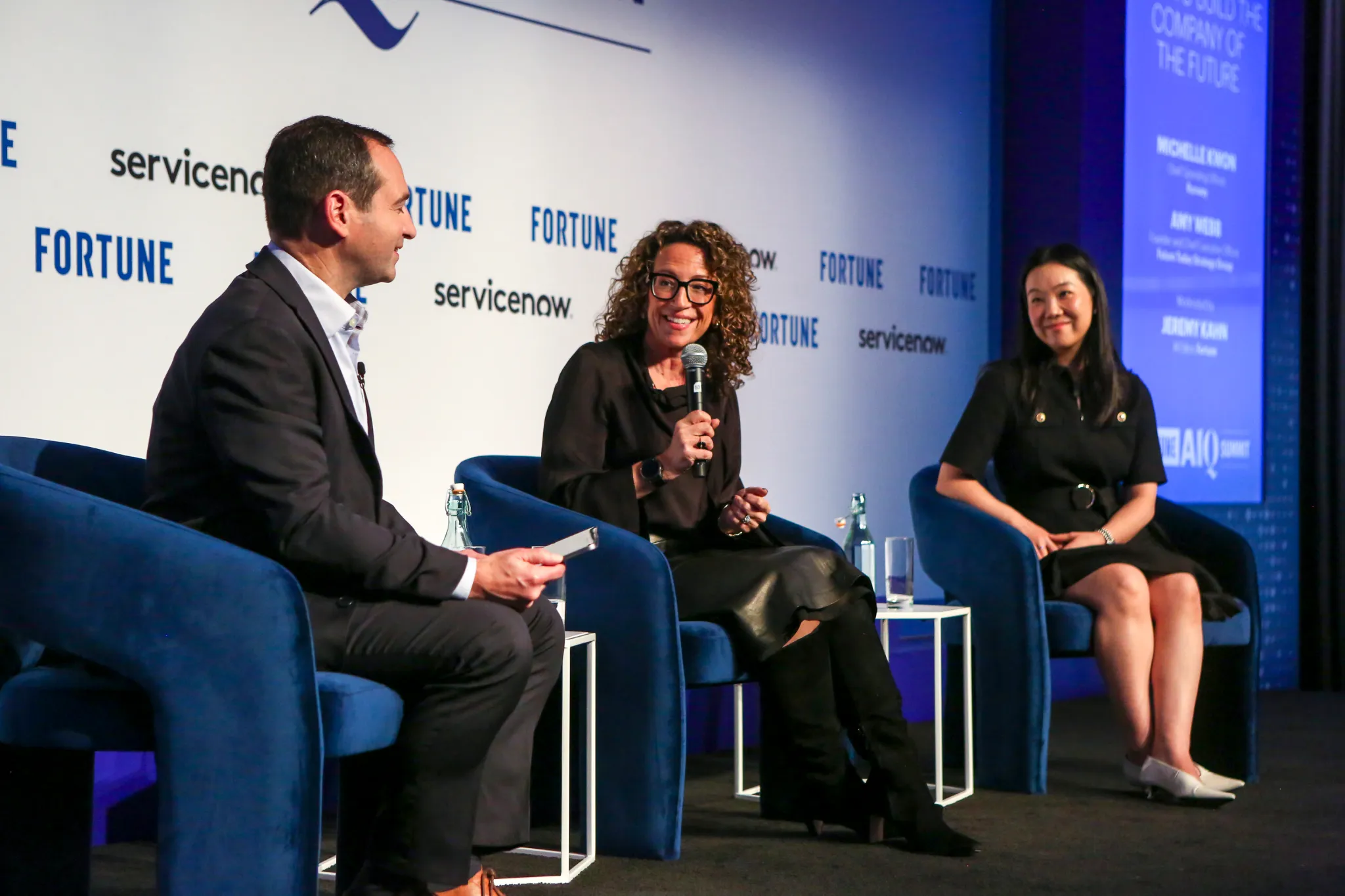
Corporate America is spending billions to deploy generative artificial intelligence, but executives across banking, travel, and industrial manufacturing are discovering that buying software licenses does not automatically translate into measurable returns. The organizations pulling ahead are the ones dismantling legacy workflows, aggressively managing inference costs, and accepting that frontier models remain too unreliable for safety-critical physical operations.
The gap between companies treating AI as a productivity overlay and those using it to restructure operations has widened sharply. According to ServiceNow’s Enterprise AI Maturity Index, 57% of organizations classified as “pacesetters” fund continuous AI upskilling, compared with just 4% of their peers. The disparity in talent strategy is even steeper: 68% of pacesetters actively recruit and retain specialized AI personnel, while only 10% of other firms do the same.
Diana David, director of futures at ServiceNow, cautioned that near-universal tool access creates an illusion of progress. Roughly 95% of employees now have access to some form of enterprise AI, she noted, but without targeted training and redesigned processes, adoption metrics fail to convert into actual output. Paul Fipps, president of global customer operations at the company, pointed to Standard Chartered as a benchmark, where AI deflected 77% of internal employee requests across HR, legal, and technology functions. Fipps argued that horizontal deployment—spanning multiple back-office departments simultaneously—generates compounding value that isolated departmental pilots cannot achieve.


This structural approach contrasts with how many large enterprises initially entered the market. Amy Webb, founder and CEO of Future Today Strategy Group, said Fortune 500 companies are broadly late to AI integration, having funded disconnected pilot programs without establishing the strategic architecture required to sustain them. Artificial intelligence did not arrive two years ago, Webb noted, yet capital continues flowing into projects lacking durable operational plans.
The financial mechanics of running these systems have forced a rapid evolution in procurement strategies. Early adopters often defaulted to the most capable available models for every task, a practice that quickly proved economically unsustainable. AJ Wijesinghe, chief AI officer at Ecolab, said relying on top-tier models for high-volume processing caused token costs to spike beyond the expense of manual human labor. By optimizing model selection, Ecolab reduced its token expenditure by 70% to 80%.
Booking Holdings applied a similar discipline through what executive vice president and CFO Ewout Steenbergen described as “effective model cost routing.” The travel company directs routine queries to cheaper, faster models while reserving expensive, high-reasoning architectures for complex problem-solving. The results are visible in the company’s operating margins: customer-service costs have declined slightly even as booking volumes grow at a high-single-digit rate. Internally, Booking’s 9,000 engineers are shipping roughly 30% more code into production, measured by merge requests passing quality-control standards.
Steenbergen acknowledged that even the hyperscalers investing hundreds of billions into large language model infrastructure lack precise visibility into their ultimate return on investment. For Booking, the long-term value lies less in automating existing travel logistics—the fundamental nature of hotels and airlines remains unchanged—and more in using AI to anticipate traveler disruptions, thereby increasing brand loyalty and lifetime customer value.
In regulated sectors, the rush to deploy autonomous agents has collided with compliance realities. Hari Gopalkrishnan, chief technology and information officer at Bank of America, said one of the industry’s most frequent errors is reflexively applying generative AI when traditional deterministic models perform adequately. The bank evaluates every proposed AI initiative against 16 distinct risk pillars, encompassing privacy, bias, workforce displacement, and intellectual property exposure. Gopalkrishnan emphasized that assistive agents operating with humans in the loop currently deliver far more practical value than fully autonomous systems.
Sally Moore, chief client officer and co-head of market intelligence for Kensho Data & Platforms at S&P Global, reinforced that data integrity dictates AI utility in finance. Clients operating within regulated workflows demand citations, auditability, and exact traceability to source documents—requirements that probabilistic text generation inherently struggles to guarantee without rigid architectural guardrails.
The limitations of current AI reliability become acute outside the office environment. Suresh Venkatarayalu, chief technology officer at Honeywell Technologies, highlighted a severe mismatch between software expectations and physical engineering requirements. Industrial customers demand 99.9999% system reliability, whereas leading frontier models frequently operate around 85% accuracy. In commercial real estate or water treatment facilities, a system failure can trigger immediate operational shutdowns. Consequently, Honeywell operates in a semi-autonomous framework where human operators remain mandatory, because a building management system cannot tolerate a 90-minute outage while an algorithm hallucinates a response.
Managing the human element inside the enterprise presents its own friction. While leaders like Danielle Gonzalez, chief people officer at Palo Alto Networks, report massive efficiency gains—an internal custom agent reduced IT tickets by 83%—the pace of change is straining workers. Francis Shanahan, chief technology officer at Peloton, warned that the ability to instantly generate unlimited outputs is driving employee burnout. Michelle Kwon, chief operating officer at Runway, added that volume is not a proxy for quality; unvetted AI-generated material often creates downstream work for colleagues tasked with reviewing it.
Drew Holler, chief human resources officer at Lennar, framed the transition as a shared obligation, providing enterprise tools while mandating individual accountability for skill acquisition. Stacy Dillow, executive vice president and chief people officer at HPE, said senior executives must treat AI integration as a core management function rather than an IT project, warning that retrofitting new technology onto broken legacy processes yields no strategic advantage.
The U.S. government has paralleled this corporate shift toward structured oversight. Following the revocation of the Biden administration’s sweeping October 2023 executive order on AI safety, the Trump administration issued new directives in 2025 prioritizing deregulation, domestic AI infrastructure development, and sector-specific agency guidance over broad federal mandates. This regulatory pivot has placed the burden of governance almost entirely on enterprise risk committees, making internal frameworks like Bank of America’s 16-pillar assessment critical for avoiding liability.