Arch Manning’s Rushing Decline Haunts Texas After OU Loss
Manning averages just 2.6 yards per carry this season, a steep drop from his 399-yard freshman campaign that Sarkisian plans to correct.
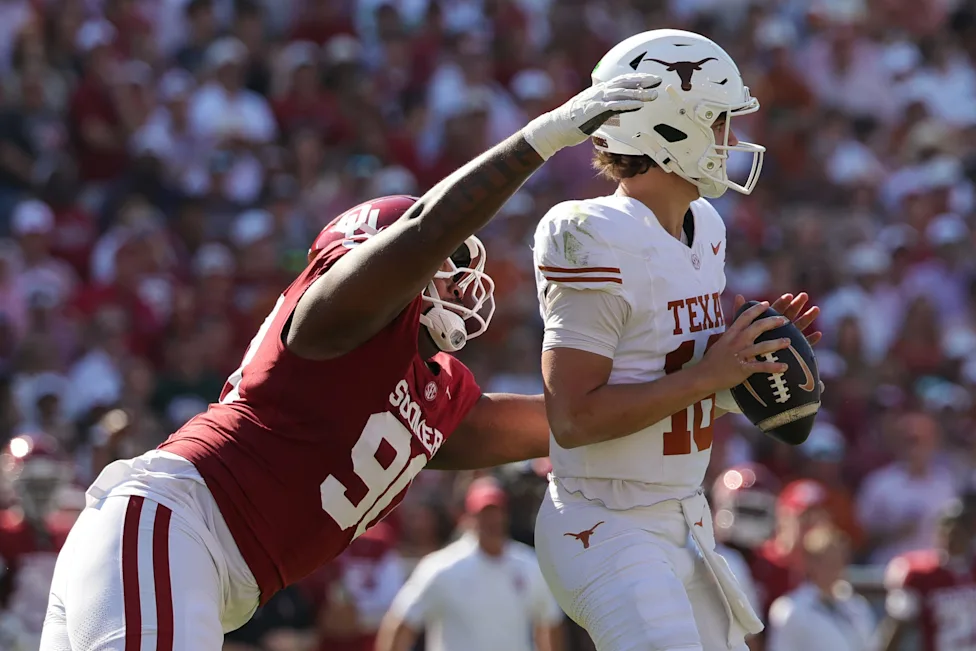
Texas head coach Steve Sarkisian publicly acknowledged Thursday that quarterback Arch Manning must become a more frequent rushing threat, a directive arriving six days after the Longhorns’ second-half collapse against Oklahoma in the Red River Rivalry at the Cotton Bowl.
The admission centers on a statistical regression that has quietly undermined one of the most anticipated sophomore quarterback campaigns in college football. Through five games in 2026, Manning has carried the ball 39 times for 102 yards and two touchdowns, averaging 2.6 yards per attempt. During his freshman season, he accumulated 399 yards and 10 scores on 92 carries at 4.3 yards per pop, finishing as the team’s second-leading rusher.


That drop-off is not merely a product of fewer opportunities. Film review shows Manning operating almost exclusively as a traditional pocket passer this fall, abandoning the designed quarterback runs and read-option elements that defined his development late last year. When he does leave the pocket now, it typically happens only after protection breaks down entirely, rather than as a calculated decision to exploit an open running lane.
In modern SEC offenses, quarterbacks who average fewer than eight rushing attempts per game allow opposing defensive coordinators to deploy lighter boxes and dedicate extra defenders to coverage. Sarkisian’s scheme historically relies on the quarterback run game to keep defenses honest, a philosophy he employed extensively during his tenure at Alabama with dual-threat passers and later refined at Washington.
Oklahoma capitalized on Manning’s stationary tendencies on Oct. 10. The Sooners’ defense, anchored by defensive lineman Trent Wilson and linebacker Owen Heinecke, consistently contained the edges without fearing a quarterback scramble. That structural advantage freed safety Peyton Bowen to play aggressively downhill, resulting in a second-half interception returned for a touchdown off a pass intended for wide receiver Cam Coleman. Kicker Tate Sandell ultimately delivered the game-winning field goal as Texas failed to sustain drives when passing lanes closed.

Manning’s hesitation likely stems from multiple factors beyond simple play-calling. Quarterbacks transitioning into full-time starting roles frequently prioritize protecting the football over improvisation, especially under the intense scrutiny accompanying the Manning name. Running backs Derrek Cooper, Raleek Brown, and Ryan Niblett have handled the bulk of the ground workload, but relying solely on traditional handoffs makes the offense predictable against elite conference opponents.
Sarkisian did not specify whether the adjustment will involve scripted quarterback draws or simply empowering Manning to pull the ball down earlier on read-option plays. Integrating those calls requires precise timing with the offensive line to ensure blocking assignments shift correctly when the quarterback becomes the primary ball carrier.
Texas resumes its schedule this weekend, facing a critical juncture where schematic adjustments must translate immediately to on-field production. The Longhorns currently sit in the middle of the SEC standings, needing consistent offensive output to remain in contention for the conference championship game in Atlanta.