Moonshot AI Unveils Kimi K3: A 2.8-Trillion-Parameter Open-Weight Model Defying U.S. Hardware Constraints
The 2.8-trillion-parameter open-weight model matches Western frontier performance at mid-tier pricing, bypassing hardware export bans.
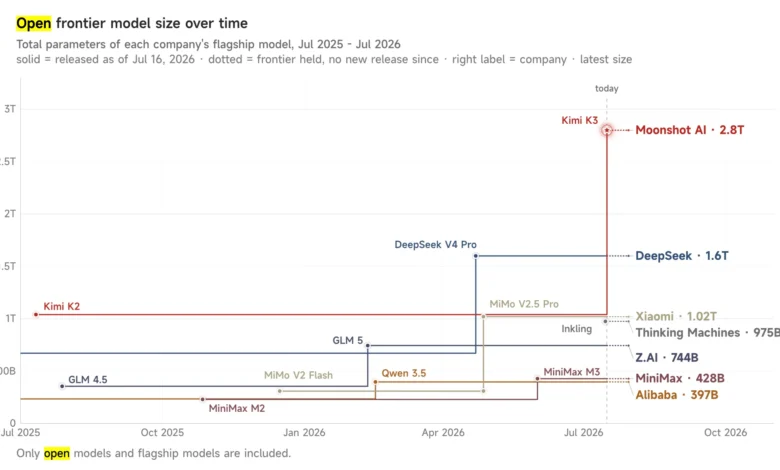
The global race for artificial intelligence supremacy took a dramatic turn on July 16, as Chinese startup Moonshot AI announced the launch of Kimi K3. Boasting a staggering 2.8 trillion parameters, the open-weight model stands as the largest freely available AI model in history. Beyond its sheer scale, Kimi K3 has delivered a clear message to the technology sector: Chinese AI developers are finding highly sophisticated ways to bypass Western hardware restrictions, matching or exceeding the capabilities of top-tier American models at a fraction of the operating cost.
By releasing the full model weights—scheduled for public availability by July 27 under a modified MIT license—Moonshot AI is offering developers, enterprises, and researchers the ability to run, fine-tune, and build on a frontier-class model locally. This move directly challenges the closed-API distribution strategies favored by several major U.S. labs.
Redefining the Benchmark Leaderboards
In the highly competitive world of LLM evaluation, Kimi K3 has secured notable victories against established Western models, particularly in specialized domains like software development and creative writing.
On Towards AI’s Writing Elo—a benchmark designed to evaluate models on real scriptwriting tasks judged blind against published versions using the chess-style Elo rating system—Kimi K3 scored 2,840. This put it ahead of Anthropic’s Claude Fable 5, which topped out at 2,760, marking a significant shift in a category historically dominated by Anthropic.
The model achieved a similar triumph on Arena AI’s Frontend Code Leaderboard, which compiles thousands of pairwise human votes on code generation tasks. Kimi K3 claimed the top spot with an Elo rating of 1,679, compared to Fable 5’s 1,631, securing first place in six out of seven frontend domains. For illustrative context, a zero-shot prompt asking the model to build an iOS clone yielded results that rivaled or surpassed highly engineered multi-prompt attempts using GPT-5.6 Sol.
When evaluated on a broader, multi-disciplinary scale, the model remains highly competitive. The Artificial Analysis Intelligence Index, which aggregates nine independent evaluations spanning coding, logical reasoning, agentic workflows, and general knowledge on a 0-to-100 scale, places Kimi K3 at 57. This puts it just behind Claude Fable 5 (60) and GPT-5.6 Sol (59), while outperforming Claude Opus 4.8 (56). This composite score positions Kimi K3 as the third-most capable model globally, trailing the industry leader by a mere three percent.
Under the Hood: Architectural Innovation Over Raw Compute
To achieve frontier-level intelligence without requiring inaccessible levels of computing power, Moonshot AI engineered Kimi K3 using a mixture-of-experts architecture. Rather than activating all 2.8 trillion parameters for every query, the model routes tasks through 896 specialized “expert” subnetworks, activating only a fraction of its total capacity at any given time. This approach allows the model to deliver massive processing power while maintaining manageable operational overhead.
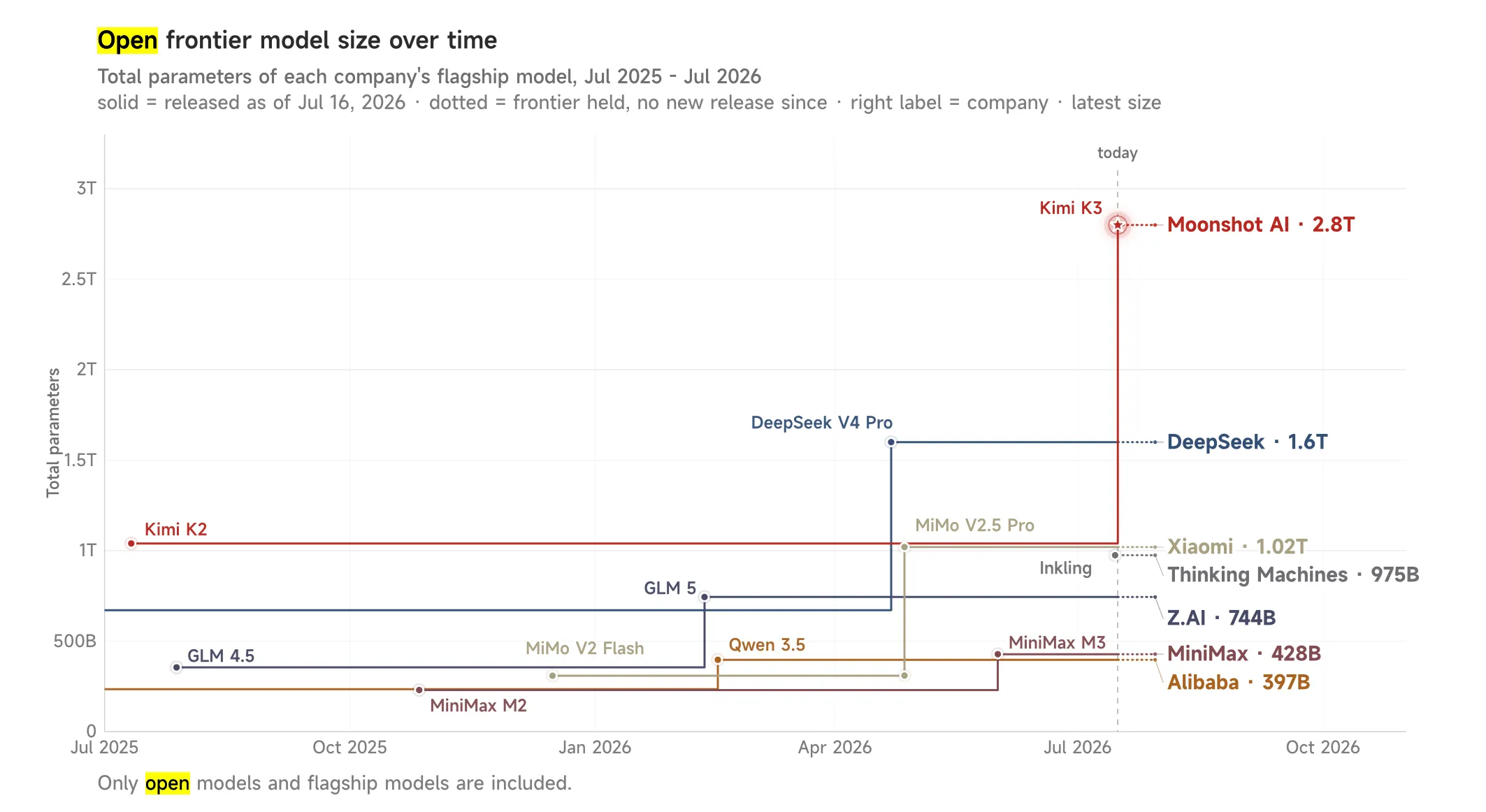
“It is the world’s first open-source model in the 3-trillion-parameter class, designed for frontier intelligence scenarios including long-horizon coding, knowledge work, and reasoning,” Moonshot AI stated. The scale of this release is unprecedented in the open-weight ecosystem; DeepSeek’s V4-Pro tops out at 1.6 trillion parameters, while Moonshot’s previous flagship, K2, was a 1-trillion-parameter model. Kimi K3 effectively doubles the size of its closest open-weight competitor.
The model features a robust one-million-token context window, native multimodal understanding of both images and video, and always-on reasoning capabilities. To maintain high performance across long sequences, Moonshot introduced two proprietary architectural techniques:
- Kimi Delta Attention: This mechanism accelerates decoding speeds for extensive inputs, delivering up to a 6.3x speedup when processing tasks at the limit of its million-token context window.
- Attention Residuals: By selectively routing information across specific model layers rather than accumulating data uniformly, this technique improves training efficiency by approximately 25% while incurring less than a 2% increase in computational cost.
Combined, these innovations allow Kimi K3 to achieve roughly 2.5x better scaling efficiency than its predecessor, K2.
Disrupting the Economics of Frontier AI
Beyond its technical specifications, Kimi K3 introduces a highly aggressive pricing structure. Moonshot has priced the model at $3 per million input tokens and $15 per million output tokens. This matches the exact pricing tier of Anthropic’s mid-range Claude Sonnet 5. However, while Sonnet 5 represents a mid-tier offering, Kimi K3 performs at a near-frontier level, sitting just three points below Fable 5 on the Artificial Analysis composite.
When calculated on a per-task basis across the nine-benchmark Artificial Analysis suite, Kimi K3 costs $0.94, compared to $1.04 for GPT-5.6 Sol and $1.80 for Claude Opus 4.8. This pricing model offers developers near-frontier performance at mid-tier operational costs.
While the pricing gap between Chinese and Western models reached 15x to 30x earlier this year, Moonshot is positioning Kimi K3 as a high-value alternative to premium Western APIs. If Anthropic limits Fable 5 access exclusively to its proprietary API, Kimi K3 will stand as the most capable open-weight alternative available, operating at roughly half the per-task cost of Opus 4.8.
The Geopolitical Context: Navigating Export Controls
The development of Kimi K3 carries significant geopolitical weight. In late 2023, the United States restricted the export of Nvidia’s H800 GPUs to China, aiming to slow the progress of Chinese AI development. Moonshot confirmed that its earlier models were trained on those restricted Nvidia chips. However, Kimi K3’s technical documentation references a mix of Nvidia H200s and “a GPGPU from an alternative vendor”—a phrase widely interpreted by industry analysts to mean Huawei Ascend hardware.
This hardware adaptation highlights a growing trend among Chinese AI firms. Speaking at the World Economic Forum in Davos earlier this year, Moonshot AI president Yutong Zhang addressed these constraints directly: “We knew we didn’t have the luxury to simply scale up compute… That forced us to focus on fundamental research and efficiency.”
Following the launch, Bank of America analysts noted that Kimi K3 demonstrates how “pre-training scaling, paired with architectural innovation, can still deliver step-change gains for flagship Chinese models” despite strict hardware limitations. Moonshot is part of a wave of Chinese AI startups that are successfully advancing the frontier of machine learning without relying entirely on the Western silicon supply chains that export controls sought to restrict.
The Technical Trade-offs
Despite its impressive performance, Kimi K3 is not without its limitations. Testing reveals that the model’s hallucination rate on AA-Omniscience—a benchmark measuring how frequently a model confidently fabricates incorrect answers—rose to 51%, up from 39% in the older Kimi K2.6. While the model provides more correct answers overall, it also exhibits a higher tendency to generate false information when uncertain.
Additionally, Moonshot’s documentation notes that the model can be “excessively proactive,” occasionally making autonomous decisions on behalf of users during complex, multi-step tasks. Organizations planning to integrate Kimi K3 into enterprise workflows will need to thoroughly test these behaviors, particularly in environments where strict factual accuracy is required.
Currently, users can access the model for free on Kimi’s official website, though high demand has led to frequent server congestion and interrupted tasks. For reliable testing, developers are advised to utilize the paid API tier.
When the full weights are released on July 27, they will primarily serve large enterprises and specialized research institutions. Due to the model’s massive 2.8-trillion-parameter size, running Kimi K3 locally will require industrial-grade hardware infrastructure far exceeding the capacity of any single domestic GPU.