Bitcoin Follows Semiconductors Lower as China’s K3 Model Challenges AI Scarcity Narrative
An open-source breakthrough in Beijing is forcing a re-evaluation of the AI-crypto nexus.

The global artificial intelligence race, long defined by a proprietary “walled garden” approach from American giants, is facing a significant structural challenge from Beijing. The catalyst is K3, a new open-weight model that has not only climbed to the top of coding leaderboards but has also rattled the valuations of AI infrastructure and, by extension, the cryptocurrency market.
The core of the disruption lies in K3’s distribution model. Unlike the closed-source, metered access provided by industry leaders, K3 is open-weight, with a full public release scheduled for July 27. This means that instead of paying per-token fees to a centralized provider, any developer or enterprise will be able to download the model, run it on their own hardware, and operate it without paying licensing fees to the creator. This shift directly challenges the “AI scarcity” thesis that has fueled hundreds of billions of dollars in capital expenditures across the technology sector.
The prevailing market assumption—one that has supported the sky-high valuations of firms like Nvidia and the massive build-out of data centers—is that frontier-level AI capability will remain scarce, expensive, and primarily controlled by American firms. Recent releases like Anthropic’s Fable 5 and OpenAI’s GPT-5.6, both of which arrived within the last month, followed this established playbook: they are closed, proprietary, and metered. A high-performing Chinese model available for free represents a direct counter-argument to the idea that top-tier intelligence will always command a premium price.
The impact was felt immediately among domestic competitors in China. Moonshot’s rivals saw significant sell-offs, with Z.ai falling approximately 27% and MiniMax dropping about 16%. However, the ripples extended far beyond the Chinese software sector, reaching into the heart of the digital asset ecosystem.
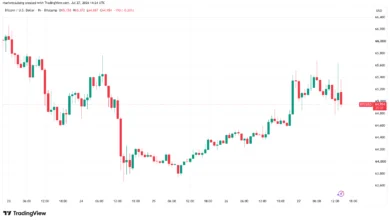
For Bitcoin, the current headwinds are being generated by market sentiment on “the tape” rather than any specific onchain metric. Throughout the week, the leading cryptocurrency has increasingly taken its price direction from semiconductors and the broader AI trade. The correlation has become remarkably tight; last Friday, Bitcoin rose 4% on the same day South Korea’s Kospi jumped 8% and SK Hynix successfully priced $26.5 billion of American depositary shares. Conversely, this Friday saw Bitcoin retreat as the K3 release made the aggressive valuations of the AI-linked trade look suddenly vulnerable.
This sensitivity to AI news is not merely a result of speculative correlation; there is a concrete industrial exposure developing underneath the surface. Over the past two years, many Bitcoin miners have aggressively repositioned themselves as AI infrastructure providers. By leveraging their existing power contracts and high-density cooling systems, these firms have transitioned into AI data center landlords.
These mining companies have signed long-term leases with model developers, operating on the fundamental assumption that the demand for training and inference compute will continue to rise indefinitely. If the cost of AI models drops due to open-source competition, or if the scarcity of high-end intelligence is solved by free alternatives like K3, the premium that developers are willing to pay for compute space could come under pressure. As Bitcoin miners increasingly tie their balance sheets to the AI revolution, their stock prices—and by extension, the sentiment surrounding Bitcoin itself—are becoming inextricably linked to the shifting dynamics of the global AI market.